


A technology can be useful and a disastrous investment at the same time. Railways and the internet changed the world, but both produced enormous financial bubbles that later caused sleepless nights for the people who financed them.
This essay is about a narrower question: how much of the value AI creates will be captured by the companies paying for the buildout, and how much will leak to customers through lower prices. AI does not need to fail for its investors to lose. It only needs to become cheap faster than they can earn their money back.
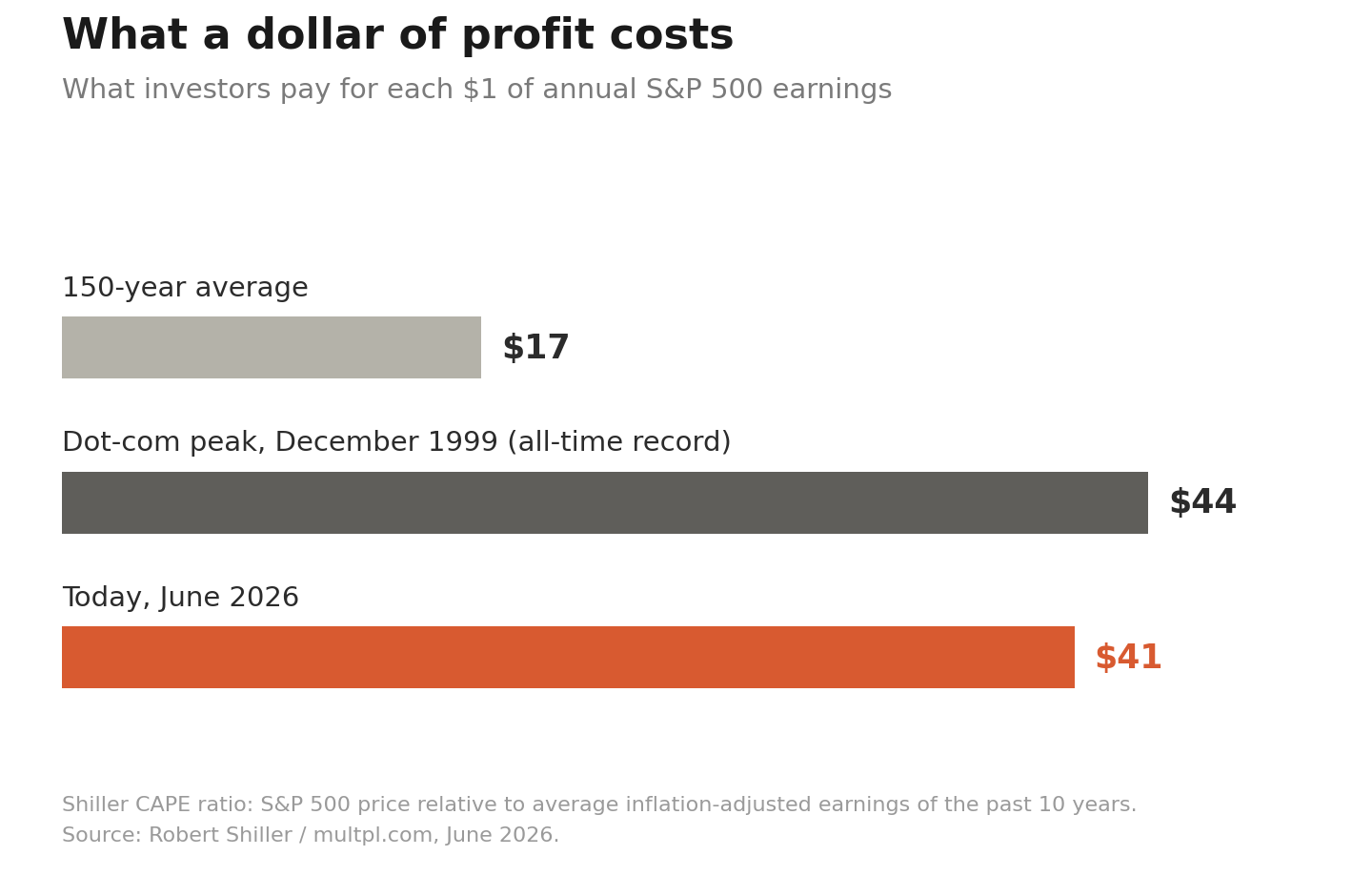
On some measures, the AI boom is approaching the 1999 dot-com bubble in terms of valuations, and it may be even larger when measured by the share of the economy’s investment it is absorbing. But this time, there is a fundamental difference: the economic life of the capital being built.
Physically, an AI chip can remain operational for years. Economically, its most valuable life may be much shorter, possibly as short as one to three years under heavy use, compared with dot-com-era fiber and telecom infrastructure that remained useful for decades. This is the most important and least settled assumption in this essay, and I will stress-test it below. The direction still matters for the infrastructure argument: dot-com fiber could be bought cheaply after the bust and operated profitably for years, whereas AI chips lose their highest-value uses much faster as newer generations arrive. They can be moved to lower-value workloads, but the buildout is still likely to leave behind a shorter-lived capital stock, even if the chips are not literally worthless.
The size of the bet
To understand what is going on, first we need to understand the numbers.
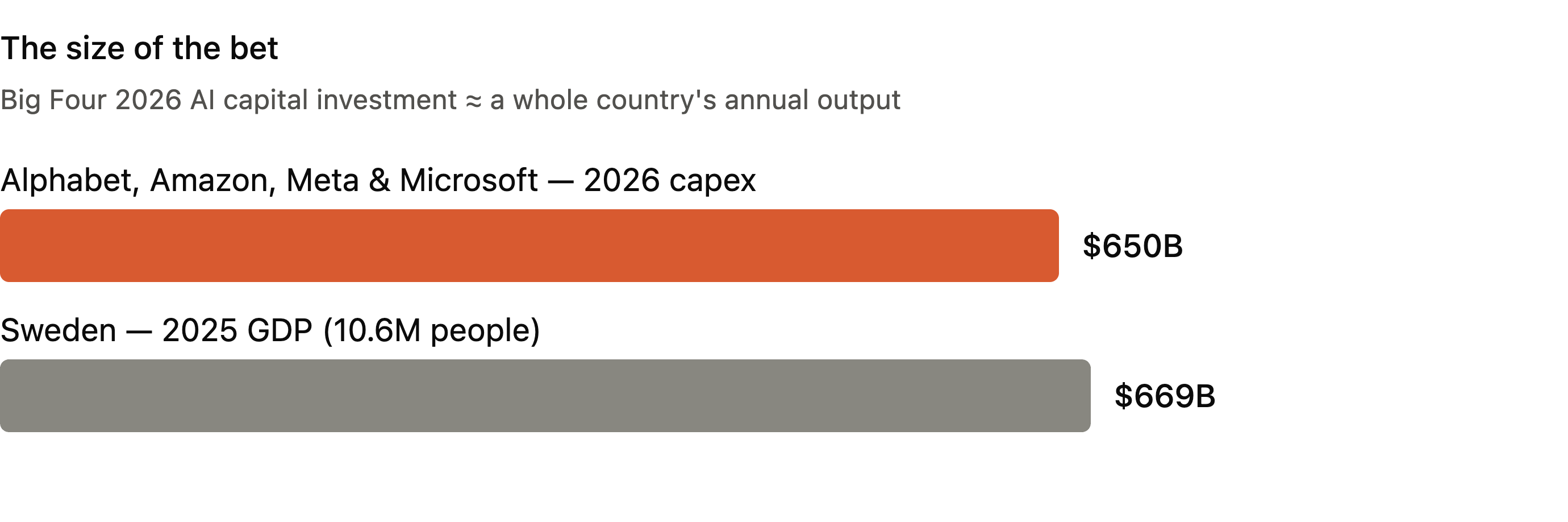
According to their latest guidance, Alphabet, Amazon, Meta, and Microsoft plan to spend roughly $695 to $725 billion in total capital expenditure in 2026: about $200 billion at Amazon, $180 to $190 billion at Alphabet, around $190 billion at Microsoft, and $125 to $145 billion at Meta. For the record: The companies do not break out a clean AI-only line; these are total capex figures.
For comparison, Sweden, a literal country with 10.6 million people, produced about $669 billion of GDP in 2025. Four companies now plan to out-spend the entire annual output of Sweden.
In addition to the enormous amount of money involved, AI infrastructure adds a utility-like layer to the technology industry: lots of physical investment upfront, uncertain returns later. Although these companies generate extraordinary profits and hold enormous cash reserves, the scale of AI investment is so vast that even this sector has increasingly turned to the bond market. The five largest hyperscalers, meaning Amazon, Alphabet, Meta, Microsoft, and Oracle, issued about $121 billion of US corporate bonds in 2025, roughly four times their annual average of $28 billion during the previous five years. Some of that borrowing funds ordinary business, but the surge lines up with the capex plans. By mid-2026, issuance had already passed $159 billion, and full-year forecasts sit around $230 to $240 billion.

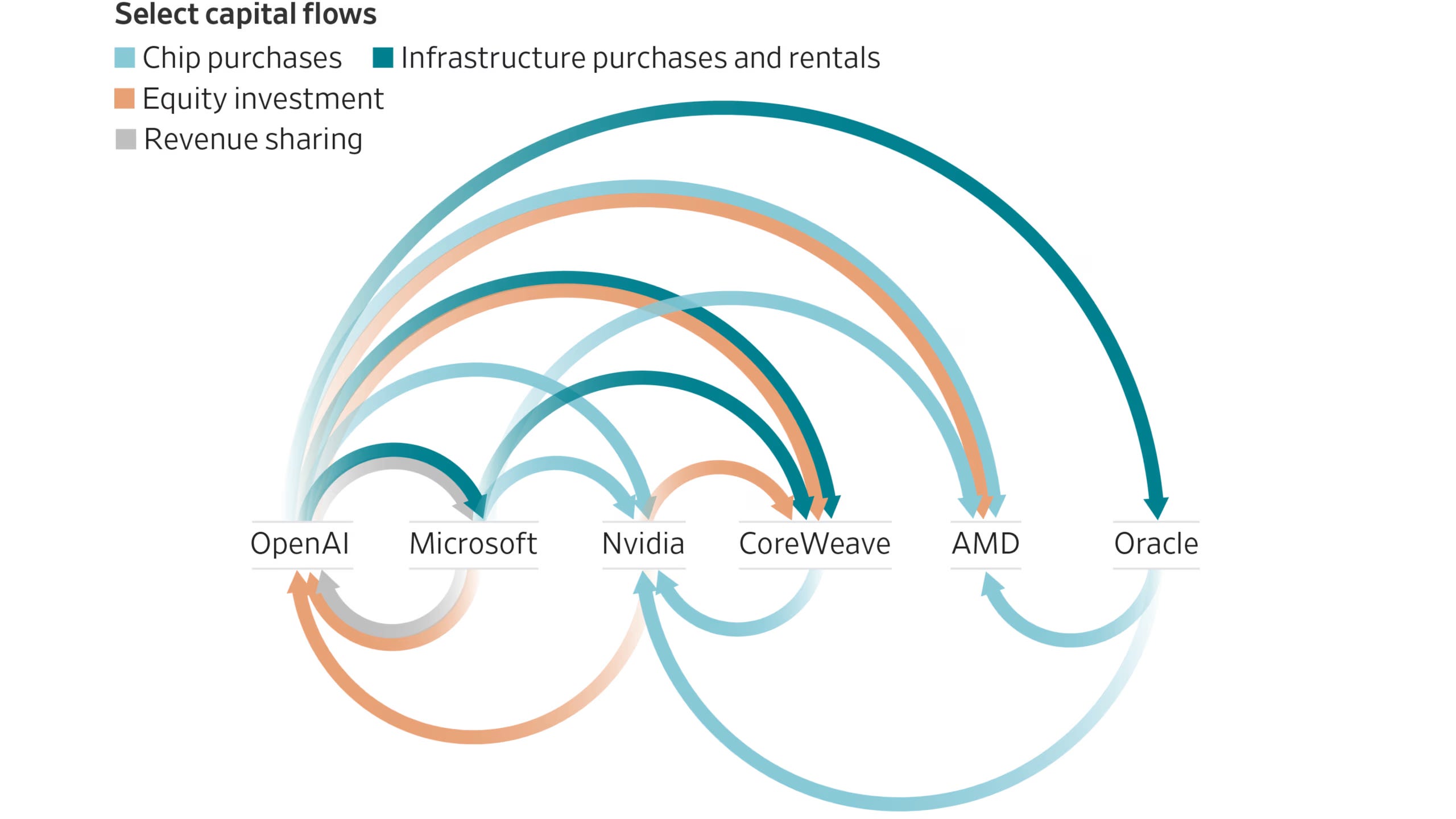
The money is also starting to move in circles. Nvidia invests in its own customers, and those customers sign multi-year compute commitments worth hundreds of billions of dollars with the clouds that buy Nvidia’s chips. A growing share of the data centers is financed through special-purpose vehicles that keep the debt off the sponsors’ balance sheets. There is nothing illegal about any of this. But vendor financing and circular capital flows are the same patterns that made earlier infrastructure booms look healthier than they were.
The depreciation question
Earlier I said the most valuable life of an AI chip may be one to three years. That claim needs support, because the companies’ own books say otherwise. Microsoft and Google depreciate their servers over six years. Meta extended its servers and network assets to five and a half years in January 2025. If those schedules reflect economic reality, the infrastructure argument gets much stronger and this essay gets much weaker.
One data point cuts the other way. In February 2025, Amazon, which runs the largest cloud fleet in the world, shortened the useful life of a subset of its servers and networking equipment from six years back to five. The reason it gave was the faster pace of technology development in AI and machine learning. Amazon had spent the previous decade extending server lives. It is the first hyperscaler to walk one back, and it did so specifically because of AI.
Why does an accounting footnote matter? Because if the true economic life of AI hardware is shorter than the book life, depreciation is currently understated, which means today’s reported profits are overstated. Skeptics like Michael Burry (the investor who called the 2008 housing crash) argue the gap could reach roughly $176 billion of understated depreciation between 2026 and 2028, though that number cannot be verified from public filings. A JPMorgan stress test found a more modest effect: applying a three-year life to AI hardware would cut earnings per share and operating margins by roughly 6 to 8 percent for most hyperscalers, with Oracle as the bigger exception. That would hurt earnings without breaking them. Still, nobody is arguing that the chips will outlast their schedules.
Also, not all of this capex is chips. Alphabet said about 60 percent of its recent quarterly capex went to servers and 40 percent to data centers and networking, and buildings, power infrastructure, and fiber genuinely do last decades. The short-life problem applies to the silicon. The silicon just happens to be the biggest and fastest-growing slice.
The price is collapsing
Obviously, these companies are not spending this money merely so that you can generate an anime-style image of your cat for free. They need the infrastructure to earn an adequate return on their investment.
To increase their profits, they need to increase volume, improve margins, or ideally do both. The problem is that the price of model access is collapsing.
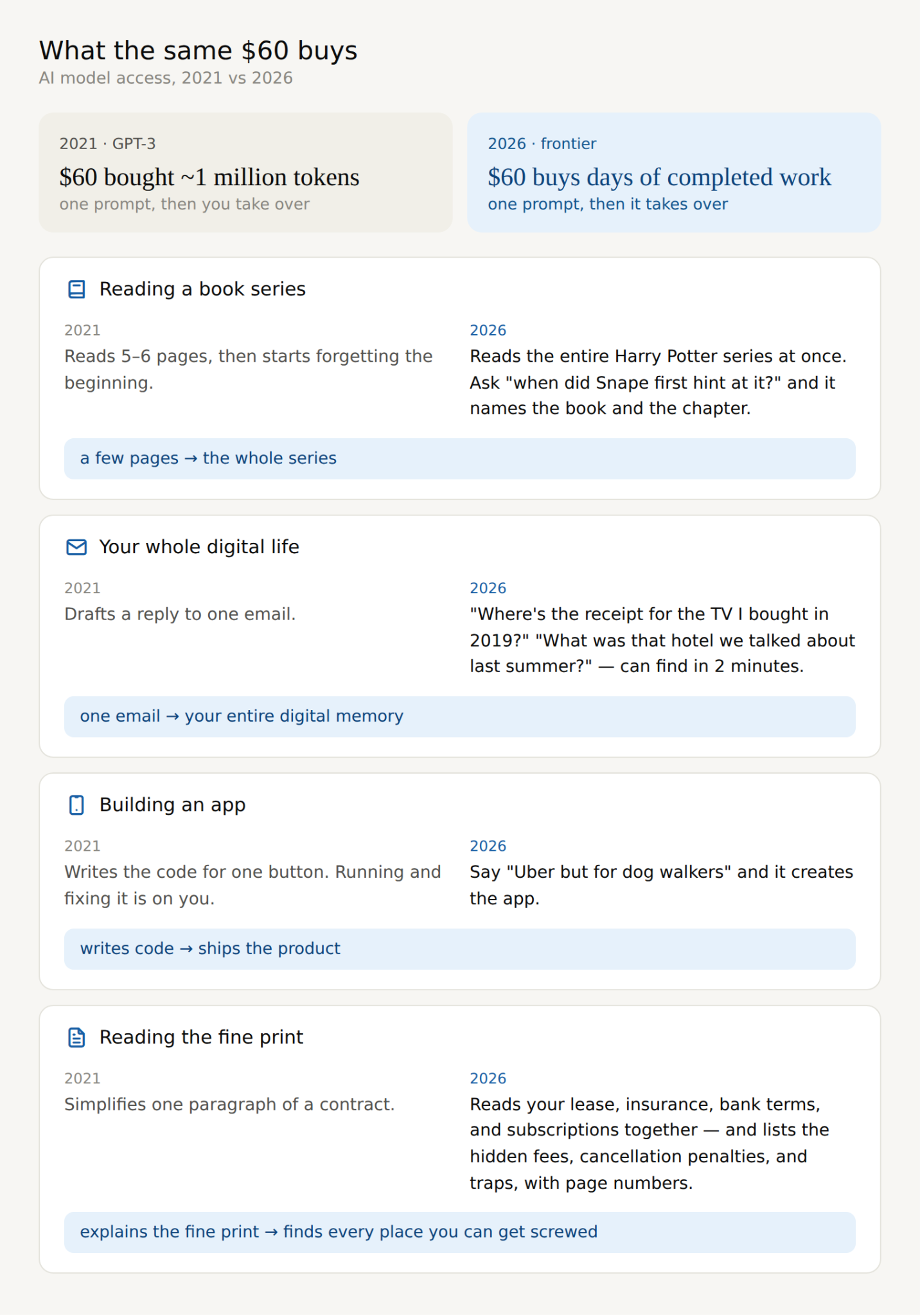
To take one benchmark-based comparison, from a16z’s “LLMflation” analysis: when GPT-3 became publicly accessible in late 2021, it was the cheapest widely available model capable of reaching an MMLU, or Massive Multitask Language Understanding, score of about 42, at roughly $60 per million tokens. By late 2024, the cheapest model clearing the same bar cost about six cents.
The price at that specific capability level has barely moved since 2024, but for a telling reason: the decline moved up the capability ladder. The same few cents now buy substantially higher benchmark scores. In fact, you no longer need a model provider at all to reach GPT-3’s level. Small models that beat it can run on an ordinary Mac with 16 to 24 GB of memory, where the marginal cost is mostly electricity.
As the price of a fixed level of benchmark performance approaches commodity levels, there are two broad ways to justify this massive investment: sell a more capable frontier model at a premium, or increase usage fast enough to offset falling unit prices. Ideally, they do both.
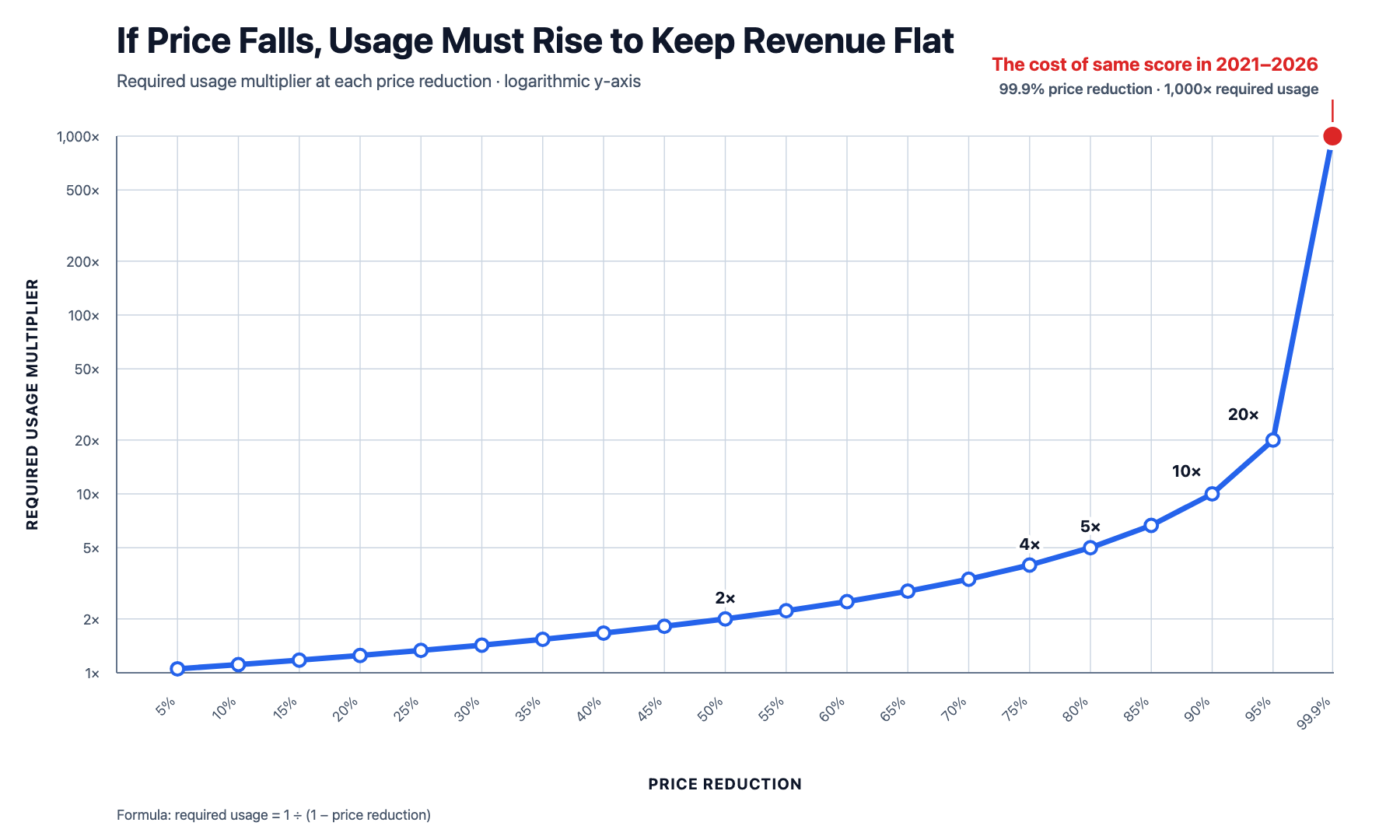
At a fixed capability level, a thousandfold fall in price would require a thousandfold increase in volume to preserve revenue. But revenue is not profit. Profit also depends on the cost of serving each token, the utilization of the infrastructure, depreciation, and financing costs.
It also matters why prices are falling. If prices fall because the cost of serving each token is falling just as fast, thanks to better hardware and better software, margins can survive the collapse. If they fall because competitors are undercutting each other, margins die with them. So far the evidence points more toward the first story: Epoch AI, which tracks these price declines, found no clear evidence that shrinking profit margins explain them. The second force is real too, though, because open-weight models put a ceiling on how much of the efficiency gains providers can keep for themselves.
Of course, as AI advances, people are using it for tasks that were not possible with GPT-3. Providers are not limited to selling more of the same capability. They can sell the newest model at a premium.
The problem is that each premium may be temporary.
The Intelligence Premium
The intelligence premium is the extra price customers are willing to pay for capabilities that cheaper or older models cannot yet provide.
Setting aside the other advantages of open-weight models (like privacy, if you self-host them), if two models can achieve the same task, who would choose to pay more?
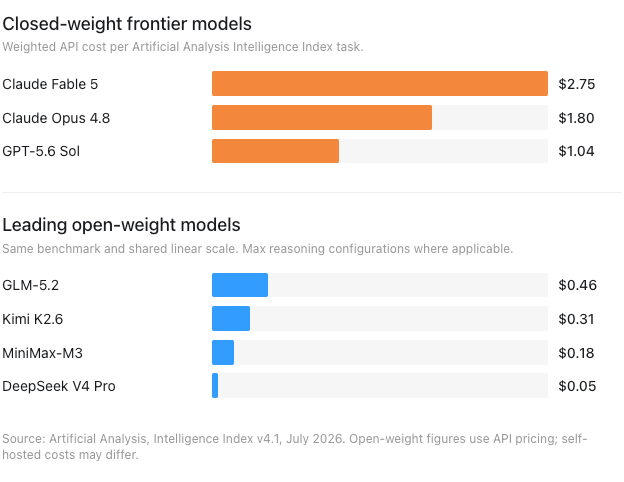
The problem is that the premium has a short half-life. As competitors catch up and smaller models improve, yesterday’s frontier becomes today’s commodity, widely available at a fraction of the price. The premium does not disappear entirely, but it moves to the next capability level.
As I was finishing this essay, Moonshot AI announced Kimi K3, a 2.8 trillion parameter open-weight model that, by its own account, trails only the two strongest proprietary models. The weights become public on July 27 under a permissive license. Moonshot priced its own API at western frontier rates, but that hardly matters; once the weights are out, anyone can host the model, and the price competition starts there.
The market graded the announcement within hours. Shares of Zhipu, a rival Chinese lab, fell 22 percent by midday, and MiniMax fell 14 percent. Notice who paid the price: the other model companies. The chipmakers and the clouds kept selling.
This creates a difficult business model. AI companies must keep spending to reach the next capability level before the premium on the current one disappears. Standing still is not an option, because the product they are selling becomes cheaper even when it does not become worse.
The real question, then, is whether the premium lasts long enough, and is large enough, to recover the cost of producing the next generation of models and the infrastructure behind them.
The bull case
However, I want to mention two strong arguments on the other side, this time with the numbers behind them.
First, falling prices do not necessarily mean falling revenue. If lower prices make AI useful for far more tasks, demand may grow faster than the price declines. A model that costs ten times less can still produce more revenue if it is used a hundred times more. And demand really is exploding. Microsoft’s AI business passed a $37 billion annual revenue run rate in early 2026, growing 123 percent year over year. Google Cloud grew 63 percent in the same quarter, with a contracted backlog that nearly doubled to over $460 billion. Both companies say they are capacity constrained: they could sell more compute if they could build it faster.
Cheaper models do not just replace expensive ones in existing tasks; they make entirely new uses economical.
Second, the hyperscalers do not need to recover their investment only through model access. Microsoft can use AI to make Azure and Office more valuable. Amazon can sell more cloud capacity. Meta can improve advertising and engagement. Alphabet can protect or expand its search, advertising, and cloud businesses. In these cases, AI may generate returns indirectly, even if the price of the model itself keeps falling.
This makes the investment case stronger, but it also makes it harder to measure. A company can claim that AI protects revenue, increases productivity, or improves an existing product without showing how much of that value came from the infrastructure itself.
So let me say what would prove this essay wrong. Usage keeps growing faster than prices fall, year after year. Serving costs drop as fast as prices. Old hardware stays busy instead of idling. Indirect AI revenue shows up in cloud and advertising numbers in a way you can measure. The backlog and run-rate figures above are early evidence for that side of the argument.
This is where the short life of the premium becomes important again. The companies are not making one large investment and then collecting returns from it for decades. They are entering a cycle in which each new generation requires more capital, while the previous generation quickly becomes cheaper and less valuable.
The result may be a business that grows rapidly while producing disappointing returns on capital. This would not make AI a failed technology, but rather a difficult industry to invest in.
Who captures the value?
The history of technology is full of examples where users captured more value than the companies that built the infrastructure. Competition pushed prices down, capacity became abundant, and the economic benefits spread across the rest of the economy. The technology succeeded, but many of the investors who financed it did not.
AI may follow the same pattern. The models can become more useful, more widely available, and more important to the economy while the companies producing them struggle to earn returns that justify the capital invested. In fact, the faster AI improves and spreads, the faster older capabilities may lose their scarcity value.
There is more than one bet hiding inside “the AI trade,” though, and the economics differ. Chipmakers earn high margins for as long as the buildout continues, whatever the buyers’ returns turn out to be. Frontier model labs face the intelligence premium problem in its purest form: enormous training costs against a premium with a short half-life. The hyperscalers sit in the middle as both the gold diggers and the landlords; they dig with their own models, but much of their AI revenue comes from renting compute to the labs. And businesses with existing distribution, customer relationships, and profitable products can plug cheap intelligence into what they already run.

This is why the central question is not whether AI will change the world. It probably will. The question is how much of the value created by AI will be captured by the companies financing the buildout, and how much will be passed on to customers through lower prices.
If intelligence continues to become cheaper, the economic value of AI may rise while the market value of producing it falls.
That is the risk behind the current investment boom. The industry may be building something enormously useful, but too cheap to sell at the prices needed to justify what it cost to build.
Sources
2026 capex guidance: Alphabet Q1 2026 earnings call ($180-190B); Microsoft FY26 Q3 earnings call ($190B for calendar 2026, via CNBC); Amazon Q4 2025 results (~$200B); Meta Q1 2026 results ($125-145B).
Hyperscaler bond issuance: M&G Investments, “Tech issues: The AI debt deluge hitting bond markets” (Bank of America data); H1 2026 issuance and UBS full-year forecast via press reports.
Price decline at fixed capability: a16z, “Welcome to LLMflation” (2024); Stanford AI Index 2025; Epoch AI, “LLM inference prices have fallen rapidly but unequally across tasks.”
Useful-life accounting: Amazon Q1 2025 10-Q (useful life change, six to five years); Meta 2025 10-K (5.5 years); Microsoft and Alphabet filings (six years); JPMorgan depreciation stress test via press reports.
Sweden GDP: World Bank / IMF, 2025.