


For the past few years, developers have often been discussed as if they were changing teams. AI was attracting talent, money and attention; crypto was losing all three. It made for an easy story, especially when every week seemed to bring another model release while the blockchain market was still recovering from its last cycle.
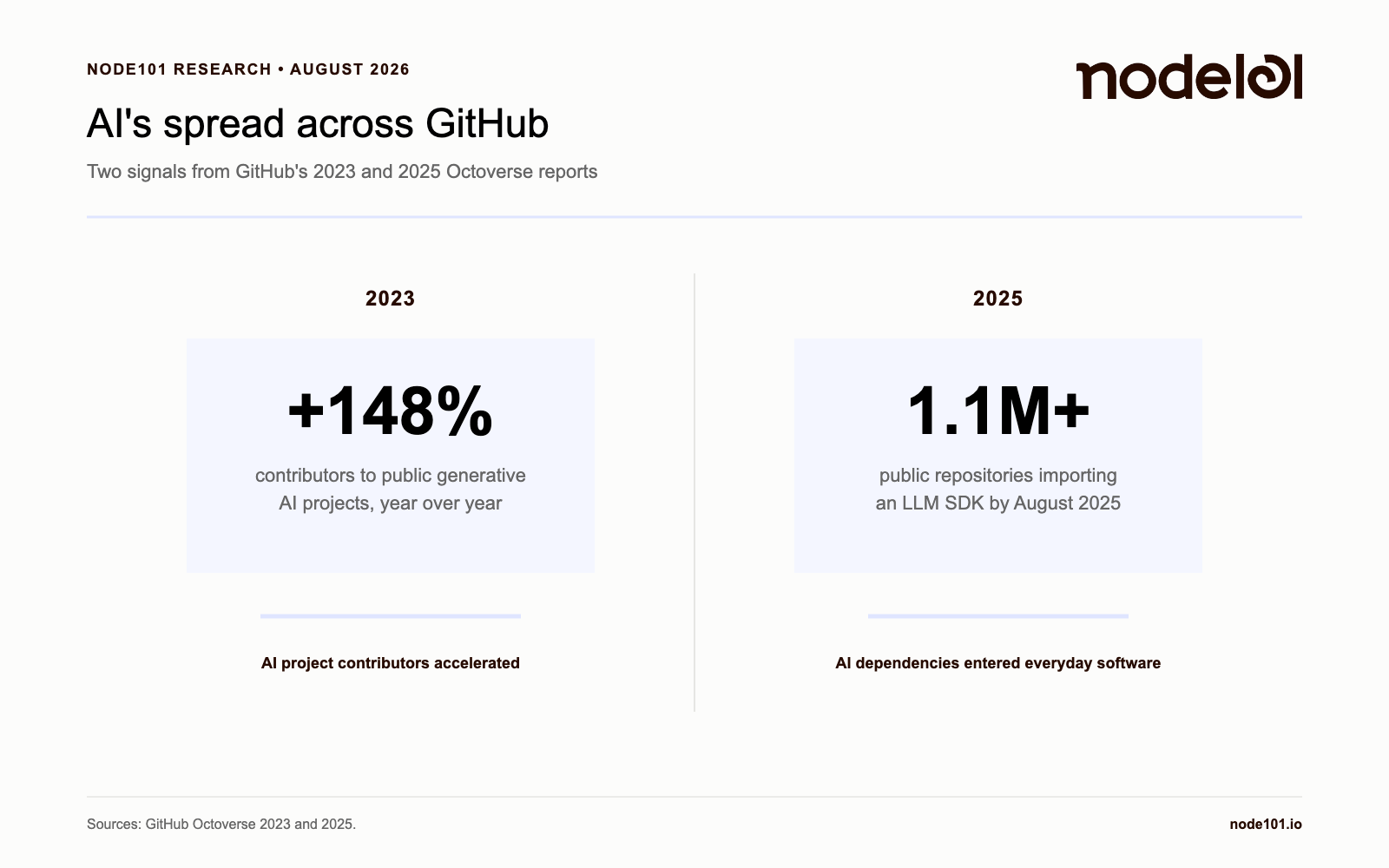
GitHub shows how large the AI shift became. In 2023, contributors to public generative AI projects increased 148% from the previous year. By August 2025, more than 1.1 million public repositories were importing an LLM SDK. AI moved quickly from a specialist field into the everyday software stack.
The less obvious question is what happened to blockchain development during the same period.
The data behind Blockchain Developer Report tells a more durable story than the headlines suggest. BDR’s average count of recently active GitHub accounts rose from roughly 20,400 in 2022 to 21,900 in 2023. It climbed to almost 28,000 in 2024 and reached 29,700 in 2025.
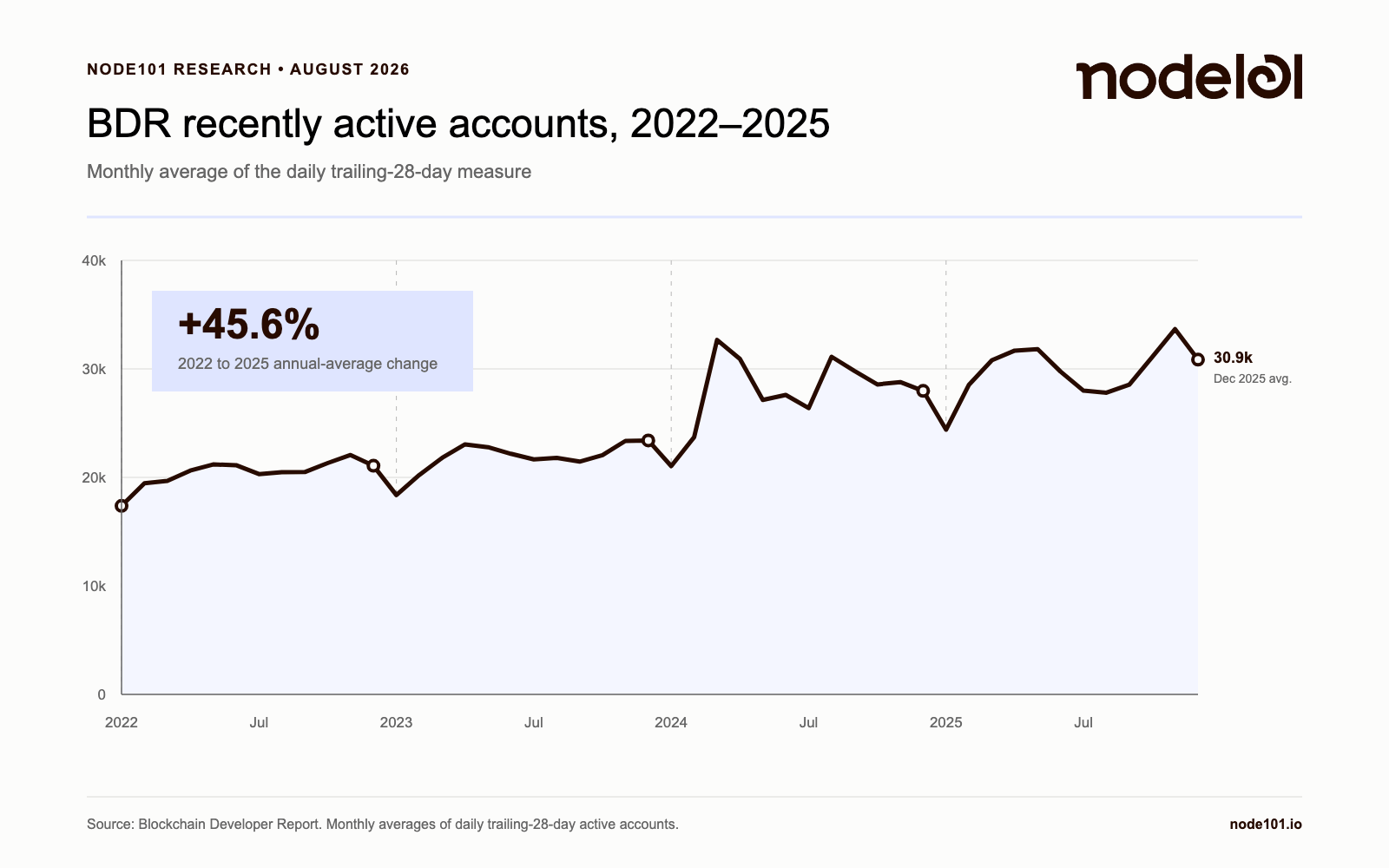
Most of that growth arrived in 2024. The pace slowed the following year, but activity remained far above its 2022 level. Public blockchain work did not disappear as AI took off. More of it became visible.
Two technologies spreading in different ways
AI adoption travels easily across the software industry. A support platform can add a language model to summarize tickets. A finance product can use one to read documents. A developer tool can generate tests or explain an unfamiliar codebase. None of these products needs to become an “AI company” for its repository to carry a visible AI dependency.
Blockchain enters a codebase differently. It tends to appear through smart-contract languages, protocol clients, wallets, cryptographic libraries and chain-specific SDKs. The work is often more tightly connected to the architecture of the product. Adding an LLM API to an existing application may take an afternoon. Introducing account abstraction, a proving system or a new execution environment usually demands a deeper commitment.
That difference matters when we try to read developer attention from GitHub. AI can spread horizontally across almost every category of software while blockchain continues growing inside a smaller technical domain. One trend does not have to consume the other.
The same developer may also contribute to both. Someone working on wallet infrastructure can use an AI coding assistant, build an internal agent or add an LLM-powered interface to the product. GitHub will record the repositories and dependencies, but it will not tell us that the developer has crossed from one professional identity into another.
The idea of a clean migration assumes that developers choose one industry and leave the other behind. Modern software work rarely looks that tidy. Technologies overlap. Tools travel faster than job titles, and a developer’s public contributions may cover several parts of the stack in the same month.
AI may even be helping more blockchain experiments reach GitHub. It has become easier to understand an unfamiliar SDK, draft a basic contract interface, generate tests or translate documentation into working code. That lowers the cost of trying something new.
It does not remove the hard parts. Security reviews, protocol design, production maintenance and ecosystem knowledge still take time. AI can shorten the path to a first prototype without guaranteeing that the prototype becomes a lasting project.
That distinction begins to show up inside the BDR data.
The base widened faster than it deepened
The total number of recently active accounts grew, but the composition of that activity changed.
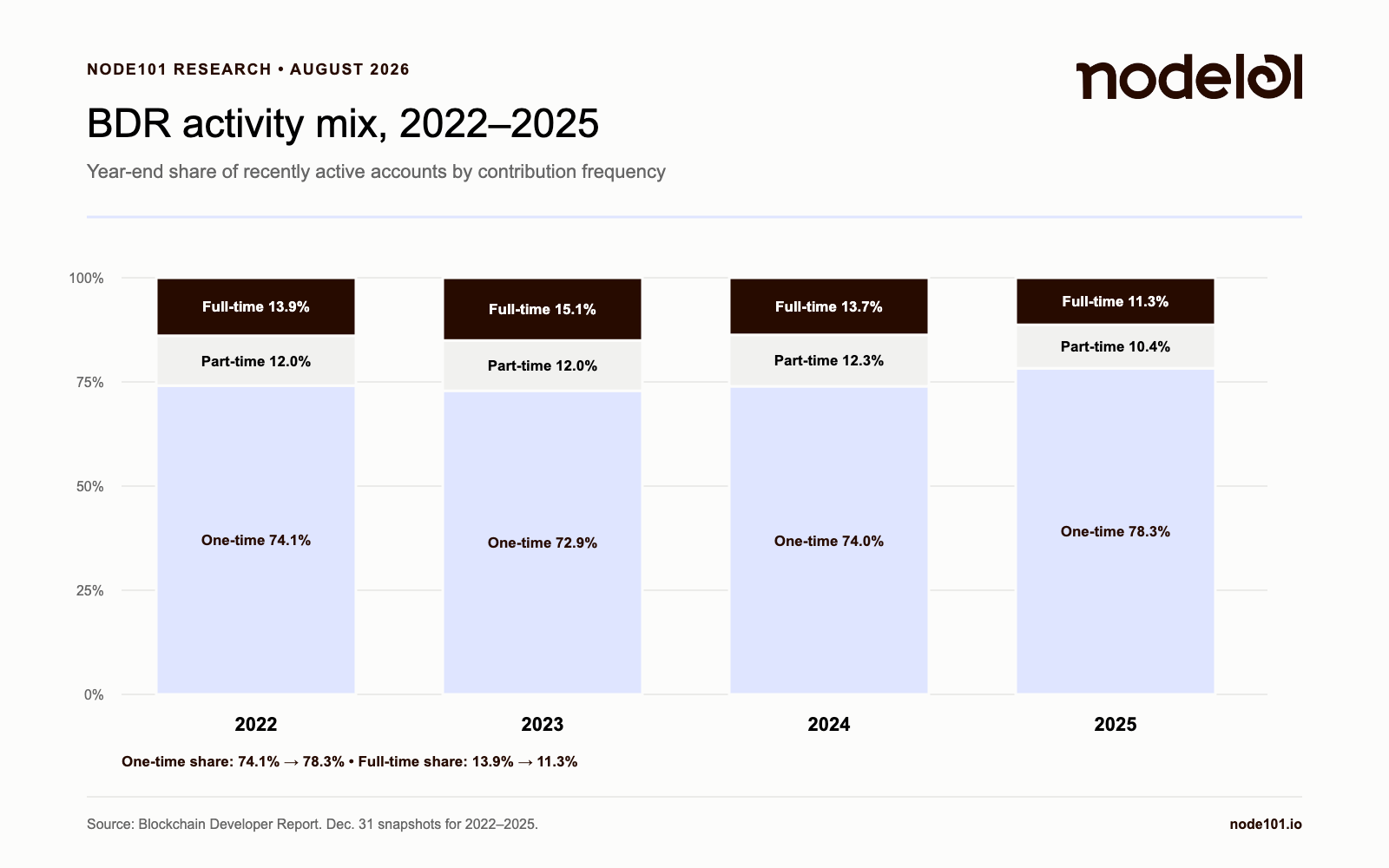
At the end of 2022, BDR’s “one-time” category represented 74.1% of active accounts. By the end of 2025, its share had reached 78.3%. Over the same period, the “full-time” share moved from 13.9% to 11.3%. The average number of full-time accounts was almost unchanged between 2024 and 2025.
These are contribution-frequency categories, not job titles. Even so, the direction is useful. The broad edge of the ecosystem expanded faster than its higher-frequency core.
There are plenty of ways for occasional activity to enter the public record. A developer may build a hackathon project, test a new SDK, contribute to a grant prototype or integrate a wallet into an existing application. Some will return. Others will leave the repository untouched after the first working version.
That early activity still has value. Experiments create feedback, reveal documentation problems and put tools in front of new developers. Every durable contributor starts somewhere.
The harder work begins after the first repository appears.
For ecosystem teams, the useful question is no longer simply how many developers showed up. It is how many found a reason to continue. Did they return after the event ended? Could they get help when the sample code failed? Was there a real project waiting beyond the tutorial? Did maintainers review their contribution while it was still relevant?
Hackathons and grants are good at creating a visible spike. Documentation, issue triage and responsive maintainers are what turn that spike into a working community.
The BDR trend suggests that blockchain has not lost its ability to attract experimentation. The next challenge is converting more of that experimentation into repeated contribution.
Growth creates a retention problem
A larger entrance can hide a weak middle.
When an ecosystem is small, bringing in new developers feels like the obvious priority. As the top of the funnel expands, the constraint moves elsewhere. More people encounter incomplete documentation. More prototypes reach the point where they need security advice, infrastructure credits or a maintainer’s attention. More grant recipients have to decide whether the second version is worth building.
AI may increase that pressure. If coding tools make the first prototype cheaper, ecosystems will receive more experiments of uneven quality. The teams that benefit will be the ones that can recognize promising work early and give it a path forward.
That path does not need to be elaborate. A useful starter issue, a reply from an experienced maintainer or a clear production example can matter more than another broad developer campaign. Small pieces of support arrive at exactly the moment when someone is deciding whether to keep going.
The measurements should follow that journey. First contributions are worth tracking, but so are returns after 30, 90 and 180 days. Ecosystems should know how often an account moves from a single contribution into regular work, begins contributing across repositories or starts reviewing the work of others.
Those transitions describe an ecosystem’s depth better than a launch-week total.
The next BDR analysis can make them visible. It can follow account-level cohorts over time, distinguish established repositories from newer additions and examine how many blockchain contributors also appear in public AI projects. That would replace the abstract idea of a developer migration with observable behaviour.
For now, the public record already tells us something useful.
AI became one of the fastest-growing areas of software development without bringing public blockchain work to a halt. BDR recorded a much larger active-account measure in 2025 than it did in 2022. The pace eased, and the higher-frequency segment did not expand as quickly as the wider base, but developers continued to build, test and publish.
The opportunity is no longer just to prove that blockchain developers are still here.
It is to give more of them a reason to stay.
Data and sources
Blockchain figures use the Blockchain Developer Report export generated on August 10, 2026 and cover the completed calendar years 2022–2025. Annual values are arithmetic averages of daily trailing-28-day active-account snapshots. BDR is a node101 product; its definitions and collection approach are described in the BDR methodology. Historical figures are retrospective and may update as public repositories are discovered or classified.
AI figures come from GitHub’s Octoverse 2023 and Octoverse 2025.