


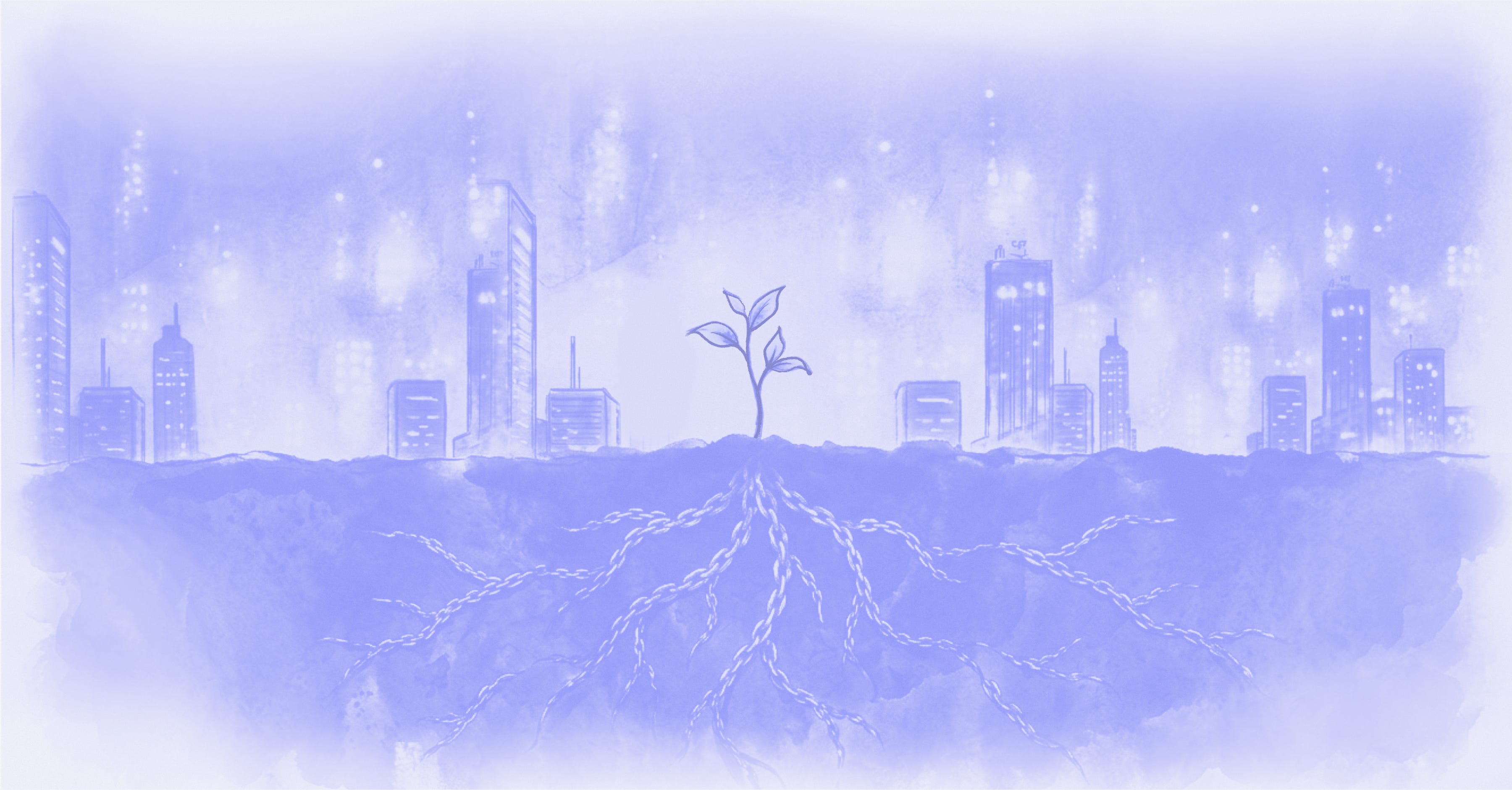
Governments and companies: They still chain the blockchain.
Ethereum has 80% of its blocks built by only 5 entities.
Solana nodes require the most advanced hardware to run.
Sui validators banned an account from the network after a major hack last year.
Most Cosmos security patches are updated closed source.
Almost all rollups are single-sequencer, with no security against censorship.
Most PoS chains do not even have economical security with the current market caps.
Most chains’ economic incentives do not even cover validatorship costs.
And Bitcoin; do you really think hardware is a distributed resource?
So what is the difference between web2 and web3?
Decentralization is not the answer to a yes or no question.
In our current world, it would be a dream to have a blockchain that is perfectly decentralized, only because the technology is so great. There are other factors that must be considered before judging the decentralization of a chain.
To better explain, let’s discuss the reasons behind some choices that foundations make;
Most chains hold most of their token supply inside the foundation & partner pools. This is a clear centralization factor in a PoS chain, as most of the supply is controlled by a single party. But these foundations have very good reasons to do so:
Whales usually attack the chain so early that there is a pump & dump situation just after the launch, before the token can even get distributed. Airdrops and such usually do not improve this situation at all, but only make it worse. Instead of making a huge airdrop at start, it may actually be very wise to keep tokens initially, and release them slowly, so that the market and users shape around it.
There is almost no real application on top of blockchain at the moment, and most of the value is superficial to start with. Personally, I do not find it logical for a chain to have billions of dollars market cap while practically no real person uses it. Thus, until the chain finds itself a place in the ecosystem, it is very meaningful to lead the ecosystem, slowly let builders deploy their products and attract users.
Another classical example is closed updates: Let’s assume you have realized a very critical bug in your chain. You need to fix it asap, and if you actually talk about it to anyone, millions can lose their funds. What do you do?
You say something important has happened, there is a new version, and please update without asking any questions.
Of course, Ethereum or Bitcoin do not have such problems, as they do not have a single blockchain client. However, this is a balance: As the code gets more distributed, then it becomes equally harder to make any update. Just look at Bitcoin. It is very secure, for sure, and no miner runs a code that they do not know, but how often do you see a hard fork in there?
But this is not the whole picture.
If this was everything, and we said that “There is not too much difference between web2 and web3 at the moment, as the world is not ready”, that would not be a very pretty picture.
Luckily, there are a few advantages of decentralization, even with all the problems that we have.
The first is transparency.
Have you ever realized ads you see online shape around what you talk to your friend on the phone? Maybe this is true, and all of the internet is watched to manipulate us behind the scenes, but you will never be completely certain.
Yes, most tokens are concentrated. Yes, most validators are controlled. And yes, all blockchains are centralized. But all actions are transparent, verifiable. If a foundation wants to stop a hacker, you know it. If tokens are held back to improve the price, you see it. Basically, even if a few parties can decide most of the important stuff, you know they are doing so, and you see each and every step that they take.
The second is integrity.
Nothing makes sense out of its context or when a part of it is missing. Just try removing the “not” in the sentence “blockchains are not decentralized”.
Blockchains bind everything together with cryptography. Maybe an Ethereum block was fully controlled, or the 66% of the tokens were used for a complete forking attack in a small chain. No problem: This will be remembered until the end of time. Even if you control the chain, you cannot delete its history. You cannot put things out of context, remove sentences from paragraphs, or change the history as you wish.
The third is accountability.
Zuckerberg can send you a very funny text on Whatsapp any moment. He can delete it at the very moment you read it. And deny the existence of this interaction all together, leaving no proof to you (and yes, a screen shot does not count).
Signatures are accountable, ZK is even better. Courts actually count a cryptographic signature as a proof. None can claim not doing something after signing it, at least not before law. Moreover, not only TXs but the entire blockchain can be made accountable with constant sized proofs through succinctness. In simple terms, today’s blockchain allows us to prove any claim we do around it.
Simple take away
Do not use blockchains because they are perfect right now. Use them because they are better.
The most important thing is to take a step forward. This is the only way to finish a journey.
And a final cool story

There is an old Chinese story.
A man sees a garden, perfect with all of its beauty, a reflection of heaven on earth. Asks to the gardener, what should he do to have a garden of such perfect beauty?
“Easy”, the gardener replies, “just water it a little after the sunrise, grub it slightly towards noon, and water it a second time right after the sun sets.”
“But this is so simple!”, the man screams, “Then anyone can have such a beautiful garden.”
“Yes”, says the gardener, “now repeat this for a hundred years, and you will have the perfect garden.”
The visual framing here is perfect — blockchain technology as roots growing beneath the city, invisible infrastructure that powers everything above. That’s the Web3 narrative that gets lost in price discussion. The chains of blockchain are the foundation of a parallel financial and social system. We cover how this infrastructure layer is evolving (and where it’s still failing) in Beyond The Coin. What aspect of blockchain infrastructure do you think is most underbuilt right now?