Fewer Validators, the Same Network
Fewer validators do not necessarily mean fewer participants.


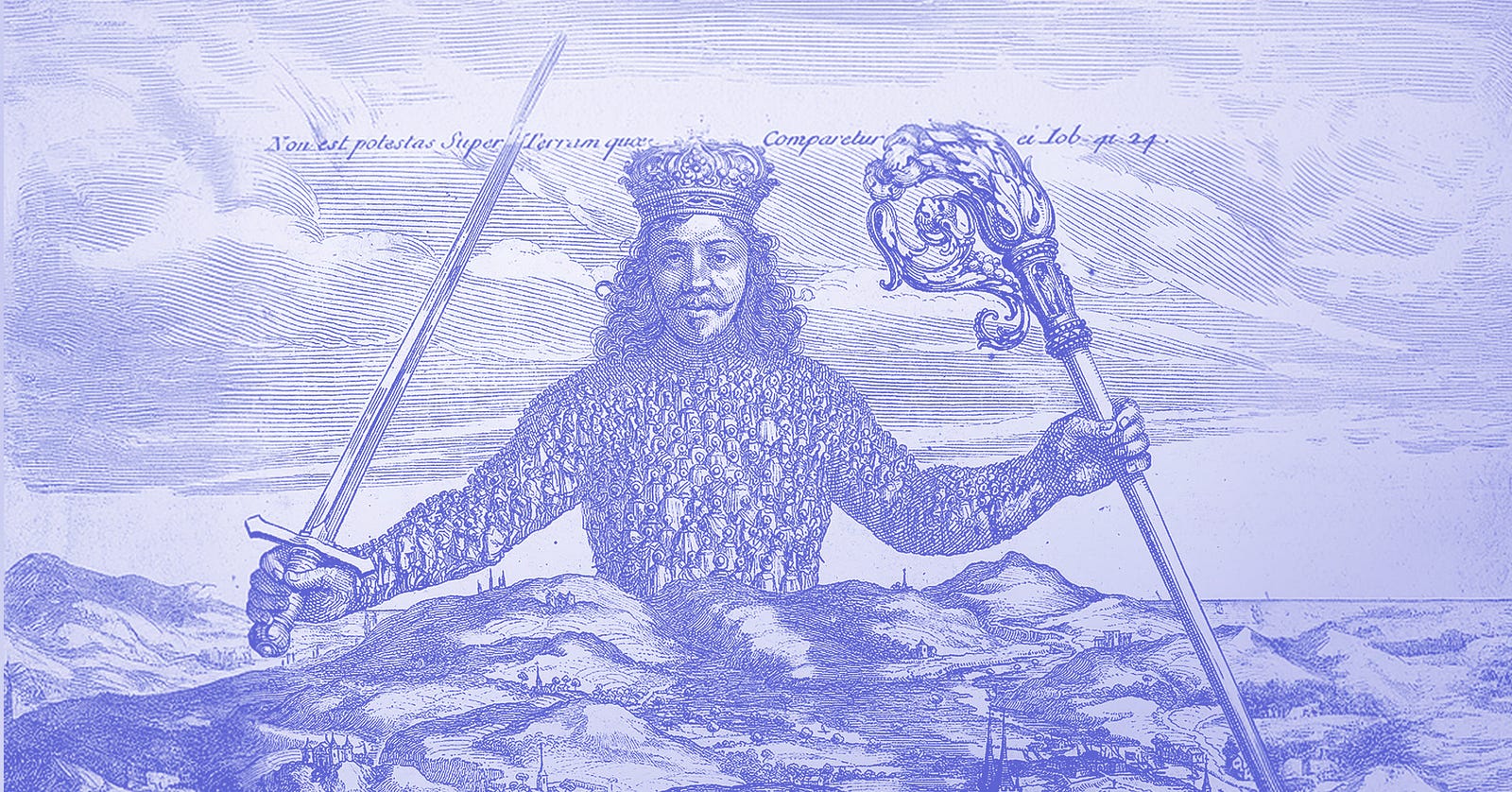
On the cover of Hobbes’ Leviathan, there is a giant king standing over a landscape. At first glance he looks like a single figure, but when we look closer, we see that his body is made of hundreds of small people.
Ethereum’s validators are usually seen the other way around. There are close to a million of them, and this number is often used to show how decentralized the network is. Yet, many of these validators are run by the same few companies, on the same servers and by the same teams. So, what looks like a crowd is partly a few large operators divided into small pieces.
Since the Pectra upgrade, these pieces have started to come together again. Operators are merging their validators, and according to recent data, the number of active validators has dropped from around 975,000 in January to around 868,000 in October. Lido alone expects its operators to merge more than 265,000 validators into about 4,000.
At first, this sounds like bad news for decentralization but to understand whether it really is, we first need to ask why Ethereum had so many validators in the first place.
Why Were There So Many Validators?
Until Pectra, Ethereum only counted up to 32 ETH of a validator’s balance: a validator could hold more, but anything above 32 ETH did not earn rewards and was automatically swept out. So if you wanted to stake more, you had to spin up another validator. That meant a company staking 3.2 million ETH for its clients was not running one validator but 100,000 of them. However, these 100,000 validators were not 100,000 machines, even though this is how most people imagine them. A single validator client can run thousands of validator keys at the same time, so a company like this could be running all of them on a handful of servers, managed by the same team. Though these validators were the same to the company, for the network each of these validators was a separate participant with its own job.
This job comes back in every epoch, which lasts about 6.4 minutes: each validator signs a vote on which blocks it sees as correct, and this vote has to travel across the network to be checked by the others. Ethereum combines many of these signatures into one to save work, though every new validator still adds a little more to the load.
In Down the Rabbit Hole, I wrote that the main cost of a blockchain is coordination. Here, the network was verifying 100,000 separate signatures and keeping 100,000 separate records in its state for what was, behind the scenes, a single company running a few machines. It was as if a shareholder splitting his shares into thousands of small accounts and voting separately from each one at every meeting. The result of the vote would be the same in the end, only the meeting would take much longer for everyone, and the longer the meetings get, the harder it becomes to plan anything that needs quick decisions.
For Ethereum, one of these plans is to finalize blocks within a single slot, which means collecting every validator’s vote in about 12 seconds, and this is much easier to do with fewer validators.
What Pectra Changed
With EIP-7251, Pectra, which went live in May 2025, raised the amount a single validator can hold from 32 ETH up to 2,048 ETH, while small stakers can still join with 32 ETH just as before.
With this change, large operators can merge their validators. That is, the balance of one validator is moved into another, without leaving the network and waiting in the queue to join again. Rewards also stay inside the validator and grow its balance, instead of being paid out every time it goes above 32 ETH. All of this, however, happens gradually, since only a limited number of merges can go through in each epoch so that the balance of power among validators does not change too quickly.
Merging brought one more problem with it: when a validator breaks the rules, for example by signing two different blocks for the same slot (double signing), its stake gets slashed. Under the old rules, a validator holding 64 times more ETH would also lose 64 times more, and operators would be reluctant to merge. And Pectra lowered this first penalty. Yet, it kept the extra penalty that grows when many validators are slashed at the same time, so operators whose validators fail together are still punished more heavily.
So, Is Ethereum Less Decentralized?
With this in mind, the decreasing number of validators looks less worrying. Merging does not really move stake into fewer hands, because the stake was already in those hands; it is only easier to see now.
This is because a validator is closer to an account than to an independent participant. Thousands of validators run by the same company use the same keys, the same servers and the same team, so when something goes wrong with one of them, it goes wrong with all of them.
This also changes how we should think about risk. One might think that splitting stake into thousands of validators made it safer, but the keys of those validators were usually kept in the same place and under the same security assumptions, so if that place was compromised, all of them were at risk together. The MetaMask incident in October showed exactly this: after a security issue in its staking infrastructure, MetaMask took thousands of validators out of the network at once as a precaution. So consolidation does not increase this risk, it only makes it visible. The one difference is in smaller mistakes, such as a misconfigured key migration, which used to hit only some of an operator’s validators and can now affect its entire stake at once. For those who really want to split the risk, the way is not more validators but Distributed Validator Technology (DVT), where a single validator key is shared across several independent machines and operators.
Networks That Took the Other Path
Some networks never had this problem. On Cosmos SDK chains, the number of active validators is fixed, usually between one and two hundred, and if you want to stake, you don’t create a new validator but delegate your tokens to an existing one, which is why this model is often called delegated proof of stake. Monad is an interesting example here, because even though it is an EVM L1 like Ethereum, its staking works much more like Cosmos: only the top 200 validators by stake can be in the active set, each of them needs at least 10 million MON delegated to it, and stake changes take effect at the start of the next epoch, which comes roughly every 5.5 hours. In networks like these, it is easy to see how stake is distributed, and anyone can check how much voting power the top ten validators hold.
Ethereum chose to stay open instead: anyone with 32 ETH can become a validator, and there is no limit on how many there can be. Merging only brings the number of validators closer to the number of real operators, which is what these networks have shown from the beginning.
Conclusion
In Children of the Prophecy and the articles before it, I wrote that blockchain design is about managing constraints, not removing them. Merging validators is a good example of this. Ethereum makes coordination cheaper by having fewer validators, and in return, each of them carries more weight and more responsibility.
In a way, this brings us back to the cover of Leviathan. The king there looks like a single person until we notice the crowd that makes up his body, and Ethereum’s validators looked like a crowd until merging showed the few large operators behind them. In both cases, what we see from far away is not enough to tell how many independent parts there really are.
For years, the number of validators was presented as proof of how decentralized Ethereum is, while it was mostly a result of how the protocol counted stake. Consolidation takes this number away, and leaves us with a more honest question.
So, if the number of validators no longer tells us how decentralized Ethereum is, what should we be counting instead?
Discussion about this post