



Over the past year, one of the world’s largest institutional staking providers stopped validating on at least eight Cosmos networks. It wasn’t pushed out by a hack or a slashing event. It simply left: on Celestia, for example, on-chain data shows the validator was shut down by its own operator.
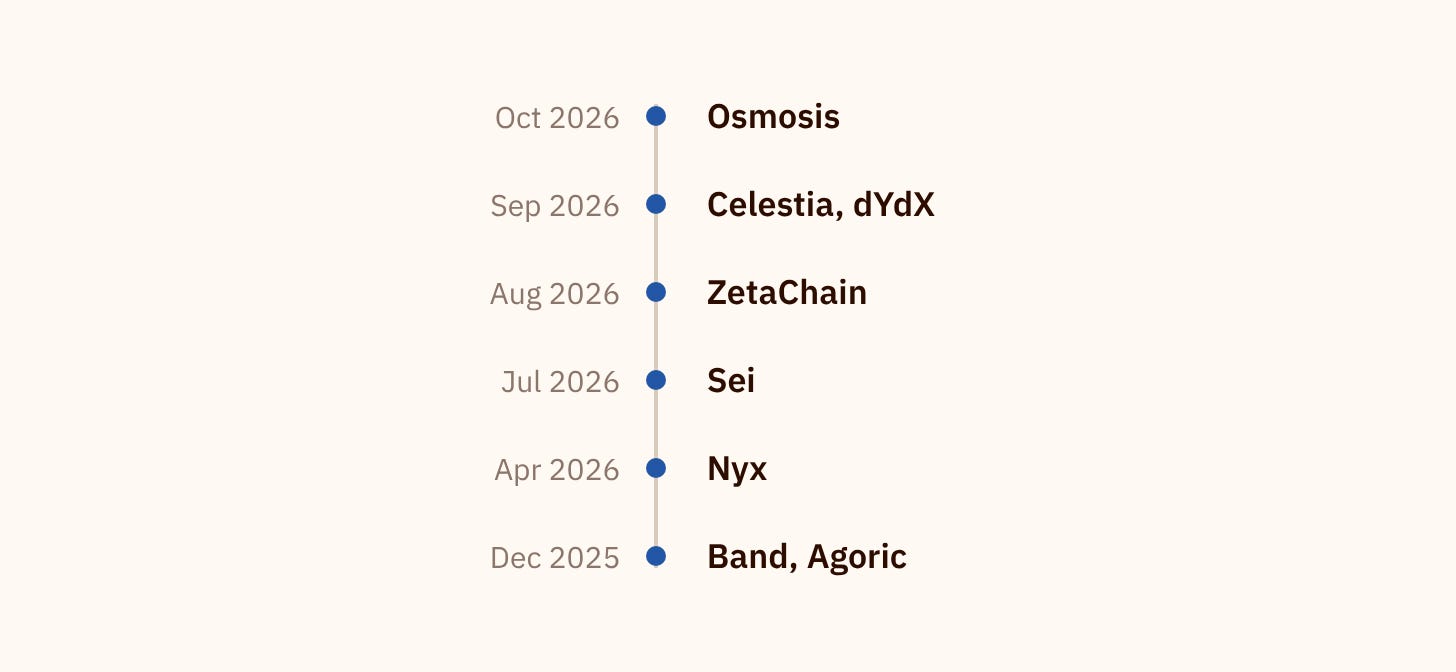
Dates are counted back from the end of each on-chain unbonding period (±1 day).
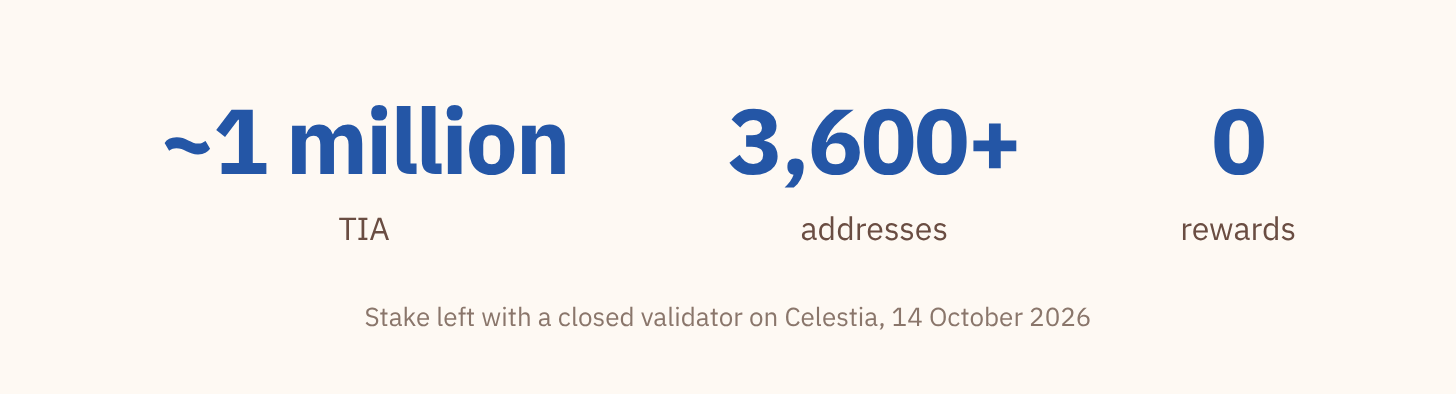
What was left behind is even more interesting. As of 14 October, more than 3,600 addresses on Celestia still had about 1 million TIA staked with the provider’s closed validator. Those tokens no longer earn any rewards, and most of their owners probably don’t know it.
Last week, Mete wrote that a quiet shakeout lies ahead for validators. It has already started. So why would one of the biggest players in the industry walk away from networks? In this piece, we look at the economics of running a validator: where the revenue comes from, why it moves so much, and what keeps a validator in business.
How does a validator make money?
A validator’s revenue is the product of four numbers:

Delegators stake tokens with a validator. The network pays a yield on that stake, and the validator keeps a small share of it as commission. That share is paid in tokens, so what the validator actually earns depends on the token’s price on the day. Let’s take the four in turn.
Stake. Delegation is won and lost. A validator cannot control it; it can only try to earn it.
Yield. The protocol sets it. On most networks, the inflation schedule falls every year, and the yield drops as more of the supply is staked. Ethereum’s network yield was around 2.8% at the start of 2026 and 2.6% by October. Newer networks usually pay more to attract stake. On Celestia, which we will come back to below, the gross yield is about 5.4% today.
Commission. As we wrote in The Market for Lemons in Staking, commission is usually the first number delegators compare, and competition keeps pushing it toward zero. Some networks set a floor at the protocol level. On Celestia, for example, no validator can charge less than 20%.
Price. This is the biggest variable in the equation, and the validator has no control over it.
The cost side is much simpler. Servers, data centers, engineers, audits and certifications are all paid in dollars or euros, and none of them get cheaper when the token falls.
Revenue in tokens, costs in dollars
Economists call this a currency mismatch: your revenue is in one currency, your costs or debts in another. Türkiye knows the problem well. In 2018, many companies that earned in lira and borrowed in dollars watched their balance sheets melt as the lira fell. In 1999, Barry Eichengreen and Ricardo Hausmann gave the inability of emerging economies to borrow in their own currency a memorable name: “original sin.”
A validator is in the same position, only with a far more volatile currency. To see how volatile, we built an equal-weighted basket of the tokens of the 10 networks node101 validates and compared its last two years with Bitcoin.
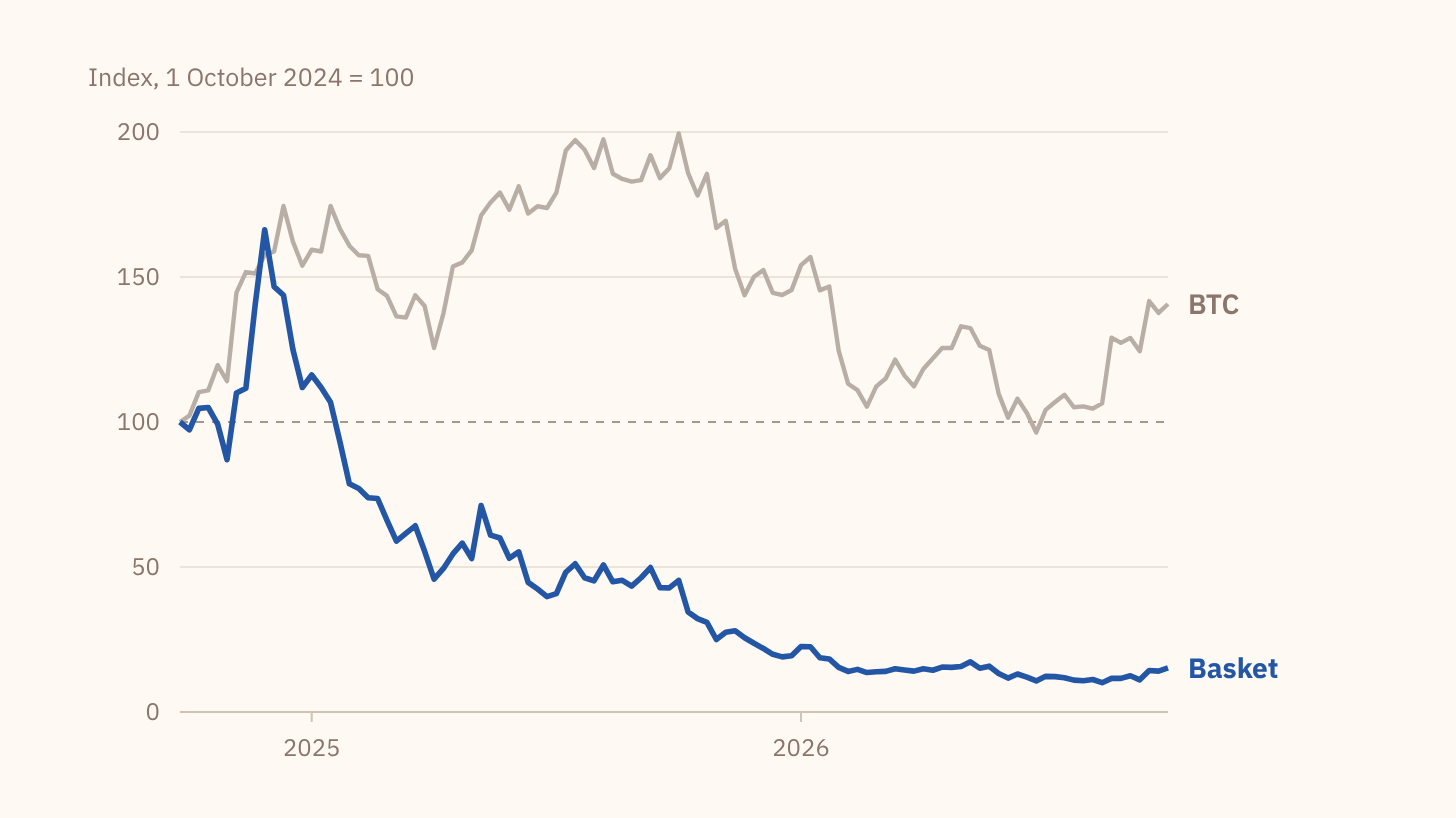
Source: Gate.io daily closes, node101 calculations
The daily correlation between the basket and Bitcoin is 0.70, and the basket’s beta is 1.27 (1.20 on weekly data). In other words, the basket moves roughly 1.2 to 1.3 times as much as Bitcoin. Over the last 12 months, Bitcoin fell 31% while the basket fell 68%. Every token in the basket did worse than Bitcoin over the same period.
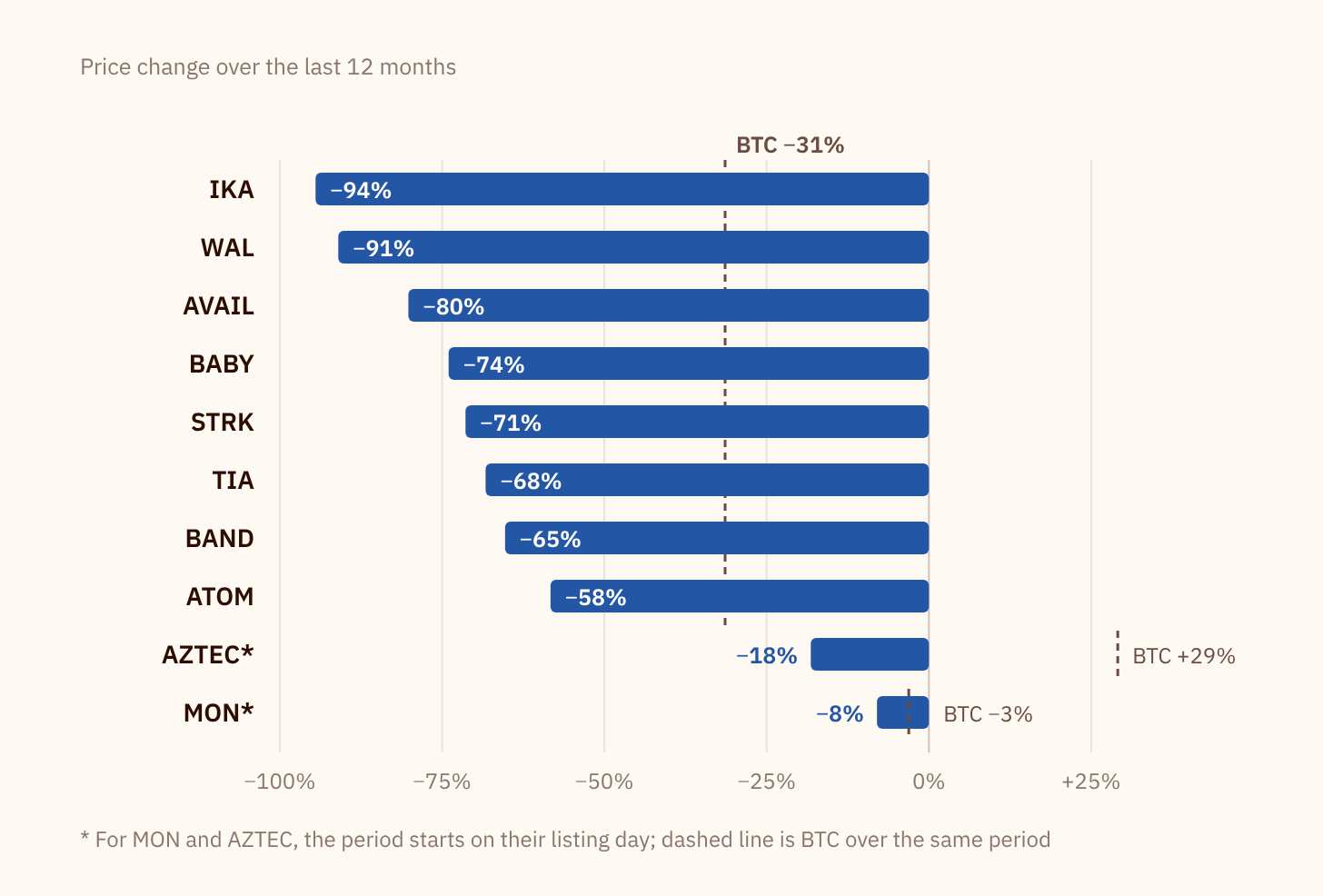
The lesson is simple. Validating on many networks spreads token-specific risk, but not market risk. A validator spread across ten networks is effectively holding one leveraged position on Bitcoin. When the market falls, revenue drops on every network at once, while costs stay exactly where they are.
How much stake does a network need?
Working out how much stake a validator needs to break even on a network is straightforward arithmetic. Divide the annual cost by the yield times the commission:

Using Celestia’s 5.4% yield and a few assumptions for cost and commission, the picture looks like this:
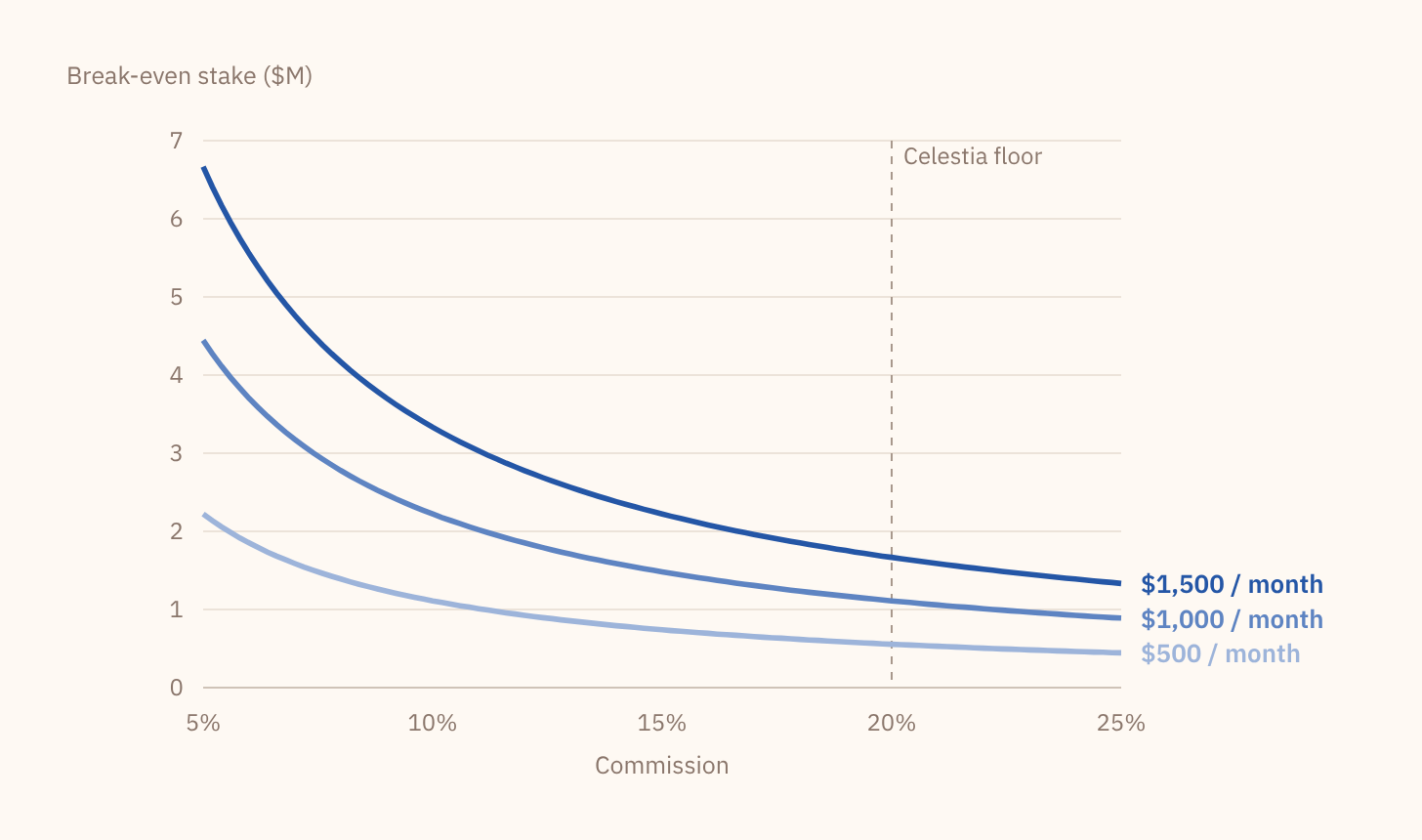
Costs are hypothetical and include servers, data center, staff and a share of audits.
These figures are in dollars, but delegators stake tokens, not dollars. When a token falls 68%, the dollar value of the same delegation falls 68% too. A validator that was exactly at break-even a year ago now covers only about a third of its costs with the same delegation. To get back to break-even, it needs three times as many tokens.
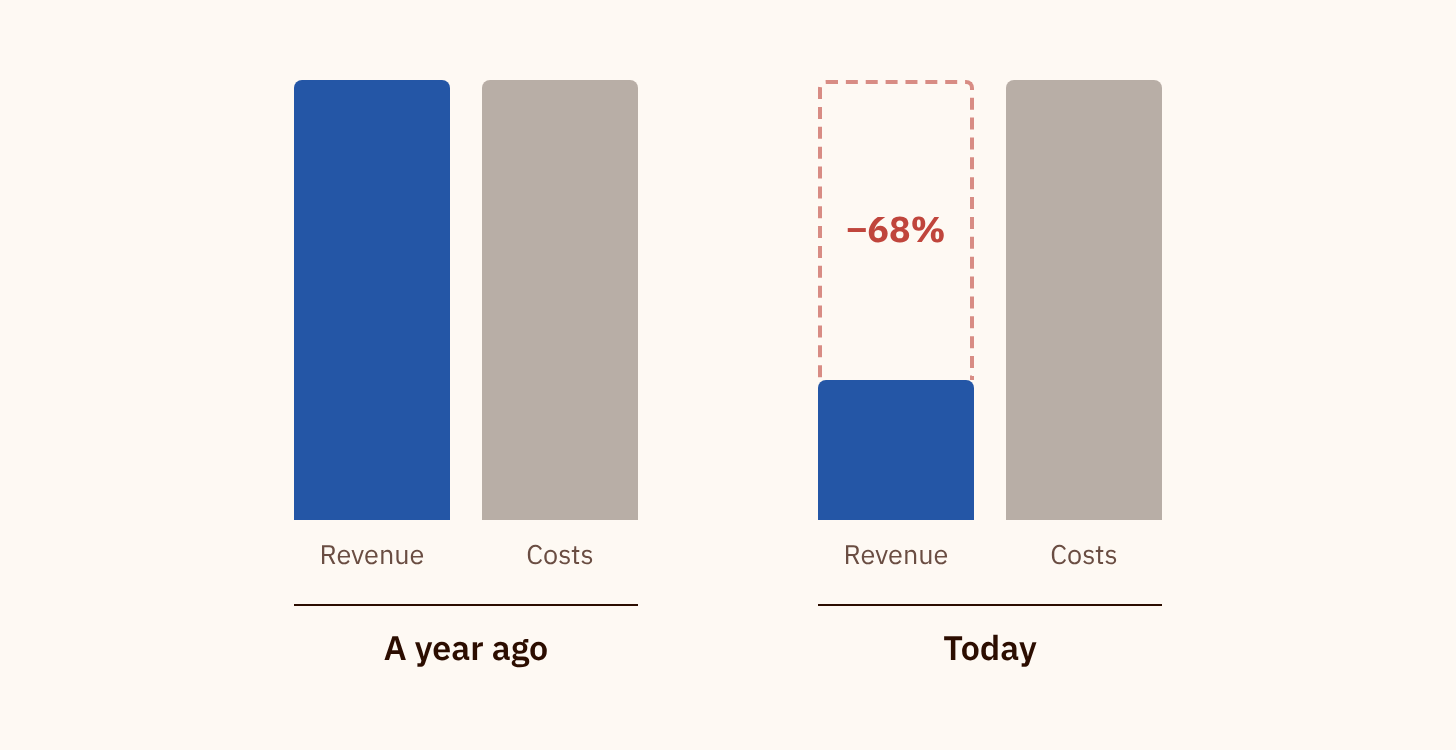
For a large institutional provider, the problem is even harder, because compliance teams, audits and insurance push its cost per network much higher. We don’t know the internal reasons behind the exits above, but the numbers explain why leaving long-tail networks can be a rational decision.
Who survives?
When revenue is this volatile and costs are this fixed, running good nodes is not enough on its own. In our experience, the validators that last tend to have five things in common.
Scale per network, not network count. Sitting below break-even on twenty networks is a worse business than being strong on five. Every new network adds a fixed cost, while, as we saw above, the revenue from all of them moves together.
Treating rewards as a currency position. Holding token rewards and waiting for the price to go up ties the balance sheet to the crypto market with leverage. Selling rewards regularly, or hedging them with futures, is the validator’s version of the lesson Turkish companies with dollar debt learned the hard way in 2018.
Income beyond commission. Revenue lines such as RPC, data services and products keep the company running when commission income shrinks with the price.
Cost discipline. A validator running its own bare-metal servers instead of the cloud does the same work for less, and lower costs mean less stake is needed to break even.
Trust. As Mete wrote last week, institutions now choose their validators on trust. Institutional delegation tends to be long-term and does not leave easily when the price drops. As we argued in The Market for Lemons in Staking, the way to earn it runs through signals that are expensive to fake.
Where does node101 stand?
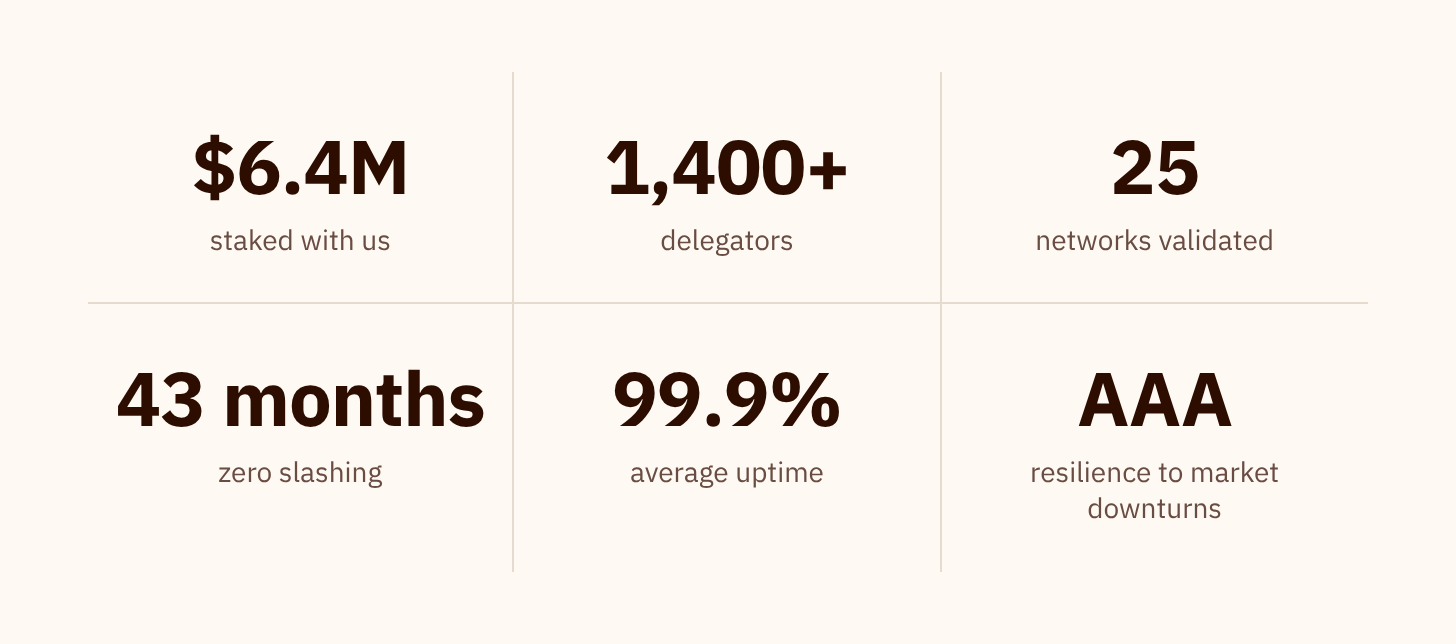
node101 has validated 25 networks to date, with no slashing in 43 months of validator history and an average uptime of 99.9%. We went through the fall in the chart above too, since that basket is made up of the networks we validate.
Staking Rewards data as of 2 November 2026.
What carried us through was investing in the points above before the downturn arrived. In its October 2026 assessment, Staking Rewards rated us AAA for resilience to market downturns, pointing to our profitable operating history, our cash reserves and our income beyond validator commissions. Our financial statements are also independently audited.
We see the delegator side of this as well. As of 2 November, more than 1,400 delegators have around $6.4 million staked with node101, according to Staking Rewards. Like every other number in this piece, that figure moves with token prices.
If there is one thing growing has taught us, it is this: how big a validator really is shows most clearly when the market is bad.
What does this mean for delegators?
When a validator shuts down, nobody may tell you. The 1 million TIA still staked with a closed validator on Celestia is the clearest example. Its owners haven’t lost their tokens, but they haven’t earned a single reward in weeks. A few simple checks are enough to avoid this:
Is your validator still in the active set? Any explorer will tell you in seconds.
If it isn’t, redelegate rather than unstake. On Cosmos networks, moving your stake to another validator is immediate, while unstaking means waiting out the unbonding period (21 days on Celestia) with no rewards.
Could the company behind the validator survive a bad year? Audited financial statements and independent ratings answer this question, at least in part.
So, is running a validator a good business? Done right, yes. But as with any business that earns in tokens and pays in dollars, the real test comes when the market is bad, not when it is good. That is also the moment to look most closely at the validator you choose.
Sources
Barry Eichengreen and Ricardo Hausmann, “Exchange Rate Regimes and Financial Fragility”, NBER Working Paper 7418, 1999.
Gate.io spot daily closing prices, 1 October 2024 – 6 October 2026; basket and correlation calculations by node101.
cosmos.directory and Celestia on-chain data: active-set exit dates and stake left with the closed validator (14 October 2026), validator rankings (2 November 2026).
Staking Rewards, node101 Staking, October 2026 assessment.
CoinCentral, “Ethereum Staking Statistics 2026”, October 2026.
Mete Koray Gergin, “The Future of Validators Lies in How Much Trust They Can Create”, node101, 27 October 2026.
node101, “The Market for Lemons in Staking”, October 2026.