


In the short time since the inception of blockchain technologies, the individuals and institutions that created the blockchain technology have had a transformative impact on daily life worldwide. These technologies, initially created outside the sphere of public institutions’ influence, have recently come under regulatory observation, with lawmakers enacting numerous measures.
So, who are these regulatory bodies, and how do the processes work? For the blockchain ecosystem, which transitioned from a crypto anarchist childhood to an adulthood subject to rules shaped by public institutions, does this represent an early death or a long and prosperous life?
How did we get here?
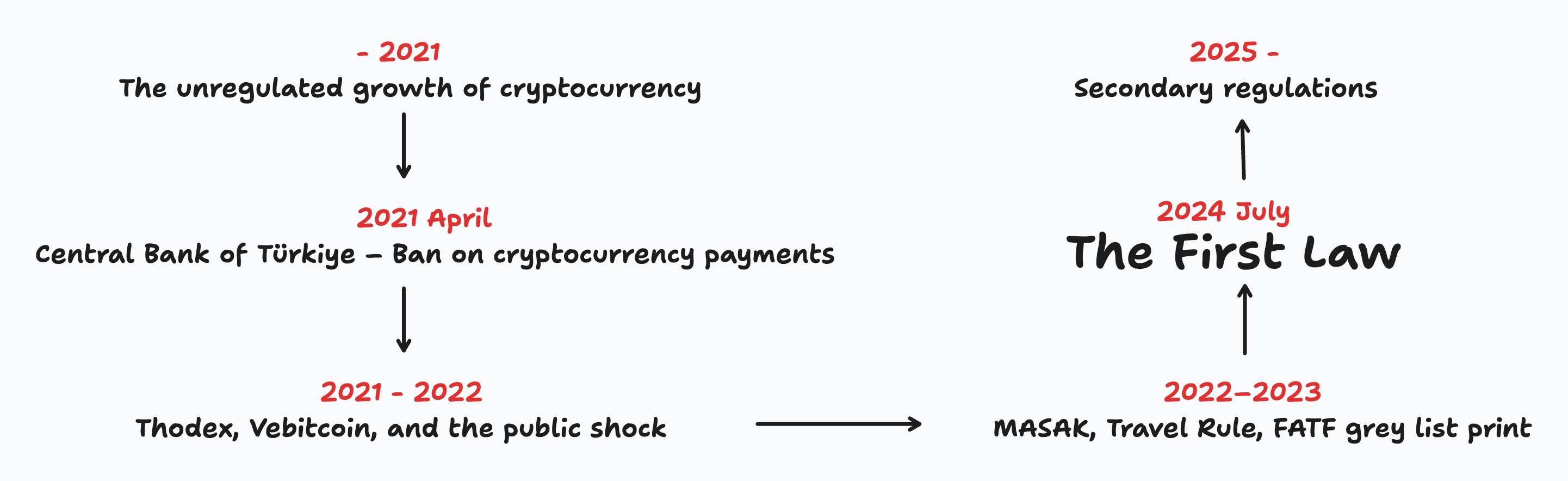
The prepandemic era was a time when the cryptocurrency ecosystem had not yet entered the regulatory radar, and blockchain technology was considered to be in a ‘legal vacuum,’ free from regulation. With the rise of programmable blockchains, the emergence of many new crypto assets reaching millions of users through various exchanges, and the injection of new cash into the economy due to the pandemic and rising inflation, which led to a shift towards new investment instruments, the ecosystem experienced its first real boom.
With the rise of programmable blockchains, the ecosystem experienced its first real boom. Here is what happened afterwards:
Mass Reach: the emergence of many new crypto assets reaching millions of users through various exchanges,
Cash Injection: the injection of new cash into the economy due to the pandemic,
Investor Pivot: rising inflation led to a shift towards new investment instruments
The prepandemic era was defined by a proliferation of unaudited whitepapers and experimental crypto-economic models. Driven by the hype surrounding NFTs and the Metaverse, massive communities organized across Discord and Twitter (as it was then known) to chase airdrops, fueling a speculative surge that directed hundreds of millions of dollars into the blockchain ecosystem.
However, the sheer number of people attracted also whetted the appetite of those engaging in illicit activities. 2021-2022 were the years when the first large-scale user scams occurred and made headlines. Among these, scandals like Thodex and Vebitcoin confirmed the fact that the unregulated nature of blockchain based financial products could lead to mass victimization, and accelerated the regulatory processes. With the first official intervention in 2021, the Central Bank of Türkiye (TCMB) banned the use of crypto assets in payments. Subsequently, due to certain deficiencies in the Financial Action Task Force (FATF) compliance processes, which were found to have influenced Turkiye’s inclusion in the Grey List, the fight against many companies using blockchain technologies intensified. During this period, we saw moves such as the Travel Rule, which mandated the implementation of AML/KYC solutions by companies using blockchain products.
In short, during this period, crypto regulation in Türkiye took shape within the framework of secure technology policies, foreign policy, and financial reputation motivations.
A Turning Point
The turning point in the legal recognition of blockchain based products occurred with the enactment of Law No. 7518 on Amendments to the Capital Markets Law on July 2, 2024. This law did not directly regulate blockchains or crypto assets; instead, it specified which institutions would issue guiding circulars bringing brokerage, custody, and service provision activities related to blockchain technologies under state supervision.
While this law addresses institutions providing crypto asset services in Türkiye, it does not explicitly cover protocols, validators, RPC providers, or smart contracts. The law deliberately requests that regulations concerning these matters be handled within the framework of the Capital Markets Board (SPK), Financial Crimes Investigation Board (MASAK), Central Bank of Türkiye (TCMB), and Scientific and Technological Research Council of Türkiye (TÜBİTAK).
SPK, MASAK, TCMB, TUBITAK: The Four Horsemen of Blockchain Regulation and More
Under this law, crypto assets are not defined as money, and many questions remain, including whether they are securities, commodities, or something else. This opens up a wide scope for interpretation for the SPK (Capital Markets Board). This means that, along with secondary regulations, the SPK gains a flexible scope for action.
Under Law No. 7518, the SPK becomes the main authority for matters such as authorizations, operating licenses, and the supervision of crypto asset service providers. Indeed, the SPK does not regulate the blockchain sector alone, it considers the sensitivities of institutions such as the TCMB and MASAK, and seeks opinions from TUBITAK regarding relevant regulations.
Current Regulatory System and Public Institutions’ Approaches
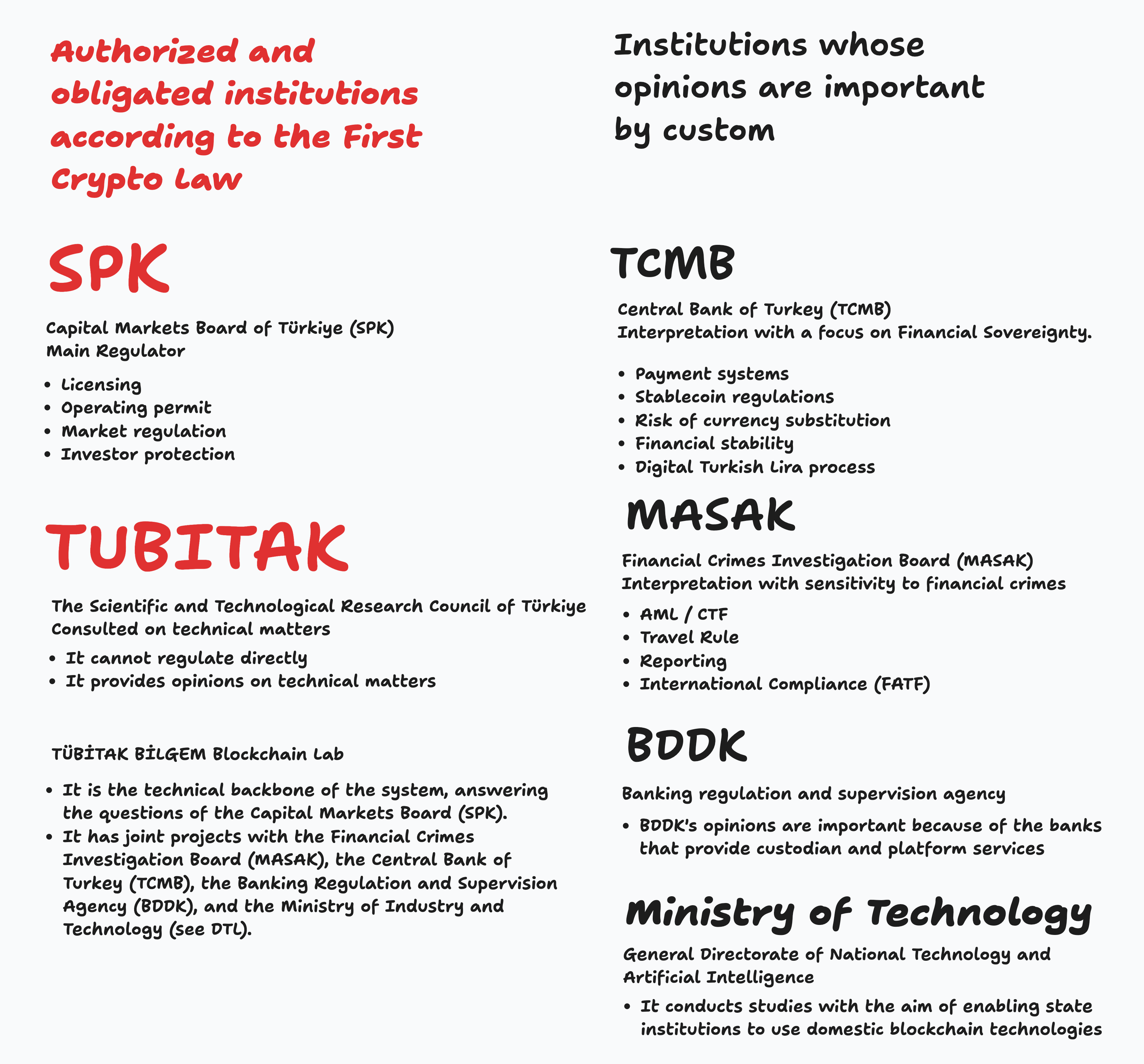
The first secondary regulation issued by the Capital Markets Board (SPK) after July 2024 took place in March 2025. The SPK, which began requesting opinions from TÜBİTAK (the Scientific and Technological Research Council of Türkiye) for this first regulation in December 2024, regulated many aspects of Crypto Asset Service Providers (KVHS), including their establishment, operation, share transfer, capital adequacy, organizational chart, and operational processes. With other regulations issued throughout the year, efforts were made to regulate the operations and compliance of KVHS, particularly those defined as Custodians and Platforms.
The compliance processes of companies whose KVHS license applications are ongoing or in liquidation are also being monitored through the same system. As can be seen, the SPK is centrally positioned, while MASAK (Financial Crimes Investigation Board) and the Central Bank of Türkiye (TCMB) provide opinions on risks specific to their areas of expertise, and TÜBİTAK undertakes roles in terms of technical capacity.
So What Should Lawmakers Do Now?
Türkiye is one of the world’s leading countries in the use of blockchain based products. Regulations that support this advantage and open doors for blockchain product manufacturers and companies in Türkiye, defining various privileges and obligations for them, will allow them to better utilize this historic opportunity.
Each blockchain case should be considered individually, and regulations should have a supervisory character, not a prohibitive one. For a healthy and value creating blockchain ecosystem to emerge, regulators must create a structure where blockchain technology and service providers (KVHS) mutually reinforce each other technologically and commercially. An ecosystem where all value is created domestically, subject to rules and protecting user interests, will also contribute to employment by creating new companies and job opportunities within itself.
Blockchain platforms based in Türkiye and serving Türkiye, and that produce all their data in Türkiye, will not only pay their taxes here but also be subject to oversight by the relevant authorities, enabling users to use blockchain products securely and with high performance.
Türkiye holds immense promise for the future in the blockchain field, both in terms of supply and demand. At this point, the fundamental role of regulatory bodies is to channel this existing energy into the right avenues, providing the impetus to transform Türkiye into a global technology hub.
Informative