



Zero-Knowledge was definitely one of the biggest topics of blockchain once, and we have seen many great projects developing their technologies. Yet, there is very little data on what is the state of ZK’s adoption today.
As a part of our developer analysis in blockchaindeveloper.report, we inspected what is the state of ZK developers as of August of 2026, and we present our findings below, for general and each ZK ecosystem.
Active Developer Comparison to All-Time Metrics
The zero-knowledge ecosystem had so far just a little less than 29 thousand repositories created, with 33 thousand developers who have tried ZK technologies in total. However, only 1341 of these developers are active as of August 2026.
This means that currently 4.0% of developers in the ZK ecosystem are still active, which is not a promising overall ratio at all. Moreover, the overall global active developer share for blockchain developers (which is again the number of active devs over all-time devs) is 27.9%, showing us that the ZK ecosystem is not doing very well even inside the blockchain ecosystem in general.
However, it is important to notice that the biggest drop in this ratio is caused by old ZK technologies that do not currently host any active developers, so this does not necessarily mean that the ZK ecosystem is losing traction, but only some ancient big ZK projects are now not very strong.
This final conclusion is also supported by ecosystem specific data that we share in later sections.
Distribution of Activity in the ZK Ecosystem
When we look over the historical charts, we observe that most of the repository count in ZK is generated by two ecosystems: Starknet (12k repos) and Circom (7k repos). Alone, the two explain 70% of all repository count. Their role is similar in the total developer count as well.
However, we see that activity is considerably more distributed, with Midnight and Starknet leading, followed by Aztec and Circom.
This observation leads us to two important conclusions: The first is that even though the two biggest ecosystems of ZK are not as active today, they still own an important developer segment. The second is that some of the newest ZK ecosystems are actually matching the old favorites in activity, which is very positive news for new technologies.
Now, let us move on to some ecosystem specific analyses to better understand the situation.
Ecosystems in the Order of Active Developer Count
Midnight
TL;DR 1367 all-time repos, 1127 all-time devs, 544 active devs
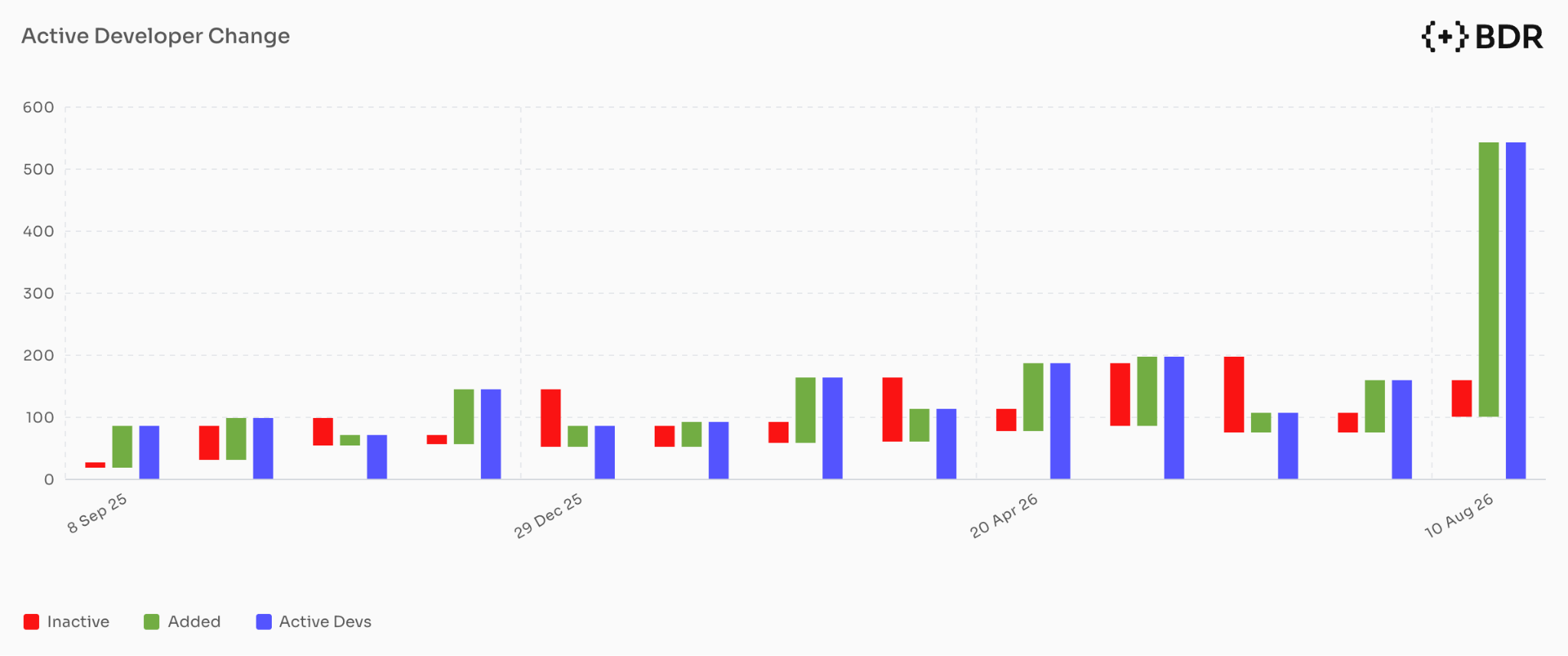
To summarize simply, we can say that Midnight is rapidly gaining traction. Their active developer count has increased very rapidly in the past 2 months, and now they own the biggest active ZK developer segment. So far, their 2-months retention is also very high with 91.8%.
Another interesting metric of Midnight is the increase in the number of returning and reactivated developers in their chart:
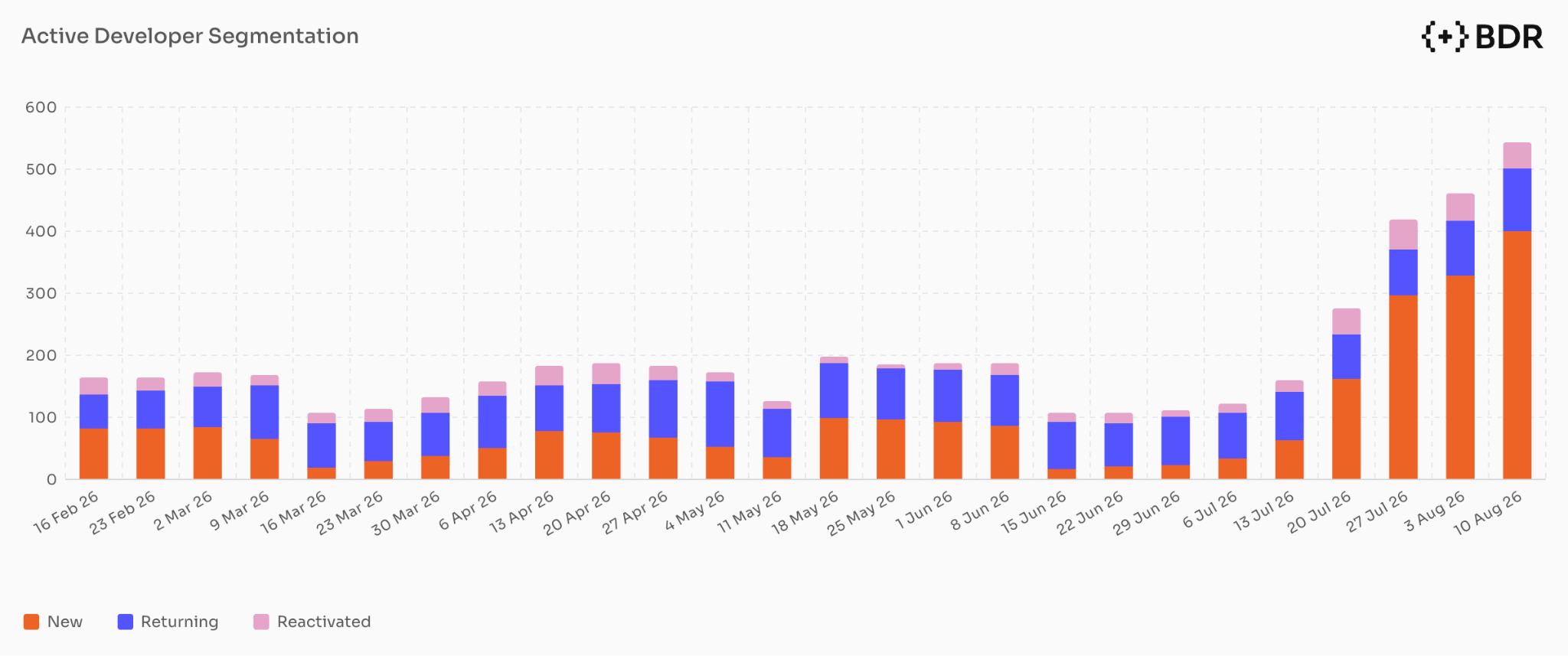
This graph indicates that the recent increase of Midnight is not only made-up of new developers, but older Midnight developers are also returning to the ecosystem.
One final graph to share is the multi-ecosystem distribution of Midnight developers.
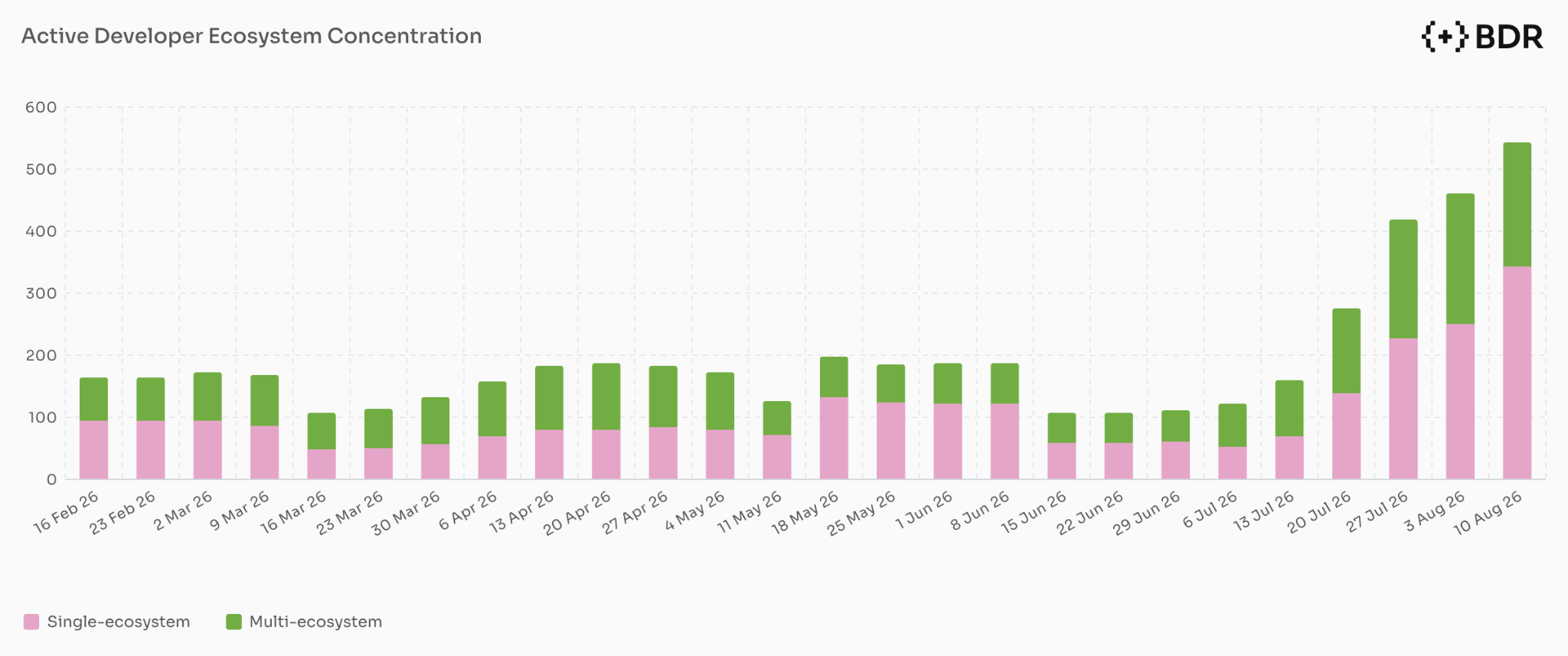
The graph shows that about half of Midnight developers are working only in the Midnight technology, which is also very high compared to most of other ZK ecosystems.
Overall, we can say that Midnight is trending fast at the moment, but the sustainability of their growth will be seen in the later months of 2026.
Starknet
TL;DR 12398 all-time repos, 13678 all-time devs, 393 active devs
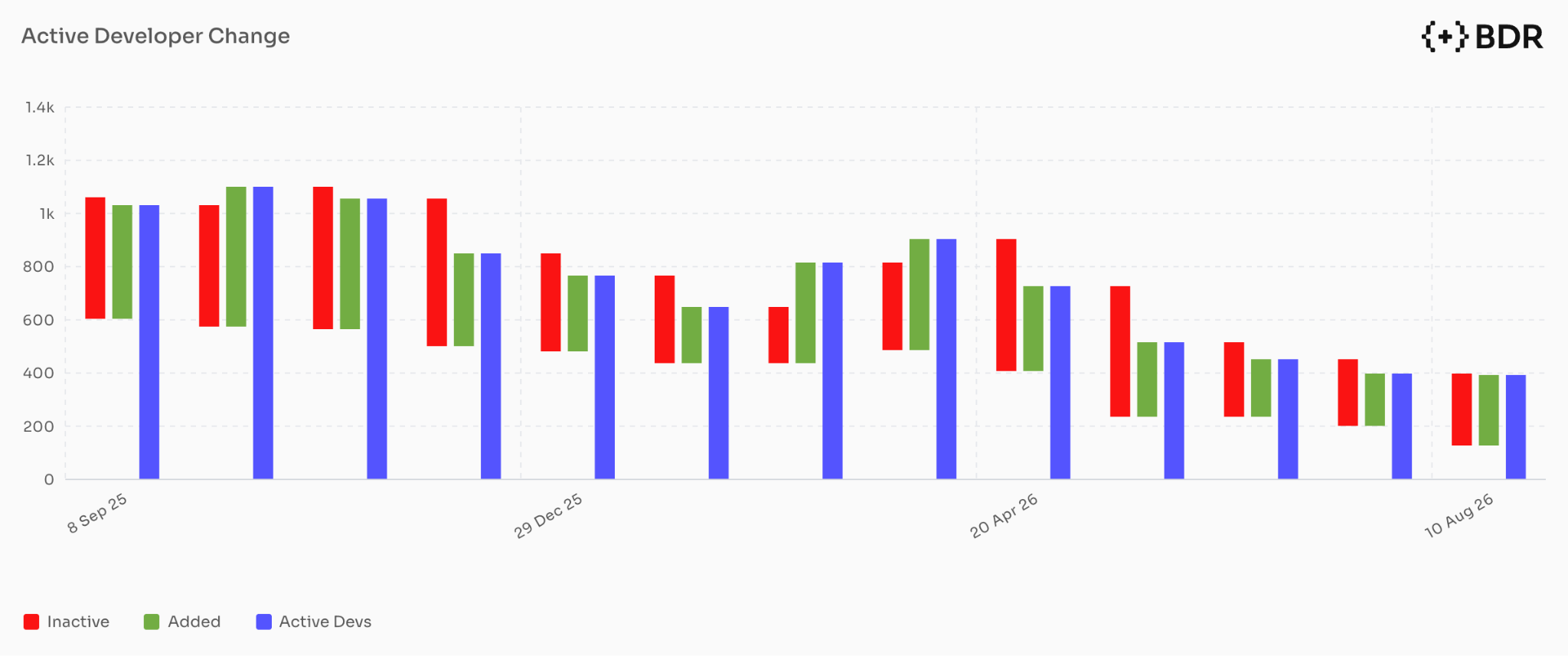
Starknet is the biggest ecosystem of ZK in terms of all-time repos and devs, but their active developer count has been decreasing since the beginning of 2026. The trend is even more clear when we look at their all-time data:
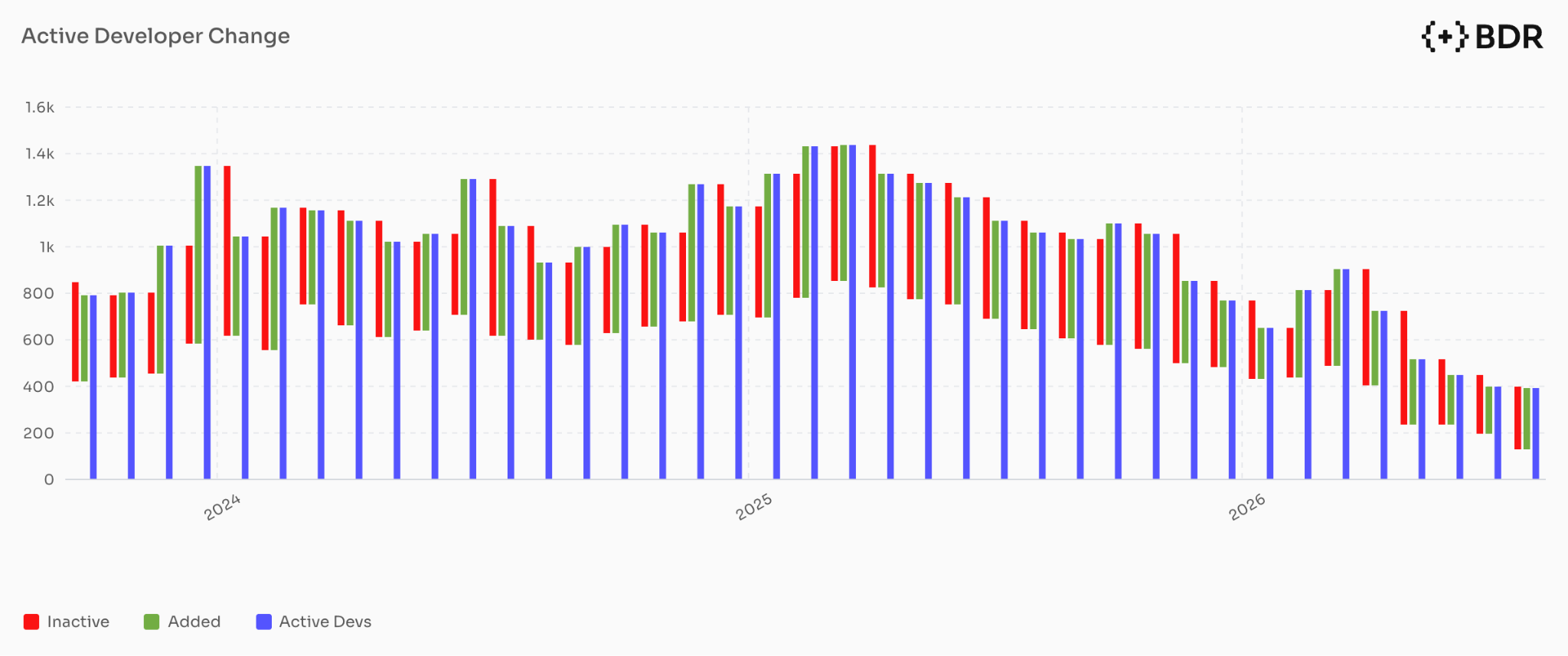
Nevertheless, there is also enough evidence to believe that this stop is finally ending, and Starknet active developer count is reaching a stable point. The high retention of 80.5 % also supports this idea.
Moreover, Starknet developers have one of the highest tenure levels of the ecosystem:
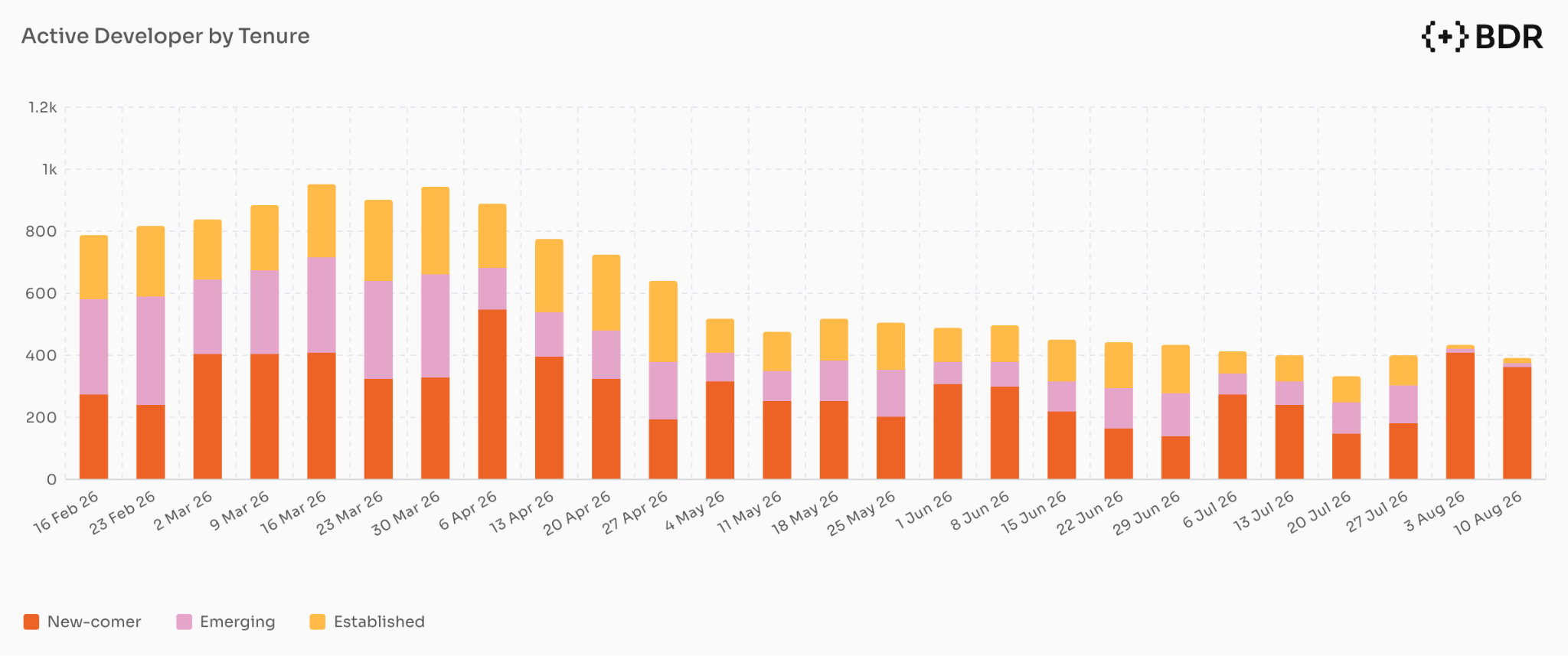
Here, we observe that Starknet has many established and emerging developers in its ecosystem, also supporting the idea of a stabilizing ecosystem. Note that last 2 weeks are not a fully accurate representation since the tenure data is often updated retrospectively.
Moreover, just like Midnight, Starknet ecosystem also hosts a significant portion of single-ecosystem developers, which is especially important considering they are an Ethereum L2.
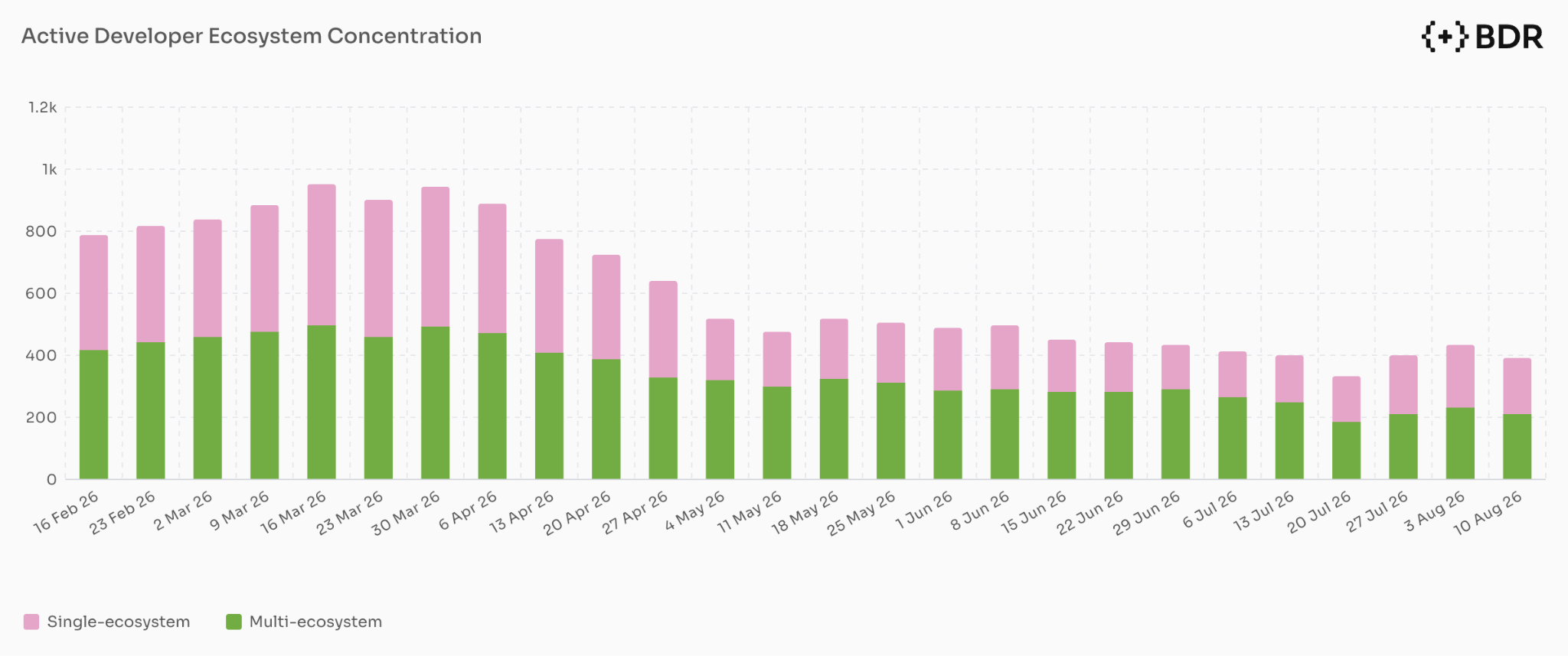
To conclude, we can say that the Starknet ecosystem is looking to be stabilizing since the beginning of 2026. Later months will determine if Starknet will be able to protect its developer base.
Aztec
TL;DR 3203 all-time repos, 2862 all-time devs, 164 active devs
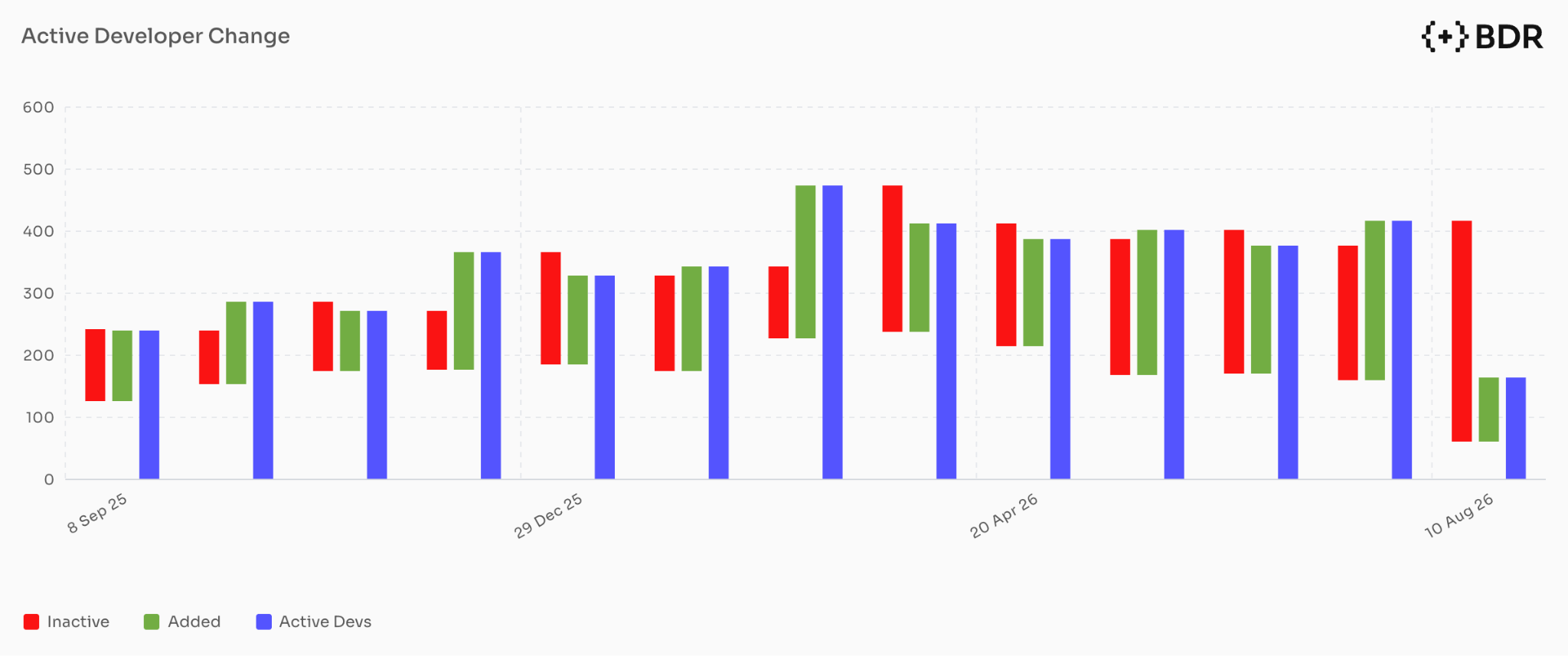
Aztec’s charts are quite surprising. Until the last month, we see that Aztec’s active developer count was having a steady growth, reaching 400 active developers in total, which is higher than Starknet’s current numbers. However, there was a sharp decrease last month, causing Aztec to drop up to 100 active devs.
We do not know the exact reason for this drop. One possible explanation may be that being a privacy-first ecosystem with institutional projects, many Aztec repos are still private, and we will see a retroactive increase in Aztec’s numbers in the coming weeks as these repos go public. Of course, data cannot relate to any cause directly.
However, it is also interesting to compare these results with multi-ecosystem segmentation.
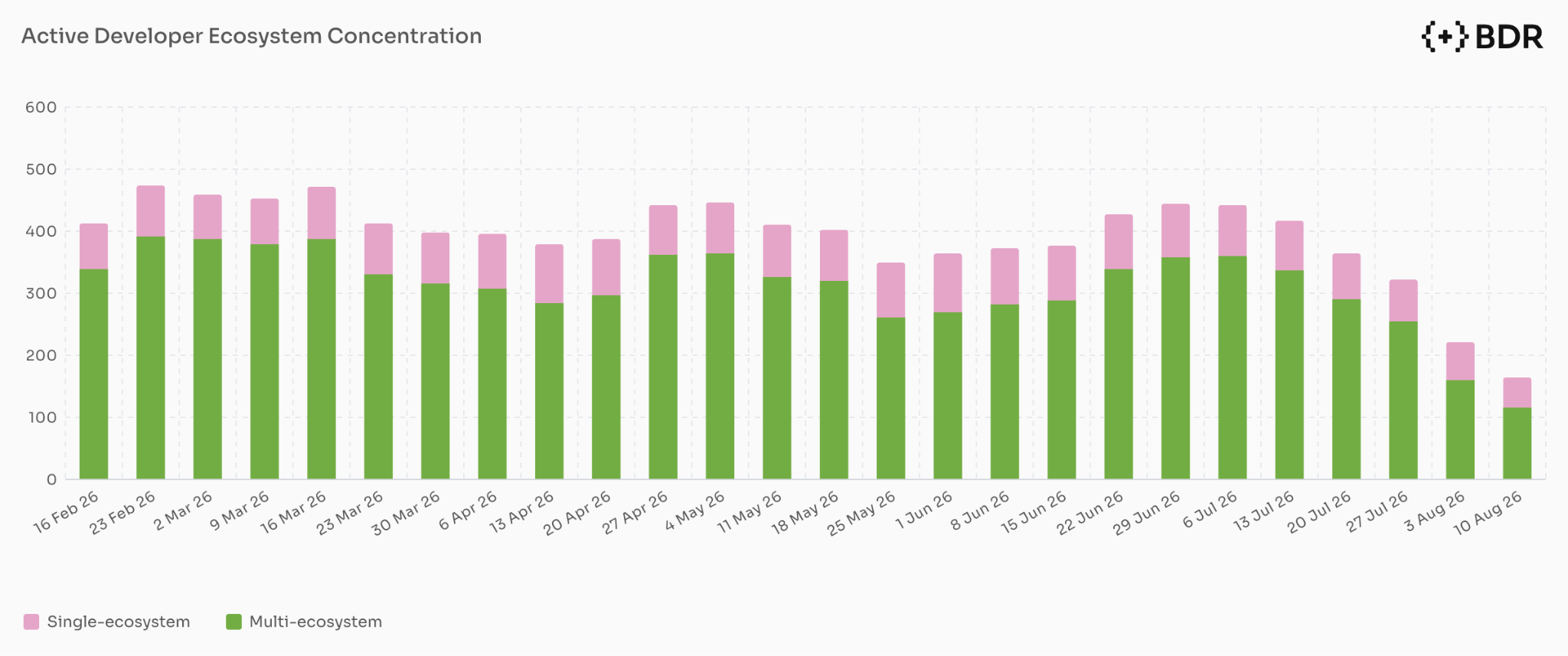
We observe that while the count of single-ecosystem developers of Aztec decreases much less, multi-ecosystem developers are the main cause of the decrease in Aztec’s charts. The fact that Aztec hosts many more multi-ecosystem developers than the two previous ecosystems also implies the importance of this difference.
Knowing that the total active developer count of the blockchain has also witnessed a significant drop in the last month, we can conclude that Aztec is affected by this change more than others, as its ecosystem co-exists with the general blockchain as well.
Coming months will show whether this decline is temporary or part of a longer-term trend.
Circom
TL;DR 7300 all-time repos, 8373 all-time devs, 132 active devs
Now, let us look into one of the oldest ZK technologies that is still in use.
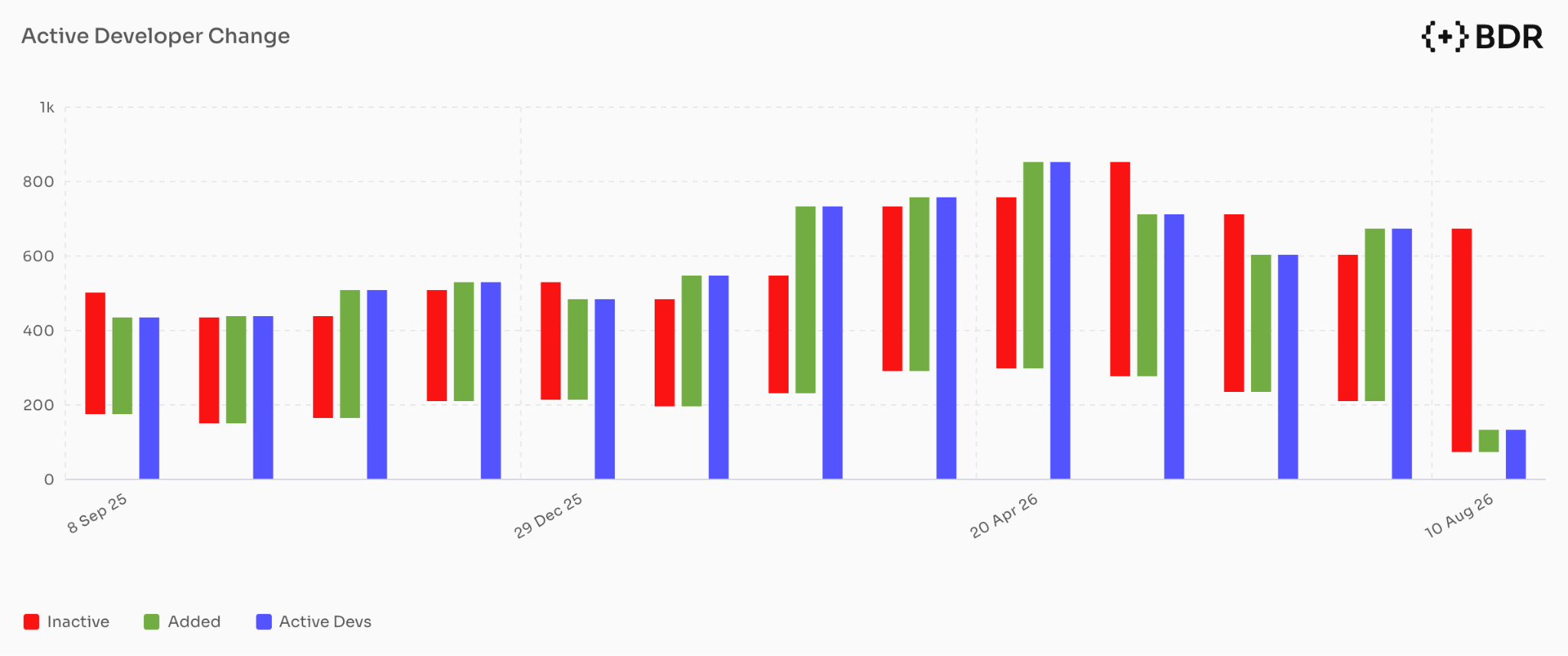
The same surprising picture of Aztec meets us also in Circom’s charts. We see that in the past month, Circom experienced a drastic drop, from 600 active devs (ecosystem high) to 132. The most optimistic explanation is again the frequency of institutional projects in Circom, and that these numbers will be updated retroactively with later pushes.
However, another possibility may be that Circom is finally leaving its place to the new technologies of ZK. Being slower and less-convenient than many, it is not a surprise for developers to start leaning towards newer technologies these days. The low retention rate (40.4%) of Circom also supports this idea.
Not surprisingly, as Circom does not have its own network, most Circom developers are also multi-chain, which is also another correlation between Circom and Aztec.
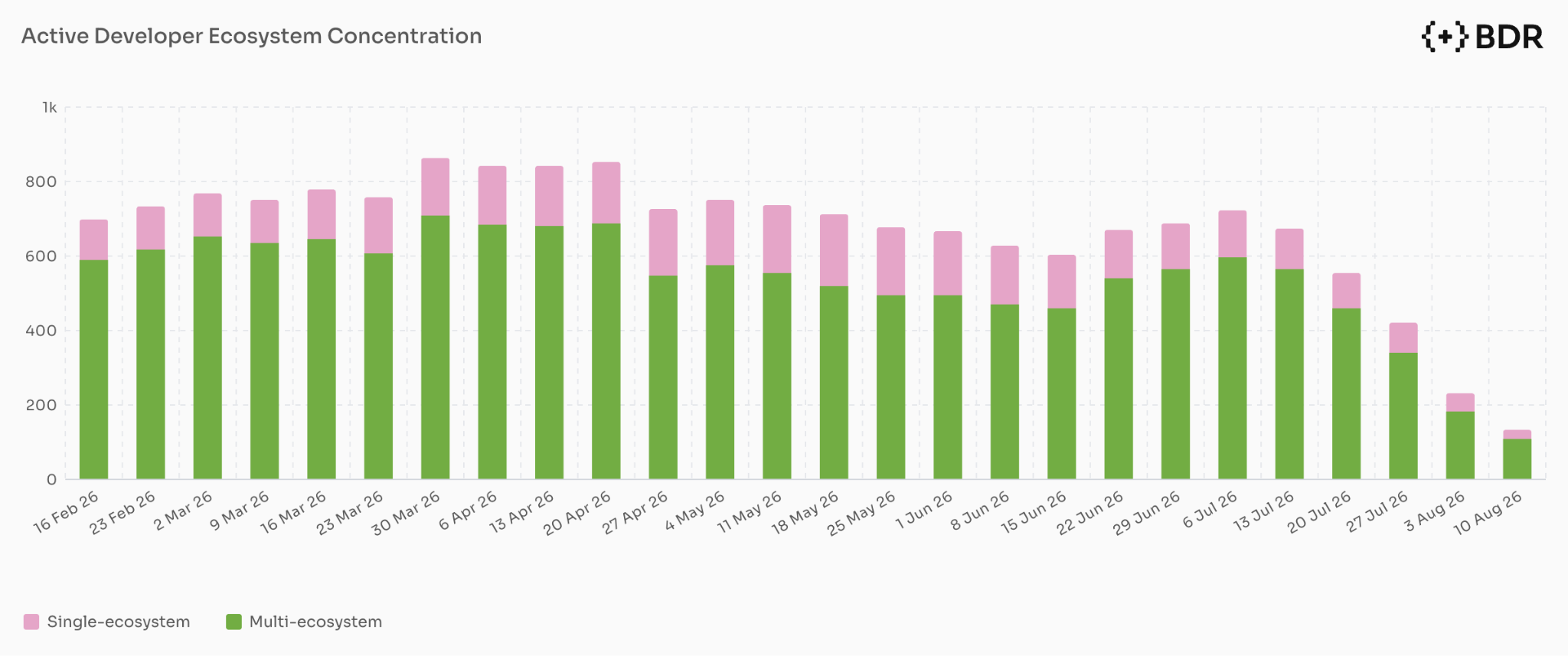
As an important difference, we can also notice that single-ecosystem developers of Circom are also leaving for the past weeks, with almost no single ecosystem developer left currently.
Of course, such a recent update is not a trend, and this does not mean anything definitive on Circom.
Succinct SP1
TL;DR 617 all-time repos, 1789 all-time devs, 59 active devs
And as a final bonus, let us look at the 5th most active ecosystem of ZK, which is also unique among the others above being a zkVM instead of a programming / circuit language.
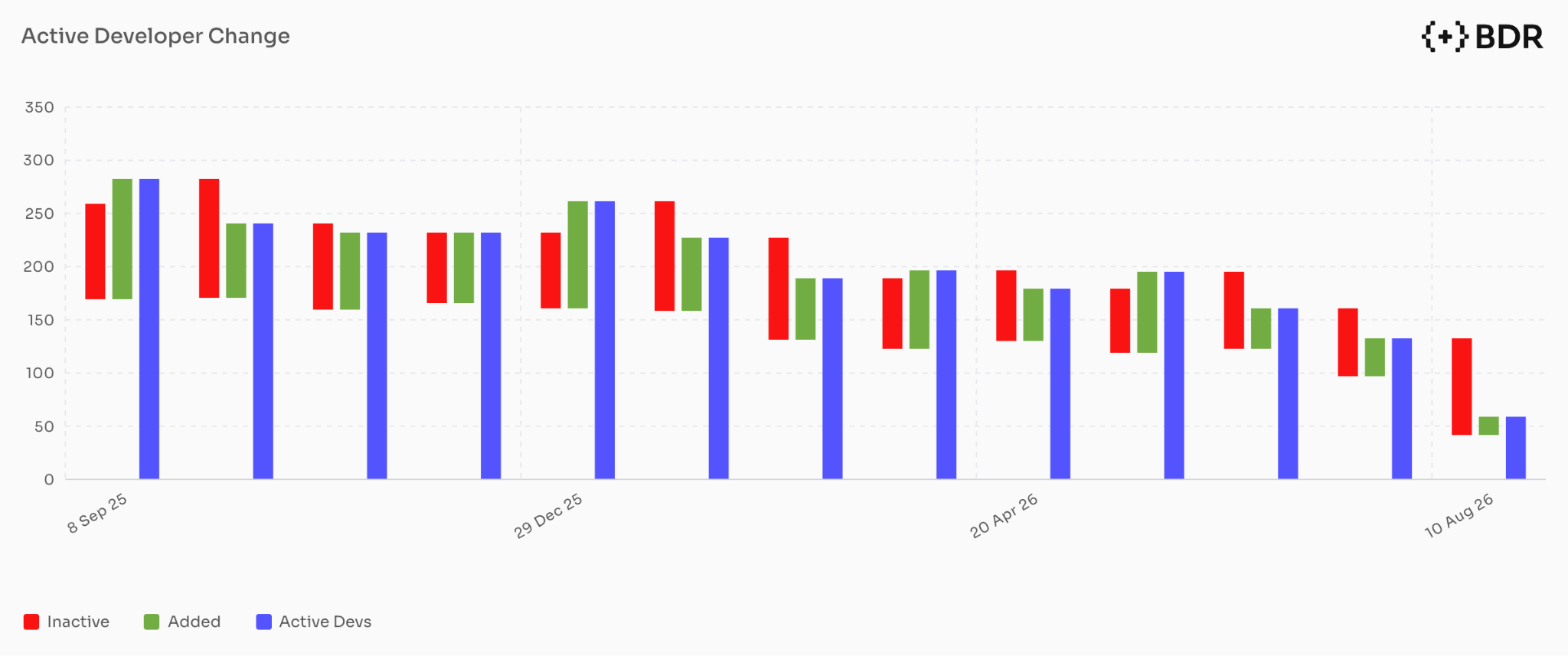
At first, we can also easily mistake Succinct being also very similar to Aztec and Circom, as it has lost many developers in the past weeks. However, the high retention rate of Succinct (70.3%) makes us wonder if we were too quick to jump into this conclusion.
Indeed, the developer segmentation charts may be pointing to a different conclusion:
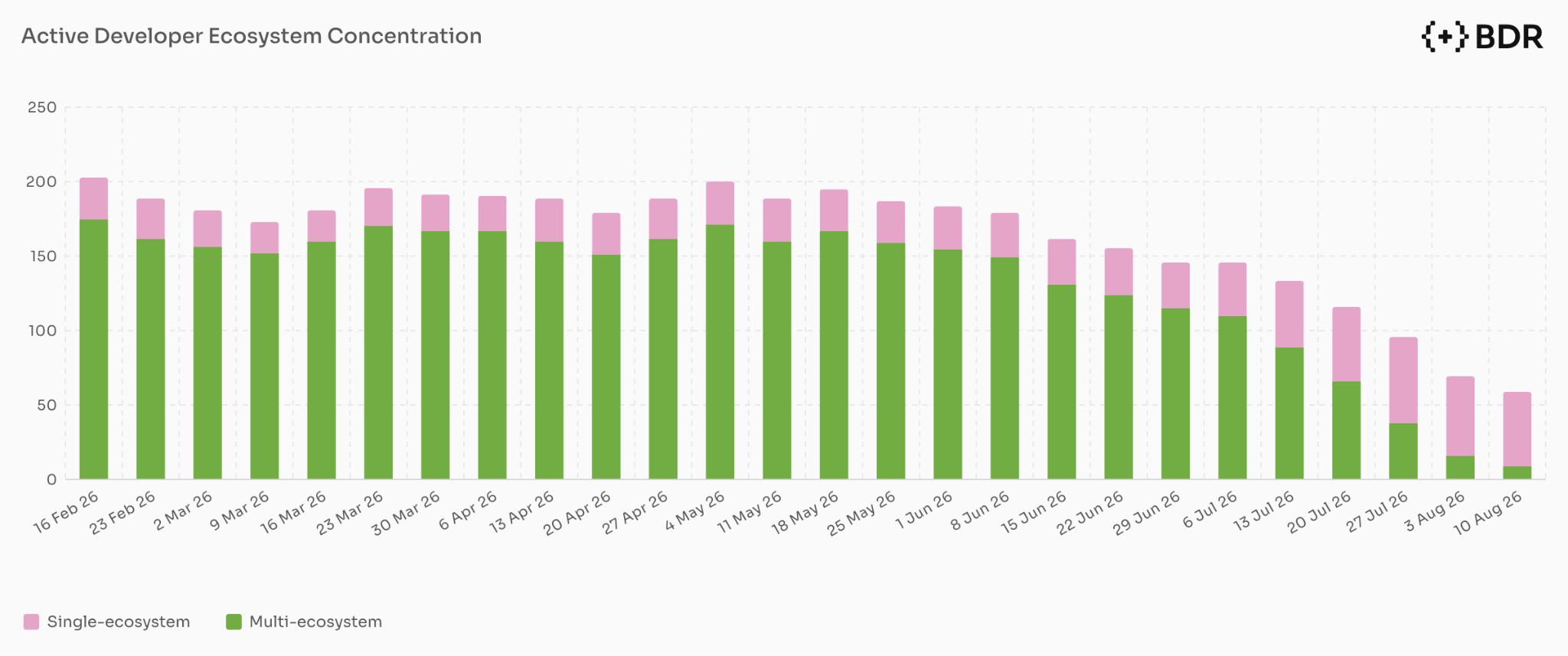
Indeed, until very recently the big majority of Succinct’s ecosystem is made up of multi-ecosystem developers. During the past month, these devs left, while single ecosystem developers of Succinct showed a significant improvement.
This chart may actually be showing us that Succinct is finally getting its own ecosystem, and later Succinct development will be much more stable.
Conclusion
The ZK ecosystem is clearly going through a transition rather than a simple decline. While much of its historical developer activity was concentrated around older technologies such as Starknet and Circom, current activity is becoming more distributed, with newer ecosystems beginning to capture a meaningful share of active developers.
The strongest signal in the data is this shift in where developers are building. Midnight has grown rapidly, Starknet appears to be approaching a more stable developer base, while Aztec, Circom, and Succinct show more volatile recent patterns that will need additional months of data before drawing strong conclusions.
Overall, ZK remains an active but changing part of the blockchain developer ecosystem. The next stage of its growth will likely depend less on the size of its historical developer base and more on which ecosystems can attract developers, retain them, and turn short-term interest into sustained activity.
Thank you for reading this report. You can reach us at hello@node101.io for any questions, or inspect all the metrics yourself in blockchaindeveloper.report.