



In my previous article, I discussed how regulations must be built on the principle of the “Separation of Powers” for local blockchain ecosystems to grow in a healthy and sustainable manner. Whether in the US, UK, EU, Turkiye, or Hong Kong, regulatory bodies need to position local exchanges, applications, infrastructure providers, and users to mutually feed into one another, rather than issuing unilateral, prohibitive mandates.
Therefore, for a healthy blockchain ecosystem, we must first correctly define our internal balances and “boundaries of power.” This means establishing a cluster where the powers of exchanges, custodians, and data providers are strictly separated, infrastructure is supported by domestic servers, and data sovereignty is secured through local blockchain infrastructure providers.
While properly defining this cluster is a valuable step, it alone will not suffice to breed digital asset companies capable of competing globally. A local separation of powers might prevent systemic collapses,like the FTX disaster,but it won’t inherently drive actors to enrich one another. For instance, while Turkiye boasts giants like Paribu and Midas capable of locking horns with global competitors, many local companies operating in niches like custody, infrastructure provisioning, zero-knowledge (ZK) tech, wallets, and neobanking clearly need support to reach international maturity. Global giants in these verticals, backed by foreign capital and commanding worldwide customer bases, operate within the Turkish ecosystem, absorbing the very nutrients local counterparts need to take root, thereby creating near indestructible monopolies.
This brings us to the core theme of today’s article How do we protect local actors against the destructive competition of foreign tech giants? More importantly, how can we transform these global behemoths into a “lever” that feeds our own domestic ecosystem?
The Small of Today, The Giant of Tomorrow
Take today’s giant exchanges as an example. What does it take to compete with platforms like Binance, OKX, Paribu, or Midas and grab a slice of their customer pie? You would need tens of millions of dollars in investment, massive teams, licenses, aggressive marketing campaigns, and countless other resources. It’s akin to trying to challenge Google in search, battle Apple and Samsung in mobile hardware, or take on Anthropic and OpenAI in the LLM landscape,an incredibly steep uphill battle.
On the flip side, the blockchain and cryptocurrency ecosystem is not composed entirely of exchanges and custodians. There are numerous emerging subsectors shaped around the needs of these heavyweights. RPC and data providers feed them blockchain data, validators supply white-label staking solutions, zero-knowledge products deliver privacy fixes, and various wallets build the user interfaces. Because their total trading or operational volumes are exponentially smaller, these sub-sectors often appear trivial compared to the main pillars. For example, while the global custody sector generates a staggering $500 billion in value annually, the RPC and blockchain data provisioning sector, a vital component of those very services, is currently hovering around just $4 billion a year.
To build a custodian today that can rival global incumbents, you must fight tooth and nail for a slice of that $500 billion pie against deeply entrenched solutions. Conversely, if you are a company investing in zero-knowledge technologies, a sector that has only recently hit a $20 billion market size, you can ride the wave as the industry multiplies tenfold over the next five years. By scaling alongside the market, the products you develop can turn you into a global player. This is exactly why we must nurture the “small of today, giant of tomorrow” companies within our ecosystem.
But how do we pull this off? Even in niche sub-sectors, global monopolies still exist. For instance, half of the total volume in validation is controlled by just a handful of massive firms, a pattern mirrored across other verticals. Major custody and exchange platforms in Turkiye currently funnel tens of millions of dollars annually to these foreign-sourced companies to access these critical tools. However, redirecting these capital flows to local alternatives would keep foreign currency within the country while paving the way for a self-sustaining blockchain cluster right here in Turkiye. By growing through domestic investments in their own products and services, today’s small enterprises will naturally become more competitive in international markets, securing a defining stake in the future of their industries as they expand.
Therefore, we must erect time-bound protective barriers for ancillary sectors whose global market sizes currently fluctuate between $50 million and $250 million. These are early-stage financial niches that will ultimately shape tomorrow’s technological architecture: Zero-Knowledge (ZK) cryptography, domestic validator networks, RPC providers, and privacy-centric cybersecurity products. Think of this as a smart, limited import substitution regime. We need to shield the Turkish market from the crushing competition of global monopolies so that our local data providers, validators, and encryption startups have the breathing room to flourish on home soil.
The Turkish Case Study ‘Today’s Global Giants Must Anchor in Turkiye’
Engaging in a direct war of resources and capital against global giants in trillion-dollar markets, like Layer 1/Layer 2 (L1/L2) blockchain networks, global payment rails, or Large Language Models (LLMs), is simply irrational. Imagine trying to impose import substitution on LLM companies that already boast millions of users, active enterprise subscriptions, and the protective backing of the US government and Senate. Proposing this would be short-sighted Turkiye would be starved of both the economic gains and the sheer efficiency these technologies unlock.
With these giants backed by trillions of dollars, how realistic is it for Turkiye to build an LLM from scratch to rival them with just a few billion dollars? While a slim chance exists, it only holds true if those LLMs solve hyper-specific problems current models cannot touch. Instead, Turkiye’s strategy here should be built around attracting international finance and global venture capital (VC) into the country.
However, letting these giants enter the Turkish market and access our local user base should not operate like an open-ended capitulation. The presence and licensing processes of global players in Turkiye must be explicitly tied to adding value to the local ecosystem, specifically through a Turkiye-In Country Value (TICV) model.
When the Big Fish Feeds the Small Fish
The magical instrument that bridges these two layers, the need for global financing and the protection of local niche sectors, is this very TICV model.
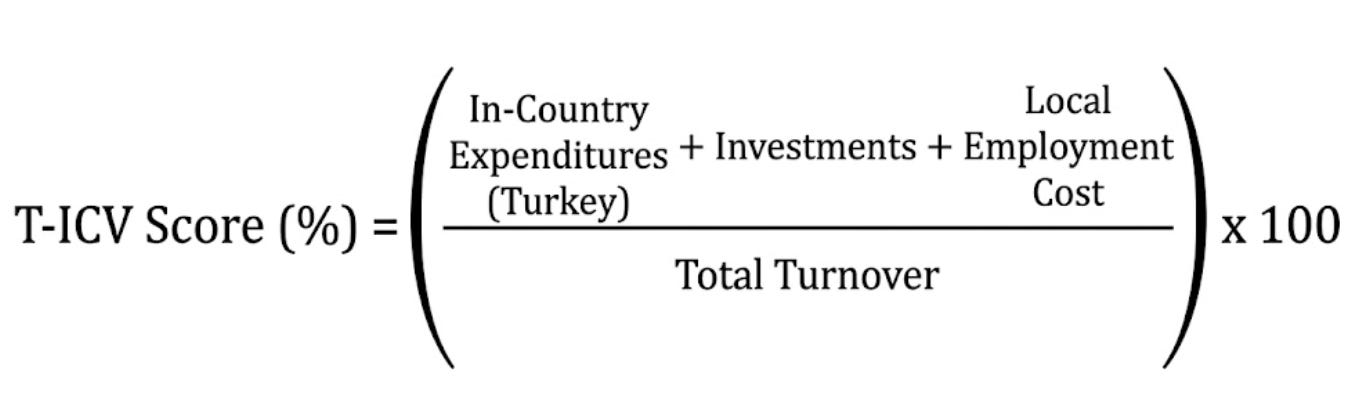
Let me map out the equation, and since this is a draft, I look forward to your feedback. Any global blockchain giant or AI powerhouse wishing to operate and secure a license in the Turkish market must maintain a high TICV score; otherwise, they face exclusion from state tenders. To boost this score, they would be required to open data centers in Turkiye, employ local engineers, and, crucially, procure products and services from our local ZK, RPC, and validator startups, the very niches we shielded under our protective umbrella.
Consequently, global capital transforms into a direct lever that fuels the growth and cash flow of our budding local startups.
Creating Tomorrow’s Global Players Today
Today, niches like ZK, validator networks, or decentralized cybersecurity are constrained within a global $50 million to $250 million band. However, over the next decade, they will evolve into massive, multi-billion-dollar core industries.
Because Turkiye will have implemented the right protective shields and TICV levers ahead of time, it won’t be a passive market playing catch-up when these niches balloon into giants. On the contrary, by regulating and safeguarding local actors today, the country will have rooted its own future billion-dollar global tech giants. Just as the seeds planted by a forced import-substitution regime due to past defense industry embargoes have blossomed into game-changing global enterprises today, it is entirely in our hands to create tomorrow’s champions in blockchain and cutting-edge tech from this moment forward.