The Access That Never Fails
Is it possible to design a system that will access networks constantly, but will never fail?



Blockchains are a part of the novel backbone that will generate the new world: whether you call it x402 or distributed computation, it is clear that the agentic future will require access to distributed networks unlike anything we have seen yet.
When the requester, the responder and the message itself are known, there is only one variable to discuss: failures. It is great to dream of a world where agents and humans are able to communicate, exchange, trade and share over a network of interoperable blockchains, but how will they handle the frictions of real life? Failures are a natural part of any distributed system, and it is impossible to ignore them.
Today, as node101, we do not just discuss the problem; we offer the solution to all our clients in our new Fault Tolerant RPC Gateway model. By combining conventional and blockchain infrastructure technologies under a single architecture, we enable an RPC model that will never silently serve the wrong information.
Let’s first understand the problem more
If you have never deployed a product on blockchain, you would never know: blockchains are hard to use. Even while you are trying to read simple data, like the token balance of an account, there are major problems you may face:
the RPC you are connecting to may lag behind and fail to give you the information,
the RPC may be hacked and serve you the wrong information,
the distributed network itself may fail to produce a consistent answer.
Although these scenarios sound very rare and hypothetical, they are not. In times of high demand, such as market downturns, people access the network with much higher throughput than in normal times. A president on the other side of the ocean makes an announcement, and capital rushes to sell or buy what they think will be affected. At such times, access to networks becomes especially complicated, and a few seconds of latency may mean a huge loss of funds. Over the past years, working with exchanges, custodians and banks, we have heard many such stories from real life.
When you are using a single RPC provider to read all of your blockchain data, this essentially means that your entire access to the blockchain is controlled by a single entity. A few seconds of latency may result in you losing funds, or a single hack of your provider may leave you open to attacks. For instance, just by manipulating your RPC endpoint to serve you an unfinalized TX as settled, a hacker can steal your funds or gain access to a service they did not pay for.
All these problems make us wonder whether it is possible to solve them and offer more secure infrastructure to our clients.
What does the solution look like?
The first, and correct, answer to the problem is using more than one provider. By accessing multiple, independent RPC endpoints for the same request, you basically distribute your risk. This is a strong idea when working with distributed networks.
However, for blockchains, this alone is not enough. Having multiple answers does not guarantee the correctness of the result. In cases where some portion of the network is under attack, you may still get the wrong answer depending on your choice of providers.
Luckily, blockchain has the solution within itself: as a cryptographic protocol, all blockchain data can be verified, at least partially, in a mathematical way. For instance, each downloaded state from Ethereum can be verified with a logarithmic witness to belong to the block header, or in Tendermint-based consensus models, the previous block’s signatures can be used to verify the next block’s authenticity.
Of course, no solution is perfect, but these measures solve the problem in many scenarios.
Let me explain how this works in more detail.
The Product: Fault Tolerant RPC Gateway
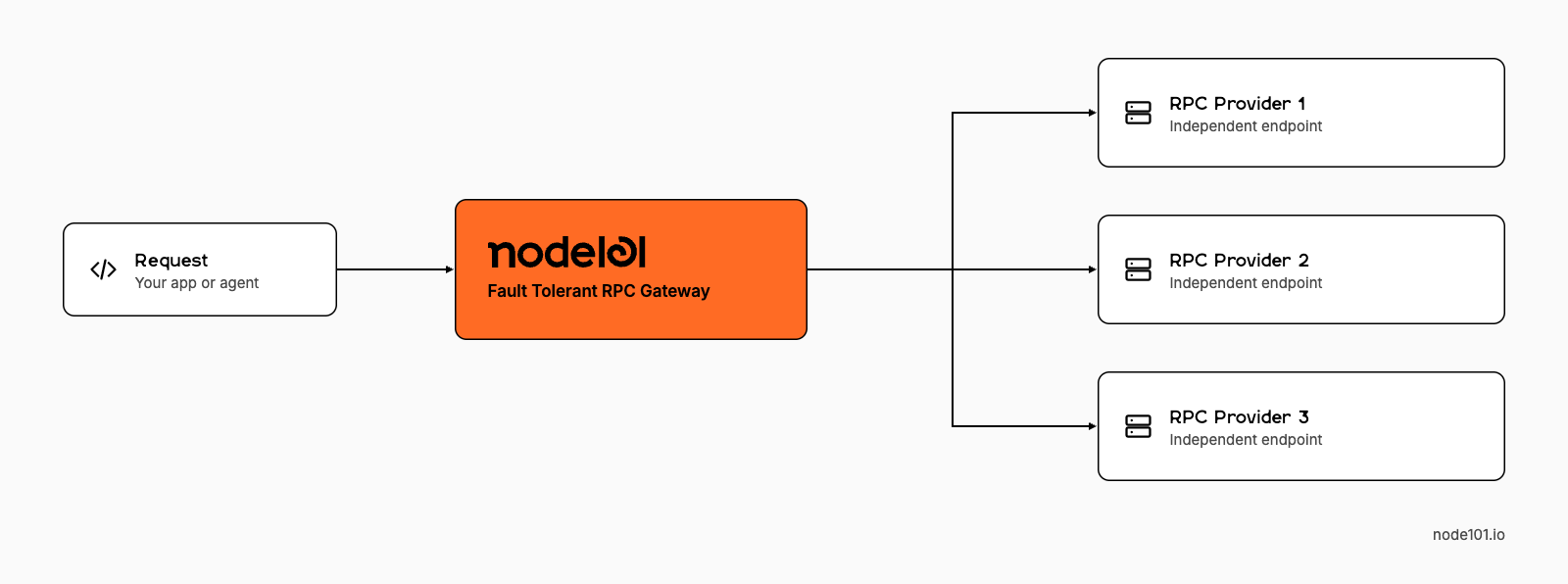
As its name suggests, this gateway aims to achieve fault tolerance by placing a gateway in front of multiple RPC providers. The blockchain-specific part is that it uses not only response status codes but also the responses themselves to cryptographically verify and compare results.
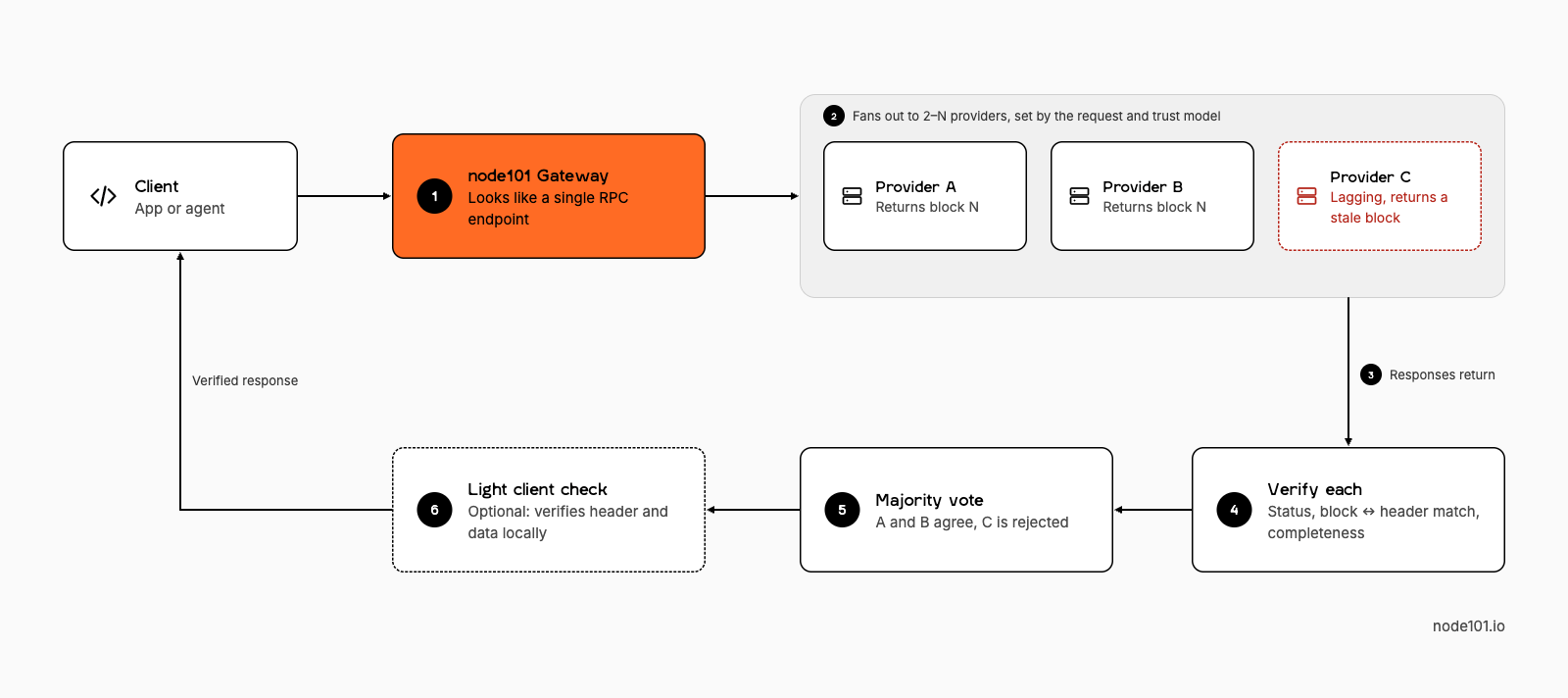
A general request follows these steps:
The request is sent to the Gateway IP, which looks identical to a single RPC for a client.
The request is transferred into all, or a few, of the RPC providers. The number of providers to use in each request depends on the nature of the request and the trust model.
After each provider generates the response, they send it back to the Gateway.
Gateway first verifies each response independently, both their status, but also their cryptographic integrity (does a block match its header?) and logical completeness.
Then, Gateway compares each response to each other, and requires at least a majority of the provider to agree on the result.
In the cases where security is much more important than speed, Gateway adds a final cryptographic verification through a local, light client. Light client is responsible for verifying the block header and any information that is served in the block. With this step, it becomes almost impossible for the Gateway to serve faulty information.
Read all at once, these steps may feel like too much or seem overcomplicated, so let me explain what each one achieves behind the scenes.
The first 3 steps are basically what increase the liveness of the Gateway: if you have only a single provider, your best speed, latency and throughput are what that RPC serves you. If you have 3 providers and you need all 3 of them to be available for each request, then you cannot tolerate the failure of any of them, which is not much better either. But if you have 5 providers, and the system only requires 3 of them to respond, then until you lose more than 2 providers, the access is perfect.
Then, steps 4 and 5 make sure that all providers in the majority are getting the same result, that is, none of them were down or hacked. This majority consensus, especially when implemented with truly independent providers, is quite strong against isolated hacks and incidents.
At this point, most requests would not need the final, 6th step. In practice, it is rare to encounter a case where the 6th step is required. However, when you are transferring a critical amount or accessing sensitive information, you cannot take the risk, and there is an edge case that none of the steps above handle: in a distributed network, the network itself can be under attack or hacked, and many RPC providers can be serving the same lie unknowingly. In these scenarios, the only solution is to use cryptography. By adding this final step, the Gateway makes sure that wrong information is never served.
Of course, the light client cannot generate the information itself, so the 6th step can never correct or choose between multiple answers, but it can stop a response and let the app know if the cryptographic verification fails. This is the true power of the Gateway: unlike conventional load-balancing systems, the proxy can stop a request even when all providers agree on the wrong answer.
The most important point is that not all requests need this. The 6th step is what we call the “secure track” of the Gateway, and it is possible to send your requests through the “fast track”, which does not require cryptographic verification. By choosing your track, you essentially decide between security and speed.
Current State of the Product
After designing each component and identifying gaps, we have combined conventional and blockchain DevOps tools into the first version of our Gateway demo. In a single UI, we enable adding multiple RPC providers, customizing the consensus and verification rules behind them, and configuring a light client for each network. Currently, our demo only supports EVM-based blockchains and Bitcoin.
Right now, we are testing the product with some of our major institutional clients and making sure the product is ready to be publicly launched. By partnering with cloud providers, we also serve the product in an on-prem, local deployment mode, which further reduces the trust required and optimizes performance.
If you also want to get early tester access and see the demo with your own eyes, you can always reach us at hello@node101.io.
Before finishing up this article, I want to repeat that no solution is perfect, and there is much to do on the Gateway. Nevertheless, I believe this is a perfect example of why blockchains are advantageous to institutions as well as to users. By using pure cryptography and game theory, it is possible to minimize the trust placed in the system, essentially verifying every piece of data you get before using it.
And in a world where trust is everything, everything should be verified.
Discussion about this post