


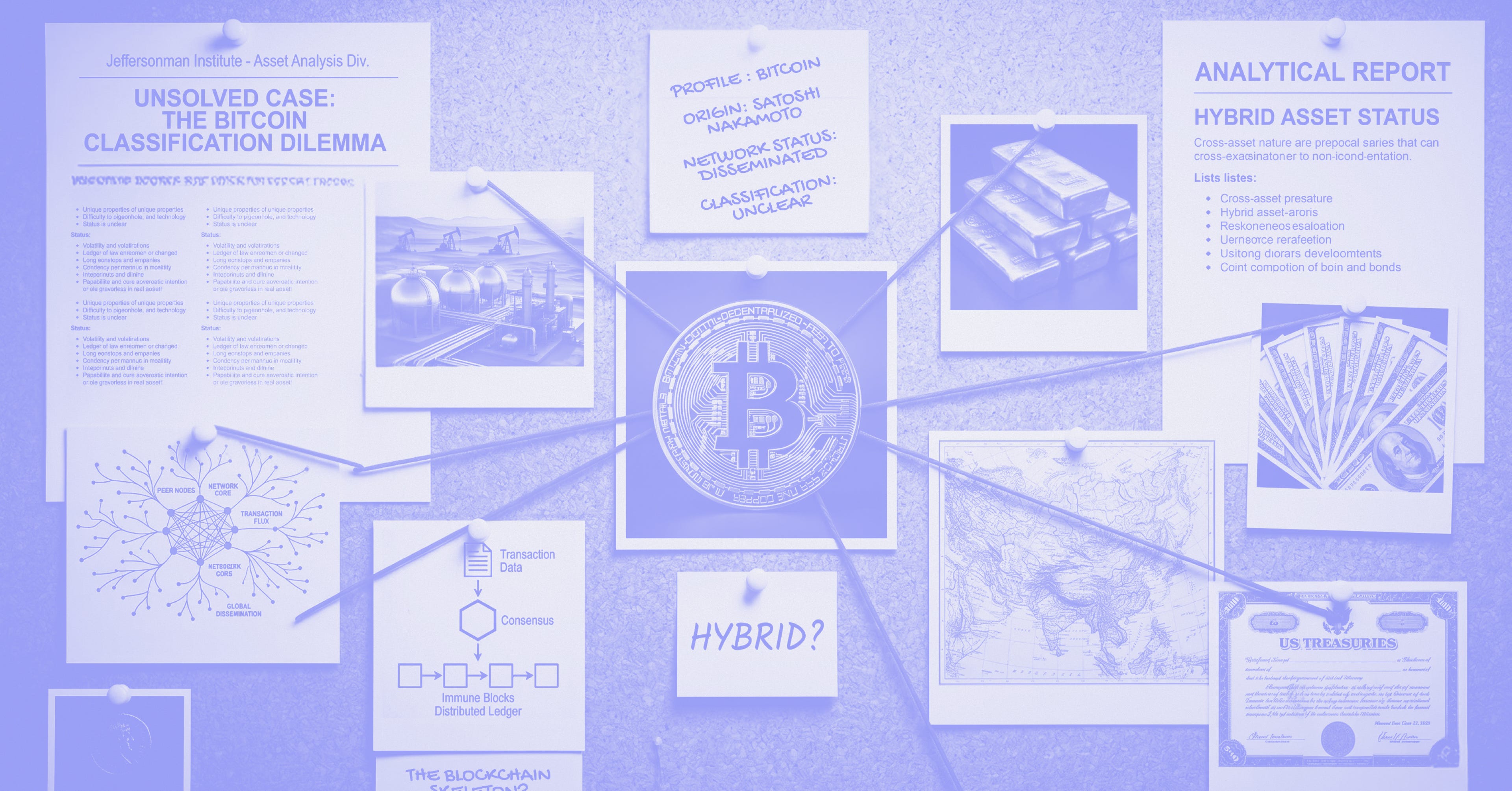
People keep asking me the exact same question about Bitcoin, mostly because our traditional financial labels just do not stick to it. Is it a commodity? Is it money? Is it some emerging type of reserve asset?
In my opinion, the honest answer is that Bitcoin touches all three categories, but with major caveats. No wonder the debate never ends. I believe everyone is staring at the exact same asset but looking through a completely different lens.
The Commodity Illusion
When I look at Bitcoin from a legal and functional standpoint, it closely resembles a commodity. It trades based on pure scarcity. Unlike a stock, there is no CEO, no quarterly earnings, and no cash flow. You are not buying into a business model. Instead, you are buying into a hard-capped supply that anyone can verify on-chain. In my view, it acts a lot more like gold than a corporate bond.
But calling it a commodity has never felt like a perfect fit to me. Traditional commodities like oil, copper, or wheat actually get consumed. They get burned in engines or baked into bread. Bitcoin completely lacks that physical industrial demand.
People hold it purely on the belief that a decentralized, scarce digital asset will only become more valuable over time. So yes, I think it fits the commodity bucket better than most other labels, but it is a truly bizarre one.
The Ultimate Test of Money
The money argument is where things always get complicated. Die-hard holders insist Bitcoin is money, and I admit they have a valid point. You can self-custody it, send it globally without a bank, and even spend it in a few places.
But from my perspective, real money is the yardstick we use to organize our daily lives. We price debt, pay rent, and negotiate salaries in dollars or euros, not satoshis. You might trade Bitcoin, but you still think in your local fiat currency. I always argue that this mental unit of account is the true test of money, a test Bitcoin has not passed yet.
You can actually see this dynamic play out inside the crypto ecosystem itself. When traders want to take on risk, they buy Bitcoin. When things get shaky, they flee to dollar-pegged stablecoins. Ironically, in a market built to escape the fiat system, I see the greenback acting as the ultimate ruler.

The Dollar and the Debt Plumbing
This brings me to the dollar. Its dominance is not just a byproduct of US military or economic might anymore. It is a massive network effect. Global trade is invoiced in dollars, commodities are priced in it, and the financial plumbing is built entirely around it. It is a self-reinforcing loop. Companies use dollars because their suppliers do, and governments hold them because the markets are incredibly deep. Bitcoin is expanding within this world, but I do not see it displacing the dollar anytime soon.
Treasuries highlight this contrast even further. I often see people lump cash and US debt together under the “dollar system,” but they play entirely different roles. Dollars are for spending. Treasuries are what nation-states, central banks, and mega-corporations hold for safety, yield, and scale.
Treasuries are the ultimate collateral. You can trade them in massive block sizes without moving the market, and they actually pay you to hold them. This is a critical feature that I feel Bitcoin advocates often downplay. A true institutional reserve asset needs to be a stable, yield-bearing bedrock. Treasuries fit that bill perfectly. Bitcoin does not.
Digital Gold and the Reserve Debate
However, Treasuries carry counterparty risk because they rely on the US government to pay its debts. For the traditional financial world, that trust is rock solid. But it inherently ties the asset to a state-based system. To me, Bitcoin’s entire appeal is its complete divorce from that system. There is no issuer, no central bank, and no promise to pay.
To traditional investors, that lack of backing makes it terrifyingly abstract. To others, especially in an era of weaponized finance and ballooning sovereign debt, I believe that is precisely the selling point.
This is exactly why the “digital gold” narrative refuses to die. Gold matters because it is scarce and it is nobody else’s liability. When trust in fiat wavers, gold shines. I think Bitcoin taps into that exact same psychological vein.
Obviously, gold has a massive head start. Central banks understand it, it has a millennia-long track record, and it does not drop 10% on a random Tuesday. If you try pitching Bitcoin to a conservative pension fund committee, you will quickly see why gold still reigns supreme in traditional circles. But Bitcoin has modern advantages: it travels at the speed of light, divides infinitely, and does not require armed guards or heavy vaults. The overlap between the two is very real.

What About the Rest of the Market?
You might be wondering why I spent this entire piece focusing solely on Bitcoin when there are thousands of other crypto tokens out there. It is a fair question. The decentralized market is huge and constantly evolving.
However, the way I see it, Bitcoin still holds the absolute lion’s share of the market, easily representing around 70% of the true macroeconomic mindshare and capital in this space. For now, the strongest, most resilient arguments regarding monetary policy and reserve assets strictly belong to Bitcoin.
As the ecosystem matures, I expect we will start seeing similar conversations evolve around other major tokens. But today, if we are talking about disrupting gold or challenging the dollar system, Bitcoin is the only asset truly sitting at that table.
Ultimately, I view Bitcoin as a hybrid. It is a commodity in the eyes of the law, “gold” in the minds of investors, and sits somewhere between a speculative bet and a reserve asset on a global level. It has not overthrown the fiat system yet. But it has forced the old system to respond to something entirely new: a scarce, borderless, digital asset with no issuer and no off-switch.