



The Divine Gap
In Michelangelo’s Creation of Adam, two hands reach toward each other. One extends with certainty, the other responds, almost meeting it. They are close, but they never touch.
It is a small detail, easy to overlook at first glance. Yet the entire scene is defined by that distance.
A similar structure appears in blockchains, although it is less visible.
On one side, there is the protocol. It operates as designed: blocks are produced, transactions are processed, and the system maintains its internal consistency. From the perspective of the network itself, nothing is missing. The state evolves, consensus is reached, and the chain continues forward.
On the other side, there is the user attempting to interact with this system. A transaction is submitted, a state is queried, a response is expected.
Between these two sides lies a layer that is often treated as secondary: the access layer, commonly exposed through RPC endpoints. It does not participate in consensus, nor does it define the rules of the system, but it determines whether those rules can be reached in practice.
When this layer performs well, it remains invisible. Interaction feels immediate, and the system appears cohesive. However, when it fails, the separation becomes apparent. Requests stall, responses do not arrive, and the system, although still functioning internally, becomes inaccessible from the outside.
The Illusion of Decentralization
Blockchains are often described as decentralized systems, and at the level of consensus, this description largely holds. Thousands of nodes participate in validating transactions, maintaining state, and securing the network.
However, interaction with these systems does not happen through direct connections to random nodes. In practice, most users and applications rely on a small set of RPC providers to access the chain.
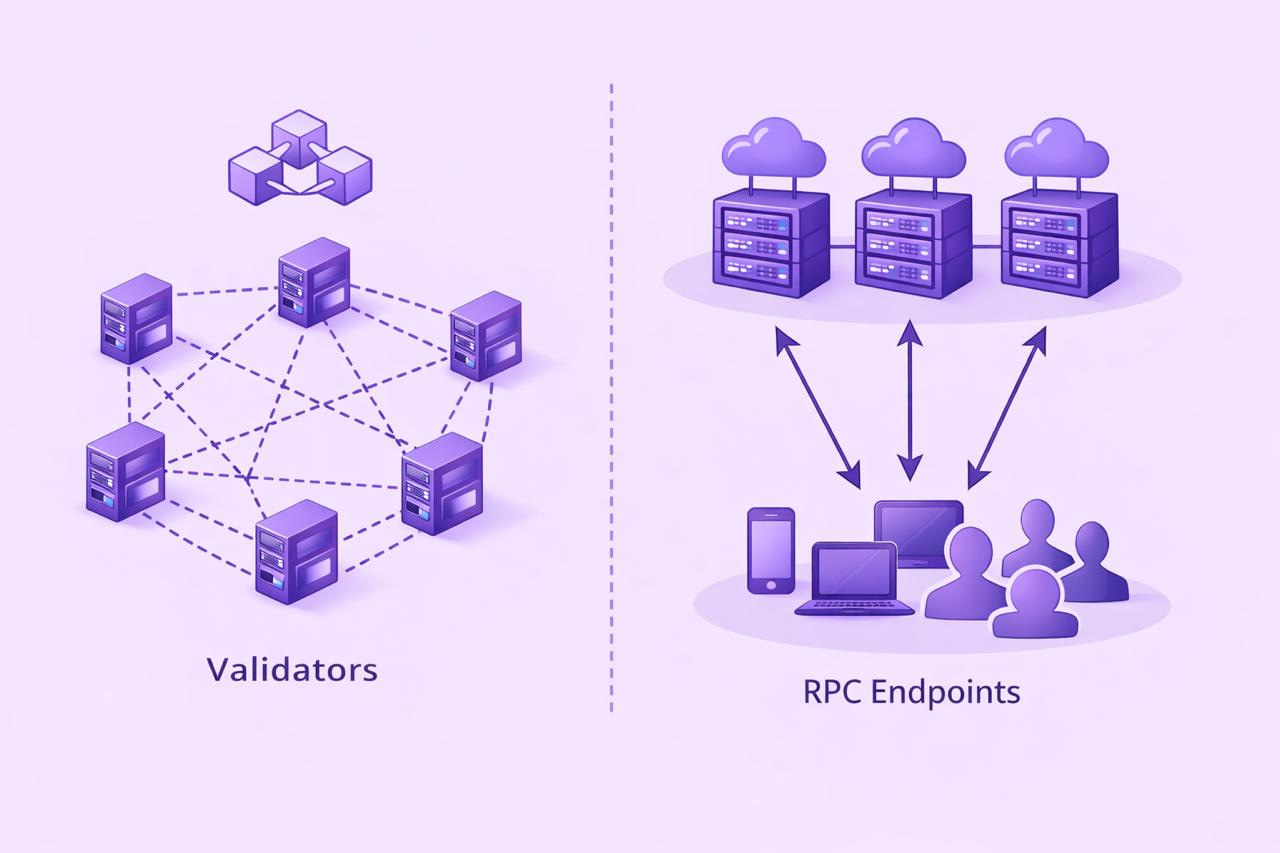
This introduces a different structure, one that is less visible but equally important.
While computation and verification may be distributed, access is frequently concentrated. A large portion of requests flows through a limited number of endpoints, often hosted on similar infrastructure, in similar regions, and sometimes even within the same cloud environments.
From the outside, the system appears decentralized. From the point of access, it behaves differently.
This distinction does not immediately create problems under normal conditions. Systems operate smoothly, requests are served, and the abstraction holds. But it defines how the system behaves under stress. When access is concentrated, failure does not remain local: it propagates.
The Silence of the Chains
When users experience outages, the immediate assumption is that the chain itself has stopped.
In many cases, this is not accurate. The network may still be producing blocks. Validators may still be reaching consensus. State transitions continue to occur. Internally, the system remains active.
What changes is the ability to reach it.
During periods of high demand, RPC providers may begin to rate limit requests. Under infrastructure failures, endpoints may become unavailable. When multiple providers rely on similar underlying systems, these failures can occur simultaneously rather than independently.
The result is a system that is operational but inaccessible. Users retry transactions. Applications fail to load state. Interfaces appear frozen. From the user’s perspective, the chain is down. But in practice, it is not.
When infrastructure is uniform, failures tend to align. Instead of isolating issues, the system experiences them collectively. What appears as a protocol-level outage is often a reflection of shared dependencies at the access layer.
Architectural Darwinism
If access determines whether a system can be used, then its design cannot be treated as an afterthought. The question becomes not only how to maintain consensus or increase throughput, but how to ensure that the system remains reachable under varying conditions.
In environments where participants operate independently, systems do not fail in isolation. They fail according to the structure of their dependencies. When those dependencies overlap, failure becomes correlated.
Reducing this correlation requires diversity.
Provider diversity ensures that infrastructure does not depend on a single class of service. Geographic distribution reduces exposure to regional disruptions. Hardware diversity introduces variation in performance characteristics and failure modes. Network diversity separates routing paths and connectivity assumptions.
These dimensions do not increase performance in isolation. Though a system built on similar components may appear efficient, it shares the same points of weakness. But a system built on diverse components distributes those weaknesses, allowing parts of it to remain functional when others are not. In this sense, resilience is not a property of scale alone, but of structure.
Decentralization, when viewed through this lens, is not defined only by the number of nodes participating in consensus. It is shaped by how independently those nodes, and the systems that expose them, can operate when conditions change.
Closing the Distance
The protocol continues to do what it was designed to do. It produces blocks, processes transactions, and maintains state without interruption. What changes is whether that system can be reached.
The distance between a functioning protocol and a reachable one is small in implementation, but significant in effect. It does not appear in consensus algorithms or execution environments, yet it determines whether the system is usable at all. This distance is not removed by increasing throughput or optimizing performance alone. It is addressed through how the surrounding infrastructure is designed, distributed, and maintained.