



Every market needs some way to tell good products from bad ones. When buyers can check quality themselves, prices do the rest of the work. When they cannot, something counterintuitive happens: the bad products slowly push the good ones out.
In 1970, George Akerlof explained this with used cars. Editors had turned his paper down two or three times before that, some of them because they found the idea too trivial for a serious journal. Thirty-one years later, it was part of the work that won him the Nobel Prize in economics, shared with Michael Spence and Joseph Stiglitz “for their analyses of markets with asymmetric information.”
The same logic fits staking surprisingly well. Delegators cannot see what makes a validator safe, so they choose on price, and the market slowly rewards the operators who cut corners. The way out is certification, audited accounts and real liability, and these work for the same reason validators complain about them: they are expensive.
How a market fills with lemons
Picture a used car market. Some cars are fine, and some are “lemons,” cars with problems you only discover after you buy them. The seller knows which kind he has. The buyer cannot tell.
Because buyers cannot tell, they will only pay a price that reflects the average car. That price is too low for someone selling a good car, so many of them keep their cars or sell them some other way. The cars left on the market are worse on average, buyers lower their offers again, and more good sellers drop out. Taken to its end, the market is left with lemons.
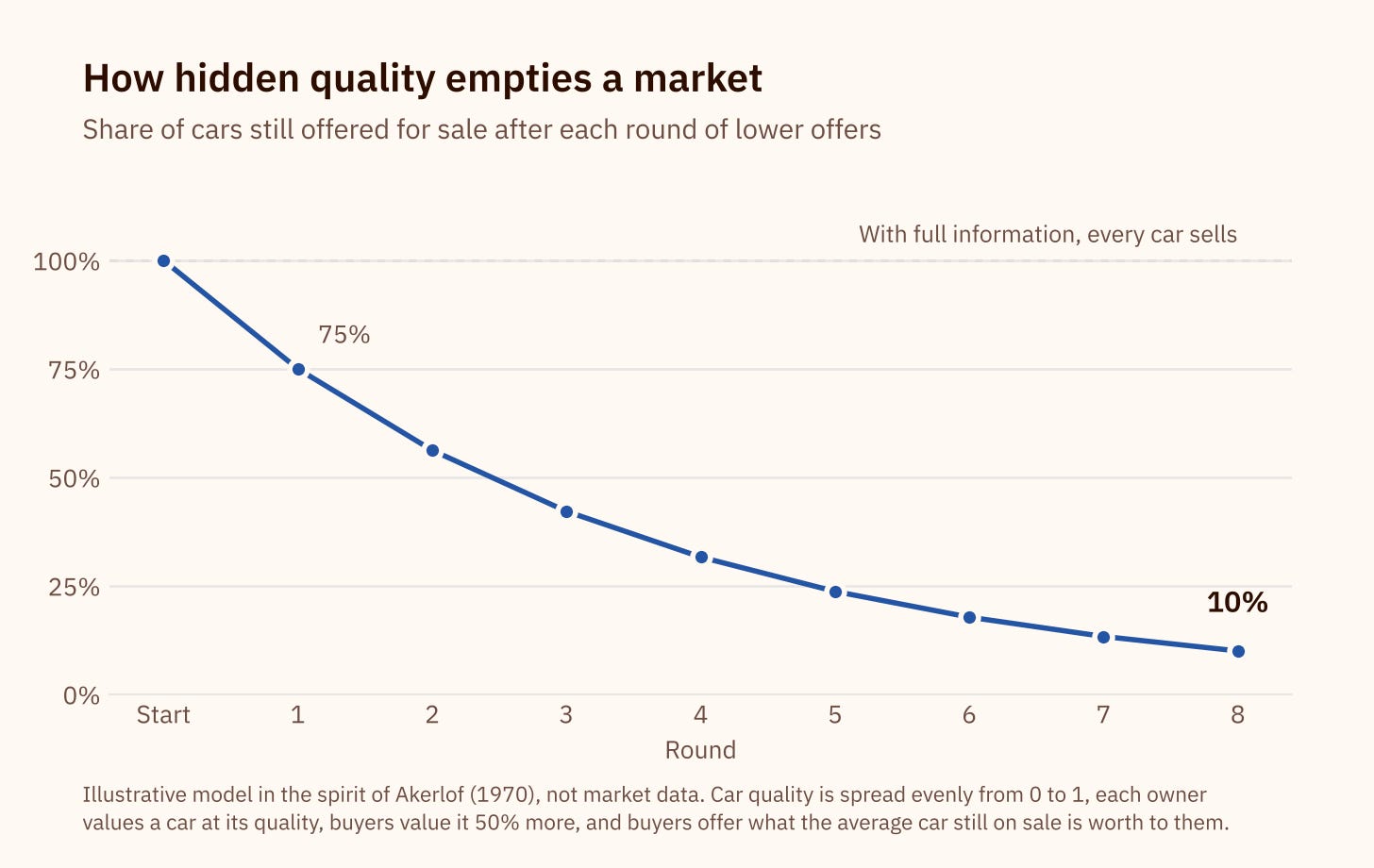
In a simple version of Akerlof’s model, each round of lower offers drives out a quarter of the remaining sellers. After eight rounds, only one car in ten is still for sale.
What is worth noticing is that nobody has to lie for this to happen; the seller of a lemon only has to stay quiet. In economics, this is called adverse selection. When buyers cannot see quality, they cannot pay for it, and a market that cannot pay for quality ends up with less of it.
Staking has the same problem
Now let’s look at how people choose a validator. What can a delegator actually see? The commission, the advertised APR, maybe an uptime number on an explorer, and a website with a nice dark theme.
What they cannot see is what decides whether the validator will fail. How are the keys stored? Who can log into the servers? Has anyone ever tested the incident response plan? Is the whole setup in one data center, with one cloud provider? Would the company survive a bad year in the market? None of this shows up until something breaks. On-chain data helps, but it records outcomes, not the controls behind them, so a validator with badly protected keys has the same clean record as a careful one until the incident happens.
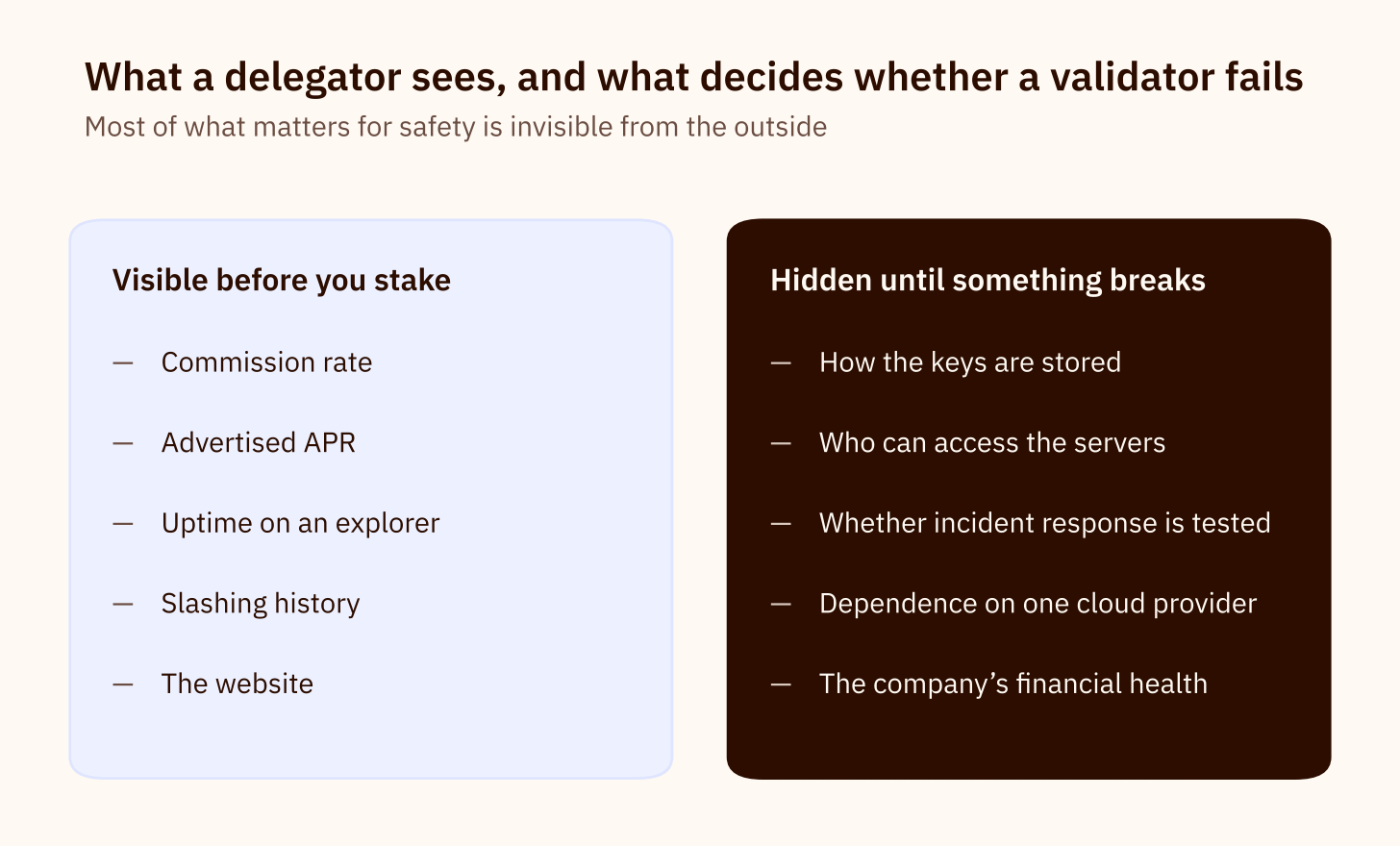
Everything on the left is easy to compare. Everything on the right decides whether the validator fails.
So delegators do what Akerlof’s buyers do and decide on what they can see. Commission is usually the first number people compare. An operator that spends on security can only show that spending in one place, a higher commission, while an operator that skips it can charge less. Over time the careful operator either lowers its standards or loses stake.
Staking adds a second problem. When a validator is slashed (penalized by the protocol, which burns part of the stake behind it) or goes offline, most of the loss falls on the people who delegated to it, not on the operator. Economists call this moral hazard: when someone else pays for your mistakes, you have less reason to avoid them.
Retail delegators accept this as part of staking. Institutions usually cannot. A bank will not stake client assets with an operator whose quality it has no way to check, so in a market full of lemons its sensible move is often to stay out altogether. This is probably one of the reasons institutional staking has moved more slowly than the technology alone would allow.
Signals have to be expensive
Spence, who shared the prize with Akerlof, worked on the other side of the problem: how the better-informed side can credibly tell the other side what it knows. His answer was signaling. The informed side takes a costly action that the other side can observe. In his best-known example, a degree works as a signal in the job market partly because it is costly to get, and costlier for people who would struggle with the work.
The cost is what makes a signal believable. Anyone can write “enterprise-grade security” on a website, which is exactly why nobody reads it as information.
Validators have a few signals that pass this test. An independent security certification such as ISO/IEC 27001 is one. An outside auditor checks how the company controls access, handles changes, monitors its systems and responds to incidents, and comes back every year to check again. Passing takes months of work and real money, and it is much harder for an operator whose day-to-day practice is sloppy. That difference in cost between a careful and a careless operator is what lets the certificate carry information. A certificate is no guarantee, since certified companies still get hacked, but a signal does not have to be perfect; it only has to cost a careless operator more than a careful one.
Audited financial statements are another. They tell a client that there is a real business behind the validator, one that will still be there next year.
The strongest signal is liability. An operator can commit to compensating delegators for slashing it causes, or to paying service credits when it misses an uptime target. A promise like this is cheap only for an operator that rarely fails; a careless operator making the same promise would eventually go bankrupt keeping it. That is Spence’s logic in its purest form.
Regulation belongs on the list too. A licence is a signal issued by someone with the power to take it away.
Reputation works as a signal too, but it takes years to build and mostly rewards size. Each of these can fail on its own. Together, they give a delegator something to price besides the commission.
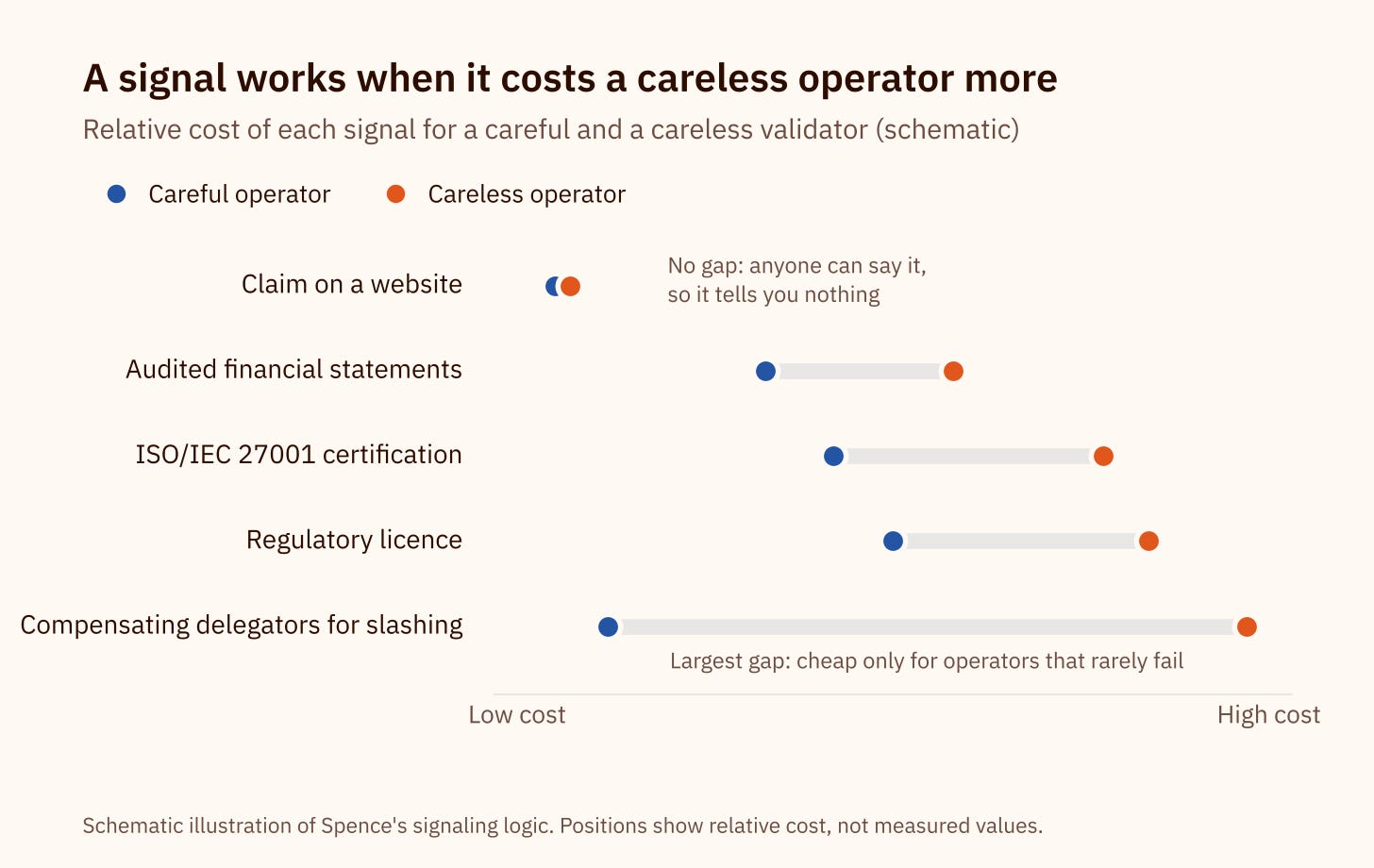
The wider the gap between the two dots, the more a signal tells you. A claim on a website costs everyone the same, so it tells you nothing.
The same problem in Turkish funds
The same mechanism is playing out in Türkiye right now, in a market that has nothing to do with crypto. In our September Regulation Journal, we wrote about the 131 funds of seven portfolio management companies that were placed into liquidation after the decisions of 17 September, with 455,758 investors between them. The decisions followed a series of scandals.
Fund investors face a version of the used car buyer’s problem. Most of them cannot see how a fund values its assets, what related-party exposure it carries, or how much of its portfolio could be sold in a hurry. When a scandal hits a market like that, the damage does not stay with the funds involved. Investors start asking the same questions about every fund, including the well-run ones.
The Journal argued that blockchain-based audit trails could help rebuild confidence, and also warned that a record on a blockchain is only as reliable as the data entering it. Transparency helps, but investors also need someone credible and accountable behind the numbers. That, again, is a signal.
What the costs buy
Blockchain companies tend to talk about certification and regulation as costs they put up with. Akerlof’s paper suggests another way to see them. In a market where quality is invisible, these costs are what make it visible, and only visible quality can be paid for.
Without them, staking drifts toward whoever charges least. With them, a bank can tell two validators apart and decide that one of them is worth more. Last month we wrote that regulation is not something to escape, but something to catch. This is the economic reason behind that line.
In a market where nobody can see quality, the cheapest validator wins whether or not it deserves to.
On Thursday we’re opening node101’s Trust Center, where we’ll be publishing our own signals. See you there.
Sources
• George A. Akerlof, “The Market for ‘Lemons’: Quality Uncertainty and the Market Mechanism”, Quarterly Journal of Economics, 1970.
• Michael Spence, “Job Market Signaling”, Quarterly Journal of Economics, 1973.
• NobelPrize.org, “The Prize in Economic Sciences 2001”, press release, October 10, 2001.
• NobelPrize.org, George A. Akerlof, Biographical.
• node101, “Blockchain Regulation Journal September 2026”, September 29, 2026.