


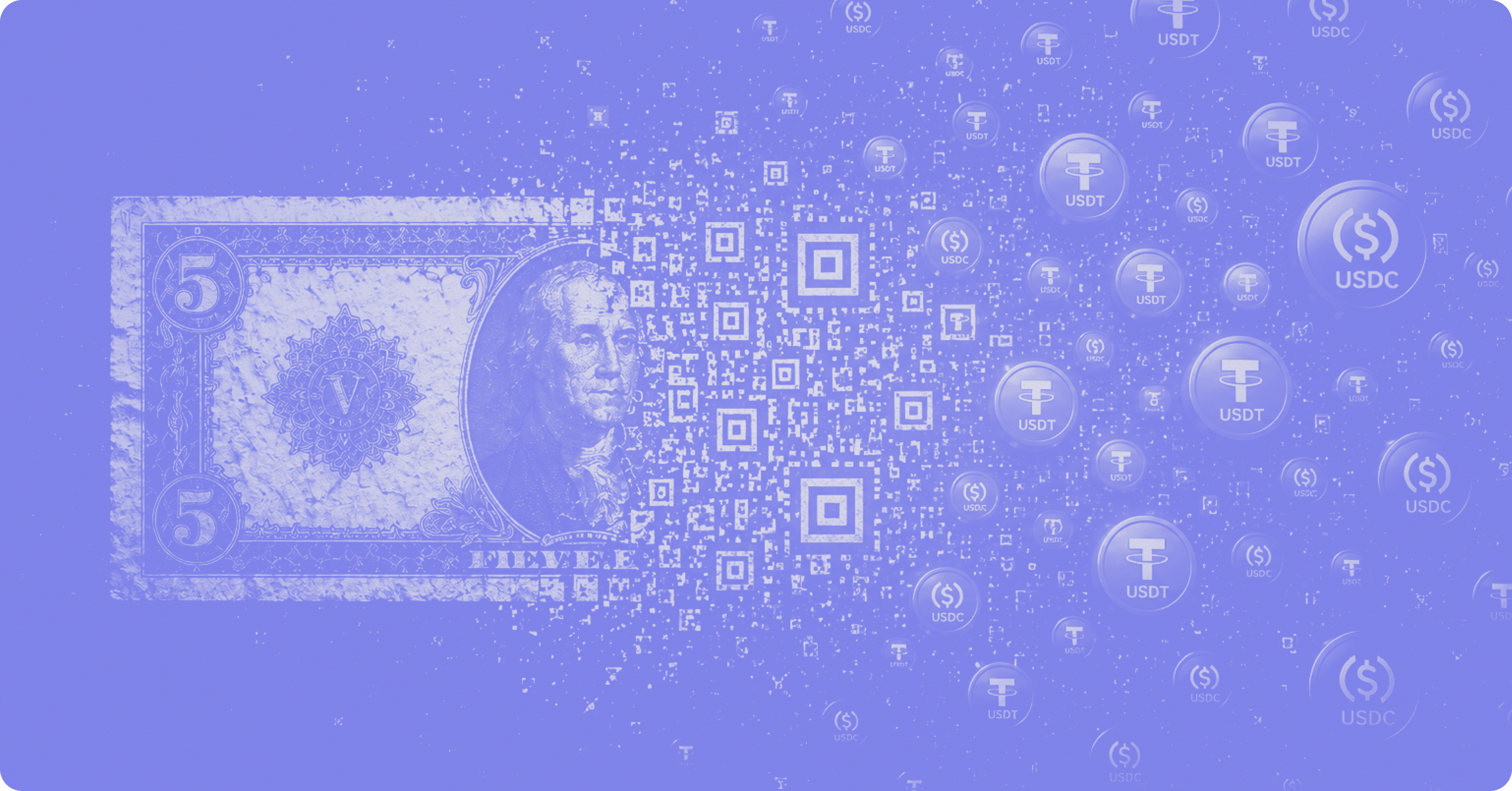
Money runs on a kind of shared belief. A banknote is paper that a whole country has agreed to treat as valuable, and that agreement holds only as long as people expect it to keep holding. Most of the time this is invisible. You get paid and you spend without thinking about why the paper works. But in some places that belief has started to thin, and people have quietly moved the part of their money they actually trust somewhere else. What follows is about what happens when a currency keeps its legal status and loses its real job, and about the technology that made walking away from it almost effortless.
Money runs on trust
Almost all sovereign nations and territories issue their own currency: the Turkish Lira in Türkiye, the Peso in Argentina (each the local currency of its country). Although the banknote itself holds no intrinsic value, it is accepted within a territory because it can obtain goods or services, and it can do so because it is issued by the legitimate institutions of a state that people trust.
In financial markets, trust often matters as much as fundamentals. In addition to data, people react to their confidence in the institutions interpreting and acting on that data. But what happens if people start to lose that trust? Maybe they begin converting the national currency into another one in their heads, all the time. Maybe the rent on your home gets negotiated in a foreign currency. Maybe your salary is no longer even in the same currency your father was paid in 20 years ago.
In economics, this phenomenon is called “dollarization.” Dollarization happens when residents of a country use a foreign currency (mostly the US dollar) instead of, or alongside, the domestic currency for saving, pricing, transactions, or even as legal tender. Dollarization is, at its core, a response to mistrust. The legal currency and the trusted currency aren’t always the same, and the gap between them is where monetary power actually sits.
The old friction, and the new rails
The history of dollarization has two sides: before crypto and after.
The old version did its job really well, mostly by being a headache to anyone who wanted to switch currencies. You had to pay more than the market rate, maybe walk into an exchange office, face capital controls, or give up on earning interest unless you held a foreign account.
Then stablecoins came. A stablecoin is a crypto token designed to hold a fixed value, almost always pegged one to one to the US dollar, so one unit is meant to be worth a dollar at any time.
None of the frictions above exist with a stablecoin. You don’t have to state a reason for your transfer, and no one can delay it without explanation. You can save in a more trusted unit, and you can shield your savings from the local currency’s collapse. Stablecoins basically collapsed all that friction into a phone.
Case study: Türkiye
It was obvious that this new system would accelerate dollarization, and that is exactly what happened. We have a case study here: Türkiye.
Türkiye experienced one of the worst inflation rates in its history after the pandemic. But what hurt the Turkish economy more than the inflation itself was the gap in the data between the official numbers and third-party numbers.
Over the five years following the pandemic, official statistics suggest that consumer prices increased by roughly sevenfold, while the estimates of ENAG (an independent Turkish inflation research group whose figures run well above the official ones) point to an increase of approximately twenty-eightfold. The implied price level under the ENAG methodology is therefore about four times higher than that implied by the official figures.
The result: between April 2023 and March 2024, stablecoin purchases in Turkey were equivalent to 4.3% of GDP, with total purchases of $38 billion against a GDP around $907 billion. That is the highest share of stablecoin purchases relative to GDP of any economy in the world. For comparison, the second and third places go to Thailand at 1.3% and Georgia at 0.7%.
So in short, since 2018 the Lira has lost over 80% of its value against the dollar, and inflation was near 65% as of 2024. The behavioral response predates crypto: Turkish residents hold over $100 billion in foreign currency deposits, having long shifted savings into gold and hard currency.
As we said earlier, stablecoins are just the newest, lowest-friction version of an exit people were already taking.
Living in two currencies
Regardless of the data above, people didn’t abandon the Lira in their daily lives. Instead, they split their money into two: local currency for what the law forces (salary, taxes, rent on paper, daily spending), and digital dollars for what they actually trust (savings, anything cross-border). The currency survives legally while dying as a store of value. This is the move that turns “Turkey bought stablecoins” into “here’s what dollarization 2.0 actually looks like.”
A state can issue the money and force people to pay their taxes in Lira, but it cannot force them to believe in it. Monetary sovereignty is more than the legal right to issue a currency: it is also the effective capacity to govern economic behavior through that currency, which requires that the public actually wants to hold it.
How it drains an economy
But how does this hurt the national economy?
To understand this, we have to understand how deposits work. When you put money in a bank account, the bank holds only a fraction of it as reserves and lends against the rest, which is how credit gets created in the economy. As savings leave for stablecoins, the bank has fewer deposits to lend against, and credit tightens. On top of that, when your savings sit in the domestic banking system, they tend to circulate back into the local economy: banks park part of them in government bonds, reserves stay with the central bank, and the interest you earn is taxed at home.
But if you hold stablecoins, Tether or Circle (the private firms that issue the biggest dollar stablecoins) holds the reserves and keeps the Treasury interest. You end up financing US bonds and a private issuer instead of your own country’s banks.
Case study: Argentina
This is where our second case study comes in: Argentina. The Peso lost roughly 95% of its value against the dollar over the five years through 2025. Until April 2025, individuals were allowed to buy only up to USD 200 per month through official banking channels, and even that access was limited in practice by a complex web of restrictions.
So a parallel market formed: the “blue dollar,” historically a cash street trade requiring physical pesos and personal trust. The crypto era’s contribution: Argentina’s P2P (peer-to-peer) USDT market effectively replaced the informal blue-dollar exchange that previously required physical cash and personal trust networks.
Why better numbers won’t bring people back
So where does this leave a country whose people have quietly moved their savings onto someone else’s rails? The temptation is to expect a reversal. Argentina lifted the cepo (its web of currency controls) in April 2025; for the first time in six years people could buy dollars freely, and monthly inflation fell from triple digits a year to low single digits. Turkey’s inflation, too, came off its worst. If dollarization were only a response to bad numbers, better numbers should pull people back.
They probably won’t. Trust is slower to rebuild than a currency is to stabilize. A decade of watching savings evaporate teaches a lesson that one good year does not unteach, and the lesson has already hardened into infrastructure: dollar bank accounts, dollar wallets, dollar QR payments. When a state’s answer to dollarization is to build rails for the dollar, it ratifies it.
The new dollarization
This is the new dollarization. There is no collapse, no formal surrender, and no central bank disappears. People earn in the local currency, calculate in dollars, and save in stablecoins, treating the national money as something to pass through rather than hold. The banknote keeps its legal status and loses its real job. A currency does not have to die to lose. It only has to become the money people are paid in, and not the money they believe in.
It does not have to stay this way
None of this is permanent, even if it looks that way from inside it. Dollarization has receded before. Peru spent the 2000s and 2010s quietly winning its savers back into the sol, and Israel did something similar a decade earlier. Both took the same unglamorous route: many years of low inflation and a slow, deliberate effort to build deep local-currency savings and bond markets, run by a central bank that stopped surprising people.
What is worth noticing is what did not work. The governments that tried to force the dollar out by decree, by converting dollar deposits or banning foreign-currency accounts, mostly made things worse. Bolivia and Mexico both tried versions of this in the 1980s and pushed money offshore and out of the formal banking system instead. You cannot legislate belief back into a currency any more than you can legislate it out. What brought people back, where anything did, was time spent being credible.
So the path home exists, but it runs through years rather than headlines, and it asks a government for the thing that is hardest to fake: a long stretch of being boring and trustworthy at the same time. For now the dollar rails are laid, and a generation has learned to earn in one money and save in another. Whether the next one unlearns it depends on whether the local currency can spend long enough being unremarkable.