



You are not a suspect, and nobody is watching a screen. A camera on your route home photographs your car anyway, and the image becomes a searchable record: plate, make, color, time, place. On its own, that record says almost nothing about you, and it won’t stay on its own for long.
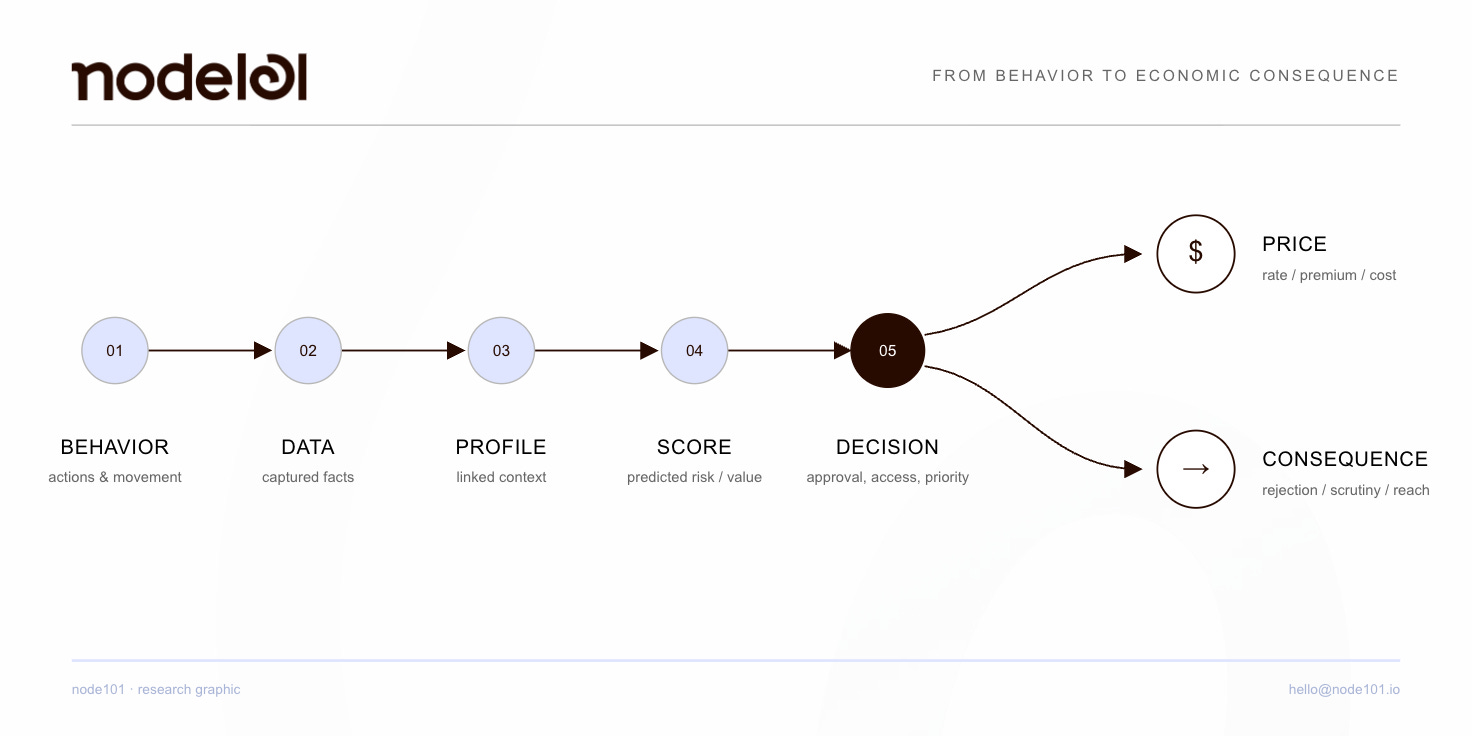
The structure is simple, which is exactly what makes it consequential. Each layer takes a piece of ordinary behavior and turns it into something an institution can act on.
Strictly speaking, a score is only an input. The output is the interest rate, the insurance premium, the rejected application, the investigative priority. “They know your price” means that these systems can translate fragments of your behavior into consequences you never see being calculated.
So here is the argument I want to make. One industry has already built the infrastructure that turns ordinary life into machine-readable records. Another turns those records into scores, and institutions increasingly let the scores set the terms of participation: what you pay, what you can rent, how closely you get examined. The cases below each carry one step of that claim, and together they point at a single question: who holds the right to score whom.
The machine that turns movement into data
The capture layer comes first, and it already runs at scale. Flock Safety sells automated license plate readers that operate, by the company’s own count, in more than 6,000 US communities. The cameras record vehicles passing through an area, and participating agencies can grant one another access or run searches across the wider network, depending on how sharing is configured.
The public-safety argument deserves a fair hearing, since plate readers do recover stolen cars, locate missing people, and help police find suspects, and a powerful tool can still be a legitimate one.
The search logs, however, told a fuller story once officials and journalists started reading them. An Illinois audit in 2025 found that Customs and Border Protection had accessed data originating in the state, which sat uneasily with a law restricting such use in immigration and abortion-related investigations. In Texas, a sheriff’s office searched cameras for a woman whose family said she had undergone a self-administered abortion. The logged reason referenced the abortion itself; the sheriff later described the search as a welfare check.
Flock paused its pilot programs with federal agencies and added new restrictions. Even so, several cities cancelled their contracts.
The cameras themselves never changed. Infrastructure justified by stolen cars had quietly become capable of answering questions about immigration status and reproductive health, because the record stayed neutral while the queries carried the intent. That settles the first step of my claim: capture at scale exists, and its purpose travels with whoever writes the query. The harder question is who converts records into decisions.
Two layers, not one machine
Companies like Flock make the physical world legible by converting events into data points. Companies like Palantir make those data points actionable, connecting scattered records into decision-ready profiles. Banks, insurers, employers, and government agencies then turn the profiles into decisions about actual people.
Palantir has supplied software to US immigration enforcement for more than a decade. In April 2025, ICE awarded the company roughly $30 million to develop ImmigrationOS, including tools for enforcement prioritization and self-deportation tracking. By September, another $30 million order sat inside a broader contract vehicle worth up to $157.5 million, one that explicitly referred to “identification and targeting for enforcement.”
One industry watches, another interprets, and the institutions downstream make the consequences real. Keep that division of labor in mind, because it later decides whom a person could even complain to when a score goes wrong.
Why scoring exists
Before going further I should concede the strongest objection to my argument: scoring exists for defensible reasons. Since lending to strangers requires estimating risk, standardized credit models made those estimates more consistent while letting lenders evaluate people who arrive without personal connections or collateral. Insurance cannot function without pricing the probability of loss. Fraud systems have to tell an ordinary payment apart from a stolen card.
My objection begins where a score travels beyond its original purpose, resists inspection, and produces consequences nobody can meaningfully challenge. The next two cases show exactly that migration.
When the score leaves home
In 2024, reporting revealed that General Motors had been sharing data collected through its OnStar Smart Driver feature with consumer reporting agencies used by insurers. The data covered speeding, hard braking, nighttime driving, and precise location, in some cases collected every few seconds.
The Federal Trade Commission alleged that GM’s enrollment process was misleading and that many drivers never gave informed consent. Some of those drivers said the resulting reports affected their insurance rates. GM discontinued Smart Driver, and in January 2026 the FTC finalized an order barring the company from sharing certain location and driving-behavior data with consumer reporting agencies for five years.
A feature presented as driver coaching had become an input for underwriting, and no grand plan was required to get there. Once a useful dataset existed, another industry found a price for it. For my argument the details matter less than the direction of travel: the score left home, and nobody who generated the data watched it go.
From score to price
A 2023 decision by Türkiye’s data protection authority shows the next step with unusual clarity. A car rental company’s website described a decision-support algorithm for first-time customers, one that weighed the applicant’s Findeks credit score, recent credit applications, payment performance, debt ratio, and even the socioeconomic profile of the neighborhood where they lived.
The company denied conducting the disputed Findeks inquiry. The authority found otherwise: access to the customer’s Findeks report had been made a condition of receiving the rental service, and it imposed an administrative fine.
The shift here is easy to miss. Information developed to assess borrowing risk had crossed into an unrelated market; the question thus stopped being whether someone would repay a loan and became whether they could rent a car at all.
This, concretely, is how scoring becomes pricing and what my title means. One system estimates risk, and another uses the estimate to alter the terms of participation. Even incentives follow the same logic, because a discount for accepting monitoring doubles as a surcharge for refusing it. As a result, privacy starts to resemble a luxury good.
The speculative next step: liquid people
Nothing described so far requires a blockchain. Its role comes later, and because this is the most speculative part of my argument, let me be explicit about which parts are documented and which are projection.
The documented layer is data capture and scoring. The experimental layer already exists in miniature: in 2020, entrepreneur Alex Masmej raised about $20,000 by selling $ALEX tokens, promising holders 15 percent of his income for three years along with access and voting privileges connected to his career.
The projected layer goes further. Blockchains can make credentials portable, and tokenization can create tradable claims on the income, access, or reputation attached to them.
Portability by itself could do real good. It could help a refugee prove qualifications after losing access to the institution that issued them, or let a freelancer carry a work history between platforms. A portable credential and a liquid market are different things, though. Portability lowers the cost of reusing information, while tokenization goes a step further and lets claims built on that information be divided and traded.
Design this badly and a person’s worst year stays legible indefinitely. Tie a market to reputation and a temporary controversy shows up as a visible selloff; falling confidence damages opportunities, and the lost opportunities then look like confirmation of the market’s judgment. At that point the price stops measuring reputation and starts producing it.
Rights on paper, review in practice
Contesting these systems is possible, at least on paper. The GDPR restricts certain solely automated decisions with significant effects. In its SCHUFA judgment, the EU’s highest court held that a credit score can fall within those rules when the recipient relies on it decisively, and its later Dun & Bradstreet judgment required an explanation meaningful enough for a person to understand and challenge the decision, making clear that trade secrecy offers no blanket excuse for refusing access. Türkiye’s KVKK gives people a comparable right to object when exclusively automated analysis produces an adverse result.
The harder problem, however, is practical. To exercise any of these rights, a person has to know that a score was used, identify who is responsible for it, and obtain review before the consequence becomes irreversible. Each of those steps can fail when data providers, model operators, and decision-makers are separate organizations. A right exercised after the apartment, the job, or the loan is gone therefore arrives too late to prevent anything.
Who gets to score whom?
Still, none of this makes the outcome inevitable, and I want to be precise about what I am defending. Purpose limits, inspectable scores, correction rights, selective disclosure, and review before consequential decisions could preserve the benefits of scoring without creating a permanent market in human worth.
Rather than separating data from no data, or blockchain from no blockchain, the dividing line separates systems that help people prove something about themselves from systems that let others turn those proofs into control over their future. The deepest inequality of the coming decades, I suspect, will hinge less on who owns the data than on who holds the right to score everyone else.
Sources
Flock Safety, “Customers Own and Control Their Flock Data”, and Frequently Asked Questions.
Associated Press, “License plate camera company halts cooperation with federal agencies among investigation concerns”, August 25, 2025.
Forbes, Flock Safety company profile, updated March 3, 2026.
Wired, “ICE Is Paying Palantir $30 Million to Build ‘ImmigrationOS’ Surveillance Platform”, April 2025.
Forbes, “ICE Awards Palantir Another $30 Million for ‘Voluntary Return’ Program”, September 30, 2025.
Federal Trade Commission, “FTC Finalizes Order Settling Allegations that GM and OnStar Collected and Sold Geolocation Data Without Consumers’ Informed Consent”, January 2026.
Türkiye Personal Data Protection Authority, Board Decision No. 2023/1234, July 20, 2023.
Roll, “Hi, my name is $ALEX”, 2020.
Court of Justice of the European Union, SCHUFA judgment, Case C-634/21, December 7, 2023.
Court of Justice of the European Union, Dun & Bradstreet Austria, Case C-203/22, February 27, 2025.