The Limits of a Single Standard
How we built one institutional standard for staking and RPC infrastructure across more than 101 blockchains at node101.



At node101, we run validator and RPC infrastructure across more than 101 blockchain networks for banks, exchanges, and custodians, spread across multiple providers in Turkiye, Europe, Asia, and North America. When you only operate a single chain, keeping every server in harmony is not very hard, because every machine runs the same software under the same assumptions. Things get much more interesting once you operate dozens of different consensus engines, client implementations, and API interfaces side by side, and those assumptions start colliding with each other.
Our engineering team at node101 has spent a lot of time working through this exact problem. In this article, I want to share how we designed our infrastructure, which tools we chose, and why we made the decisions we did.
Why We Built Around ISO 27001 and a Single Base Layer
When banks, exchanges, or custodians rely on your staking operations or send live traffic through your RPC endpoints, managing servers by hand stops working very quickly. That is why we pursued and obtained ISO/IEC 27001 certification at node101. As I wrote in The Weight of Keeping Things Running, reliability comes from habits built into the infrastructure long before an incident happens, and you cannot build those habits if every server is configured differently.
At node101, every bare-metal or cloud host starts from the same Ansible base layer before any blockchain client ever touches it. Permissions are tied to role groups rather than individual people, engineers connect over Tailscale SSH with short-lived session checks, and our UFW firewalls are generated automatically from declared service metadata alongside fail2ban so old manual rules are never left behind. On top of that, we harden our hosts against the CIS Benchmarks.
Here is where things get tricky, though. Standard enterprise checklists were written for ordinary web servers, where restarting a service after an automatic security patch is harmless and halting a host when a log partition fills up is considered safe. On a live consensus node, those same rules can cause real trouble. An automatic restart in the middle of an epoch makes a validator miss blocks and lose rewards for its delegators, while halting a host over a logging threshold turns a minor administrative alert into immediate downtime. Even practices that sound obviously right on paper, like running Docker in rootless mode, can add serious latency on high-throughput RPC nodes if you do not test them against real traffic first.
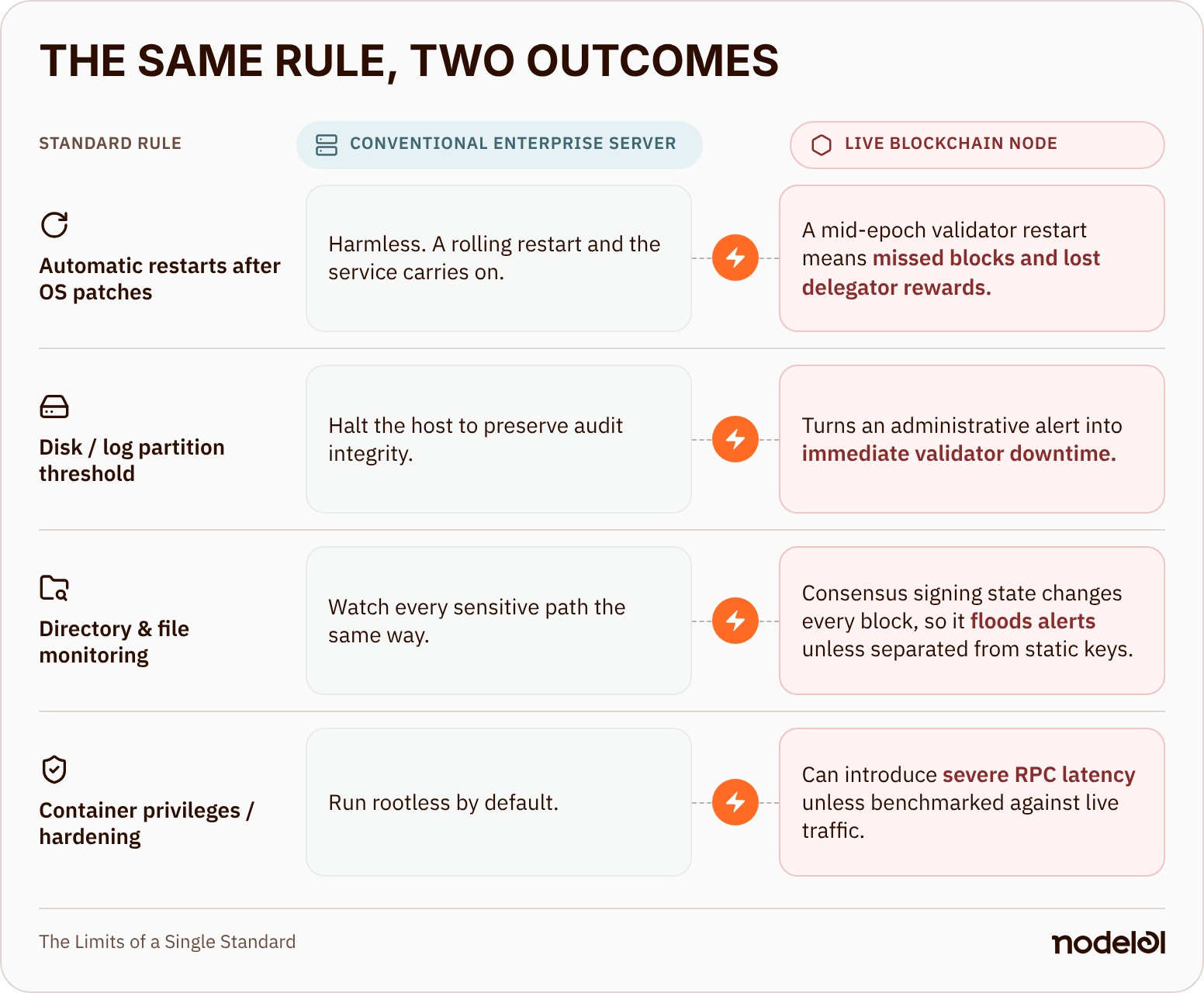
That is why we do not treat a checklist as a substitute for engineering judgment. At node101, we keep security updates enabled while leaving validator restarts to human-approved maintenance windows. We also run the unmodified CIS reference right next to our own node101 security baseline inside Wazuh. Whenever a protocol genuinely needs a different setting, we declare that exception in configuration and tie it to a written decision, so both our team and external auditors can see where we departed from the textbook reference and why.
Protocol-Aware Monitoring and Security
Of course, a clean base layer is not worth much if you cannot see what your servers are actually doing. Every host in our fleet runs Grafana Alloy and node_exporter, sending metrics and logs over mTLS into our dedicated Kubernetes observability cluster. Inside that cluster, we run dual Prometheus replicas backed by Thanos and S3 so our long-term metrics stay deduplicated and intact. Logs and audit streams move through Kafka into Loki and Tempo, while customer-facing RPC request logs go into OpenSearch so institutional clients can inspect their own audit trails. Our team follows live fleet health in Grafana, and Alertmanager sends critical alerts straight to PagerDuty and Google Chat.
On the host security side, we rely on Wazuh for file integrity monitoring and daily configuration checks. Yet even here, you cannot ignore what the protocol is doing underneath. On proof-of-stake validators, the node updates its signing state on every single block so that it never signs two conflicting blocks for the same height. If your security agent watches that active state directory the same way it watches static system files, routine consensus writes flood the pipeline and bury real anomalies. At node101, we separate static signing keys from busy state directories and keep reviewed exclusions for known workload noise, so when an alert fires, it actually means something.
One Architecture Across Staking and RPC
M.C. Escher’s Relativity shows one orderly building where people walk along three different planes of gravity at the same time. Running multi-chain infrastructure feels quite close to that drawing. From the outside it looks like one unified operation, though inside each ecosystem plays by its own rules.
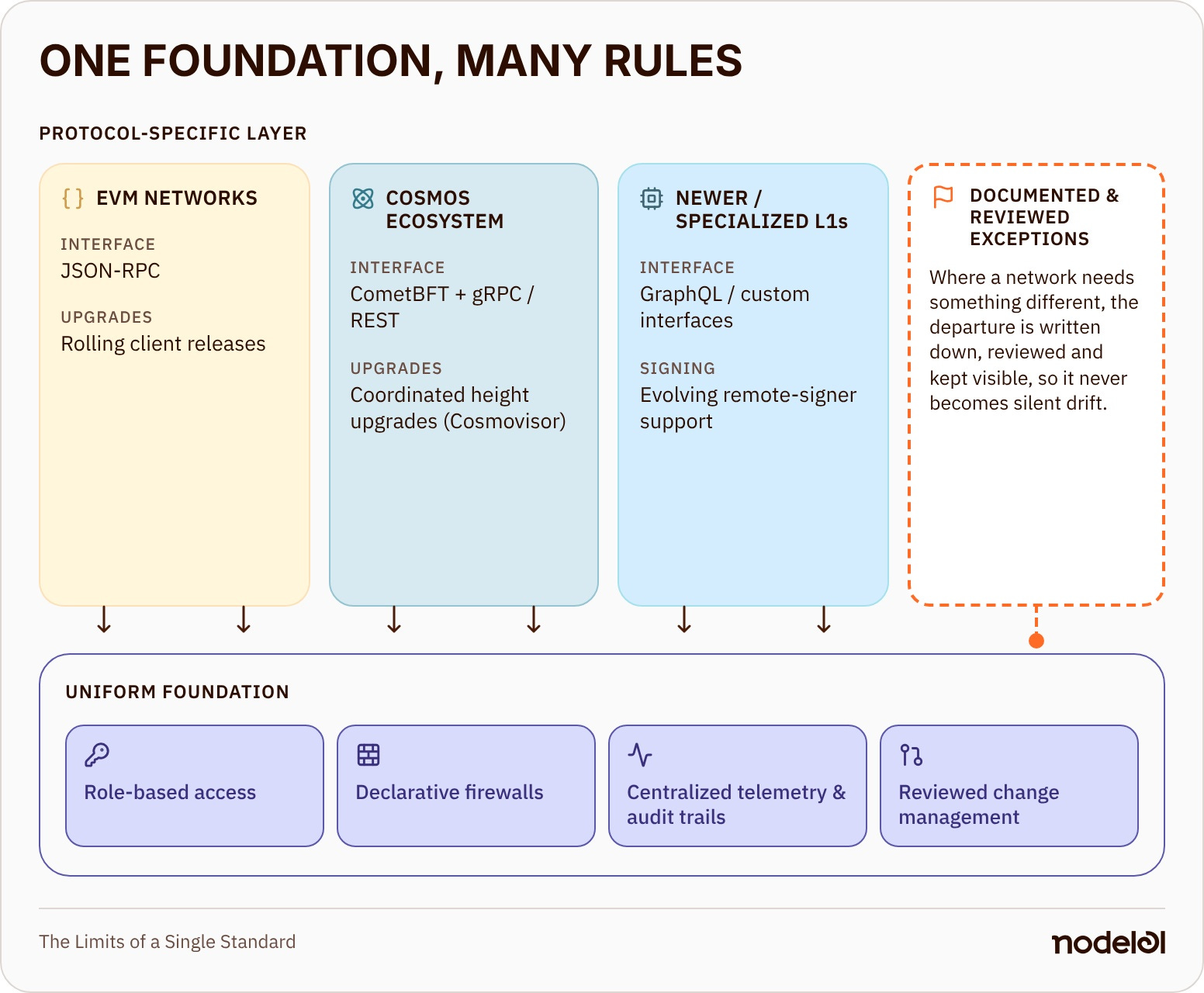
On the staking side, networks mature at very different speeds. Where a protocol supports remote signers or hardware security modules, we keep signing keys off the validator host altogether. Where remote signing tooling is not ready yet, we place those signer hosts behind stricter host-level boundaries so routine engineering accounts cannot reach key material. Upgrades need the same protocol awareness. Some chains coordinate hard forks at an exact block height with tools like Cosmovisor, while others ship rolling client releases. Because falling even one release behind a hard fork can silently knock a node out of consensus, we built an alert-only release radar on Cloudflare Workers that checks official chain feeds regularly against the versions we run and sends DevOps the relevant runbook, while every production rollout stays under human approval.
On the RPC side, protocols do not even speak the same language. One chain uses EVM JSON-RPC, another uses CometBFT with gRPC and REST, and another relies on GraphQL, each with its own caching behavior and failure modes. Rather than maintaining separate ad-hoc setups for every chain, we route traffic through Envoy Gateway, our RPC Engine for compute-unit metering, rate limiting, caching, and failover, and a Git-versioned Chainspec policy catalog deployed with ArgoCD. That same access layer connects directly into our Fault Tolerant RPC Gateway for multi-provider consensus and light-client verification.
Knowing What Belongs to the Frame
Global shipping offers a good parallel here. Modern ports scale because every container has the same outer dimensions and locking points, so the same cranes and ships can move them anywhere, even though frozen medicine, grain, and heavy machinery follow completely different rules once the doors open.
At node101, we try to draw that exact same line. The foundation stays consistent across every server we run, from Ansible provisioning and Tailscale access controls to UFW firewalls, mTLS telemetry, and ISO 27001 change reviews. Above that frame, every protocol gets the room it needs to run properly, and every necessary exception is written down in code and reviewed as the network evolves.
In Down the Rabbit Hole (Part 2), I wrote that moving toward modular layers and specialized chains did not remove complexity, it only moved it to the teams running these networks side by side. Building a uniform operational foundation around deep protocol awareness is how we handle that shift at node101, so our institutional clients can count on the same staking and RPC reliability across more than 101 networks.
Discussion about this post